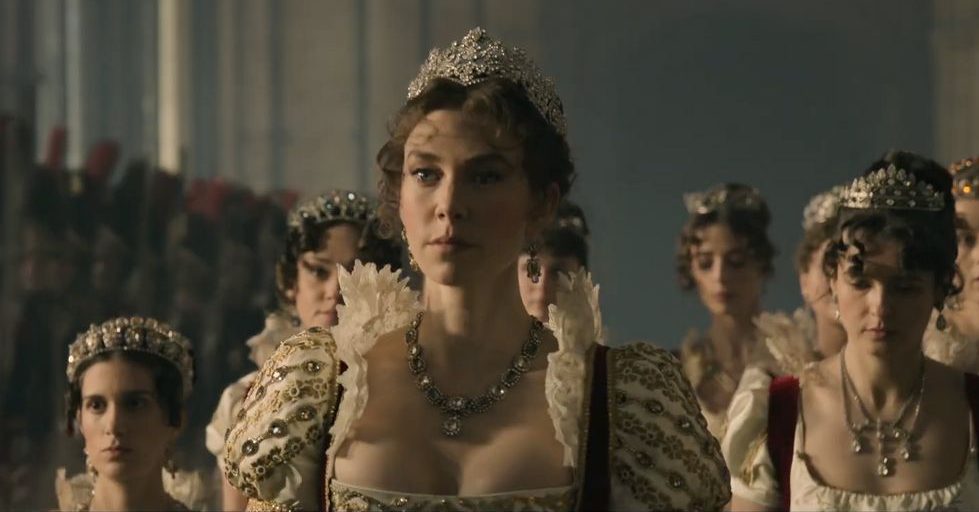
Ridley Scott’s latest directorial feat, “Napoleon,” is coming to Apple TV+ in November. The historical drama sees Joaquin Phoenix play the famous French leader, with Vanessa Kirby of “The Crown” cast as his first wife, Empress Joséphine.
In the first trailer for “Napoleon,” which debuted on Monday, we get our first glimpse at Kirby’s Joséphine, who is charming, desirable and cunning as she seduces her future spouse into what eventually becomes a tumultuous marriage. Ahead of the film’s fall release, learn more about the life and legend of Empress Joséphine Bonaparte.
Related Articles

Who was Napoleon’s first wife Joséphine Bonaparte?
Marie Josèphe Rose Tascher de La Pagerie, later known as Joséphine, was born and raised in Martinique, a French colony off the coast of South America. She came from affluent stock, as her parents owned a sugar cane plantation on the island.
You May Also Like
At the age of 16, Joséphine married French general Alexandre François Marie, the Viscount of Beauharnais. The couple had two children, a son named Eugène, born in 1781, and two years later, a daughter Hortense, who would go on to marry Napoleon’s brother.
After over a decade of marriage, Alexandre died in 1794 during the Reign of Terror. Due to his involvement with the French forces, he was guillotined by revolutionaries. Joséphine was briefly imprisoned alongside Alexandre, though she was released after the execution of Maximilien Robespierre.
How did Joséphine meet Napoleon?
Joséphine first became acquainted with Napoleon in 1795 at a society ball hosted by her then-lover, politician Paul Barras. Joséphine and Napoleon became romantically involved before marrying in 1796. The future emperor was six years her junior.
Before meeting Napoleon, Joséphine went by Rose. It was Napoleon who first called her Joséphine, which she adopted from then on.
In the early years of their relationship, Napoleon wrote Joséphine a series of now legendary love letters, though she rarely returned the favor. In 1796, while her husband was away on a military campaign, Joséphine began an affair with Hippolyte Charles, a French lieutenant.
When Napoleon caught wind of their fling, he soon struck up an affair of his own with Pauline Fourès, the wife of cavalryman Jean-Noel Fourès.
These affairs caused a rift in Napoleon and Joséphine’s marriage, which was further exacerbated by their inability to produce an heir.
Was Joséphine known to be a big spender?
Joséphine had a serial shopping habit, much to the chagrin of her husband. She mostly spent money on clothing, shoes and jewelry, though she also dug into Napoleon’s finances to renovate their home Château de Malmaison and the estate’s extravagant gardens, which included greenhouses and exotic animals like kangaroos, monkeys and zebras.
Why did Napoleon annul his marriage to Joséphine?
In 1804, Napoleon became the Emperor of France, making Joséphine his empress. Despite their decaying marriage, Joséphine briefly managed to abate her husband’s desire to divorce her. Shortly after Napoleon’s coronation, at Joséphine’s request, he married her in a second ceremony at Notre Dame.
When it became apparent that Joséphine wouldn’t birth an heir, Napoleon sought out a new bride. This, as well as Joséphine’s excessive spending, ultimately led to the downfall of their relationship. The emperor annulled his marriage to Joséphine in January of 1810. Four months later, he married Marie Louise of Austria.
Despite their split, Napoleon allowed Joséphine to keep her empress title. In 1814, she died of pneumonia at the age of 51.
Are there any other films about Empress Joséphine?
Joséphine has been portrayed in both films and television shows. The first was 1927’s “Napoleon,” in which Gina Manès played the empress. In 1938, Ruth Chatterton took on the role of Joséphine in “A Royal Divorce.” Joséphine is also a supporting character in several other films about Napoleon, including “Désirée” (1954) and “Austerlitz” (1960).
Jaqueline Bisset and Isabella Rosselini also played the empress in two separate miniseries, “Napoleon and Josephine: A Love Story” (1987) and “Napoleon” (2002), respectively.