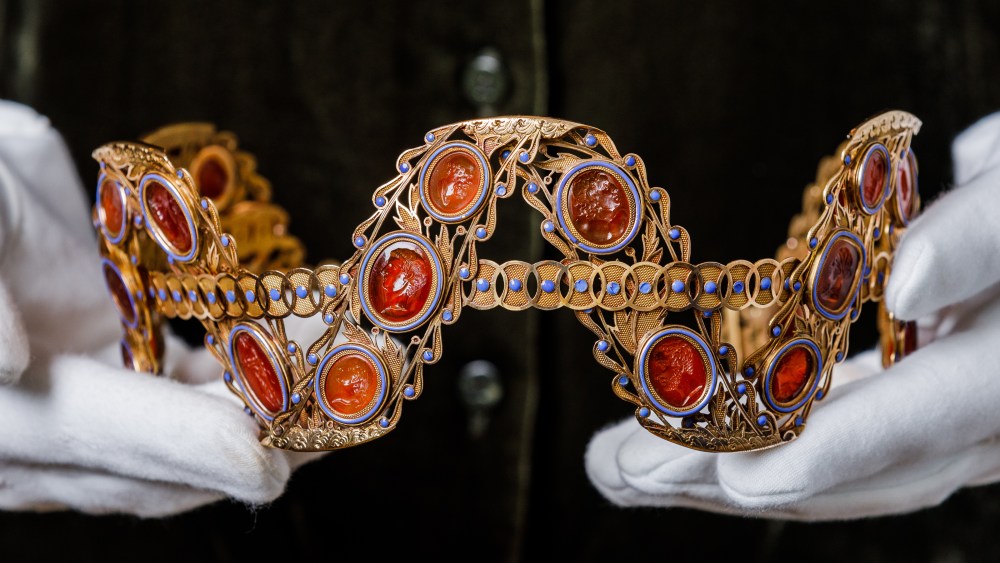
CROWNING GLORY: A pair of tiaras believed to have belonged to France‘s Empress Joséphine will go under the hammer at Sotheby’s as part of the auction house’s “Treasures” salon on Dec. 7.
Best known as Joséphine de Beauharnais, she married revolutionary general Napoléon Bonaparte in 1796 and became empress of the French in 1804 after he was elected as emperor. The couple’s lavish lifestyle revitalized the luxury industry and jewelry workshops that had been reeling from the French Revolution and its aftermath.

Made around 1808, the jewels are examples of the neoclassical style that rose as Bonaparte sought to legitimize his position by culturally connecting his regime to Ancient Rome. They were part of a private British collection for the past 150 years and are still in their original custom cases.
Related Articles
Cameos, particularly antique ones, came to be in vogue and the empress is said to have particularly enjoyed them. Not only did she make them a pivotal element of her adornments, but she also sought the advice of Dominique-Vivant Denon, a reputed French archeologist best known for his contribution to modern Egyptology who became the Louvre’s first director, to learn about hard stones, engraving techniques and the figures represented on them.
You May Also Like
“Empress Joséphine was much more than just a collector of antiquities. By being the first to incorporate these cameos and intaglios into her dress, wearing them side by side with pearls and diamonds, she created an entire new fashion that swept Paris and the world, based on neoclassical forms,” said Kristian Spofforth, head of Sotheby’s jewels department in London.
Each tiara offered at auction is part of a set. The first is a gold diadem, figuring a floral ribbon wrapping around a circlet, features 25 carnelians engraved with classical heads circled with blue champlevé enamel. It is offered with a pair of pendant earrings, a hair comb and a belt ornament featuring a cameo of the Roman divinity Bacchus. The ensemble is expected to reach between 200,000 and 300,000 British pounds ($275,000 to $413,500).
A similar set now belongs to the Swedish royal family, acquired when one of de Beauharnais’ granddaughters married the heir to the throne.
The second diadem is attributed to Jacques-Amboise Oliveras, a reputed jeweler of the period, and features five cameos. Two depicting Greek gods Zeus and Dionysus are estimated to date from the 18th century, while the other three, featuring the mythical figures of Medusa, Pan and Gaia, are said to date from the 16th century. A belt clasp with an agate cameo of Medusa and belt ornament with one of Zeus complete this set, which is estimated to go for between 100,000 and 200,000 British pounds ($138,000 and $275,000).
But while they strongly resemble items de Beauharnais wore in portraits, establishing their provenance with certitude was not possible. Inventories made in 1804 and after her 1814 death list examples of her jewelry without providing precise enough details for identification.
Other items thought to have belonged to her will be offered up at the sale, such as a collar featuring cameos and engraved intaglio stones. They will be exhibited from Nov. 2 to 9 at the Mandarin Oriental in Geneva, alongside highlights from the “Magnificent Jewels” sale.
FOR MORE, SEE ALSO:
Chaumet to Hold Joséphine and Napoleon Exhibit at Vendôme Flagship
Sotheby’s to Auction Karl Lagerfeld’s Furniture, Art, Cars and& More