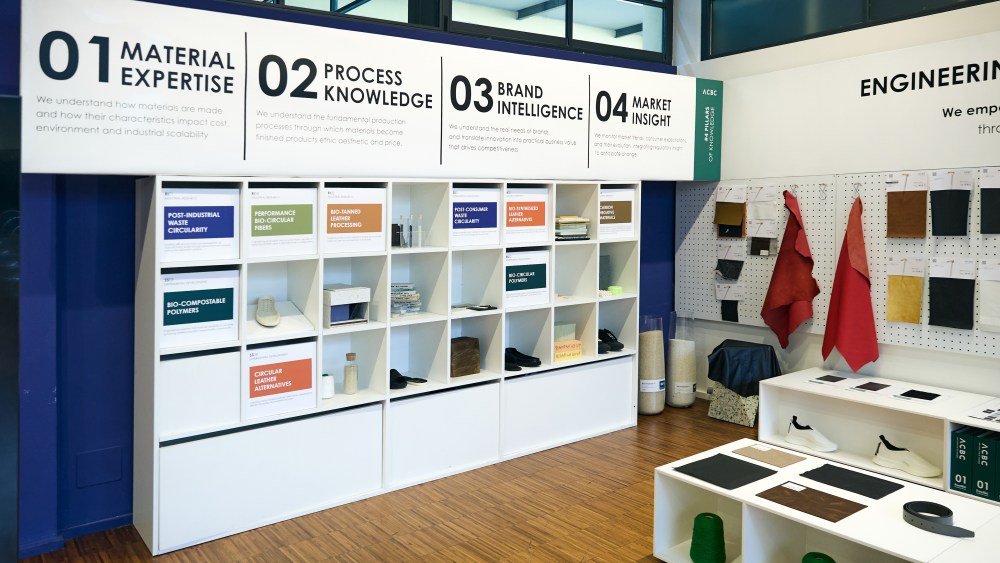
MILAN — Italian sustainability specialist ACBC has found a new home to showcase its innovation.
The firm — which launched as a sustainable shoe brand in 2017 and has grown into a consultancy platform for fashion and accessories players — on Wednesday unveiled its Innovation Hub space here.
The 4,305-square-foot location nestled in Via Signorelli — a 10-minute walk from the city’s ADI Design Museum — aims to house all the activities of the firm under one roof, as the company has pivoted its business following investment from Gyrus Capital last year. As reported, the Geneva-based fund operating in the health care and sustainability sectors took a majority stake in the company, marking its first investment in the fashion sector. This was aimed at growing the business by diversifying the service offering and expanding in new markets.
Related Stories
At the time of the transaction, sustainability consultancy operations for fashion brands and the third-party manufacturing business made up most of the ACBC business, with only 5 percent of revenues generated by the owned shoe brand’s operations. Hence the label — best known for its modular sneakers engineered with a zipper system that ties together the sole to several variants of the upper part — was wound down to focus on the business-to-business projects.
You May Also Like
Now ACBC acts as a consultancy platform integrating research on materials; product and strategy development; go-to-market activities, and circularity and product end-of-life management. It also enlarged its scope from footwear and fashion to automotive and interior design, as the cross-pollination of fields further empowers the research at the core of its mission.
“With the Innovation Hub we are strengthening our vision: building an infrastructure capable of connecting skills, technologies and supply chains on a global scale, leveraging know-how and execution capabilities,” said Gio Giacobbe, ACBC’s cofounder and chief executive officer. “We want to consolidate our role as a key partner in the evolution of the sector, helping to drive the transformation toward more advanced, integrated and competitive models.”

The hub showcases emerging sustainable solutions, aimed at helping both international start-ups and established companies.
A team of eight people operating under cofounder and chief innovation officer Edoardo Iannuzzi was assembled to oversee this area. They work with a database of more than 3,800 materials and 200 players among start-ups and multinationals, covering supply chains in Europe, Asia and the U.S.
Innovations are available across three levels. These include the “Available” category, consisting of seasonal fibers, textiles, alternatives to leather and polymers that are ready to be integrated and implemented into products right away; “Advanced,” materials tweaked to better adapt to clients’ demands and meet their specific needs in terms of quality, performance and price, and “New Frontiers,” where ACBC develops its own innovative technologies and patents, backed by its investments in R&D that account for around 5 percent of its revenues, which the company didn’t disclose.
Adding to the innovation part, three other divisions build the ACBC ecosystem. The Strategy Consulting arm supports companies in defining plans to grow their businesses and rethink their business models, production and operations to integrate sustainability along their supply chain; the Supply Chain Managed Services division empowers the execution, from development and industrialization of a product to the sourcing of materials, and the Marketing and Communication arm develops the storytelling, positioning and activations on the market.
Iannuzzi noted that the synergy between these elements puts ACBC in a privileged position, with a comprehensive view on the industry, from product material innovation and product end-of-life, passing through expertise in navigating the regulatory landscape.
ACBC is also investing in expanding its international footprint. For one, it acquired a Spanish company operating in fashion textiles which will be turned into ACBC Spain, its first outpost outside Italy. Expansion in Europe will be top priority, but ACBC is already looking to develop its business in Asia and the U.S.
The company already counts a network of suppliers in Asia, specifically across Indonesia, Vietnam and China. These flank the European ones stretched across Italy, Portugal and Albania. Depending on clients’ demands in terms of innovation, quality, performance and price, products are developed in one location or the other.
Despite shutting its direct-to-consumer brand, ACBC will still be active on the design front by introducing a format dubbed Innovation Day and timed to the fashion calendar. Starting in June, it will present collections based on seasonal trends to showcase innovative materials on ready-to-go products, each flanked with key performance indicators in terms of costs, technical features and environmental impact to further help clients in their choices.
Even if not targeted to end consumers, such a move acts as the legacy of the ACBC brand. An acronym for Anything Can Be Changed, this was established by Giacobbe and Iannuzzi in 2017 via Kickstarter, and became a Circular Science Company and B Corp enterprise since 2020 and 2021, respectively.
Through the years, it has collaborated with Giorgio Armani’s EA7, Alice + Olivia, Love Moschino, Missoni and Save the Duck, among others. Even if not under the ACBC brand, the company will continue to partner with similar players, as Iannuzzi teased a soon-to-be-launched footwear tie-up with Italian chain OVS.
“The truth is that sustainability is not a trigger for end consumers. Only 3 to 4 percent of the population shops driven by sustainability, the rest make purchases driven by the brand, the emotional aspect of the product or its perceived value,” said Iannuzzi. “Being a specific aspect of sustainability, circularity might impact clients even less, but it will influence companies due to the European regulatory laws.”
“Since our launch, we have always put innovation at the forefront, ahead of the design aspect. Design is essential in fashion but innovation is the real disruptor and we’ve seen very little of it in the past decades,” said Giacobbe. “Innovation has a cost and it’s never short-termed, which is the opposite of how fashion companies operate, as they want everything right away and at the right price. But especially in a moment like this for the market, innovation is key. And innovation can’t overlook sustainability.”
The novelties Iannuzzi presented as part of ACBC’s “New Frontiers” category included the FreeBio Infinitive material developed for the automotive industry to mimic the touch and feel of suede but 97 percent of which is made out of recycled textile waste; Soleic, a bio-based but micro plastic-free alternative to polyurethane foam destined for footwear and automotive, and the BeyondPlastic LTX bio-based alternative to rubber. He also teased the Everloop technology to be released next year and poised to enable the recycling of products that today are challenging to recycle for the complexity of their components and the pricey costs of the process.