
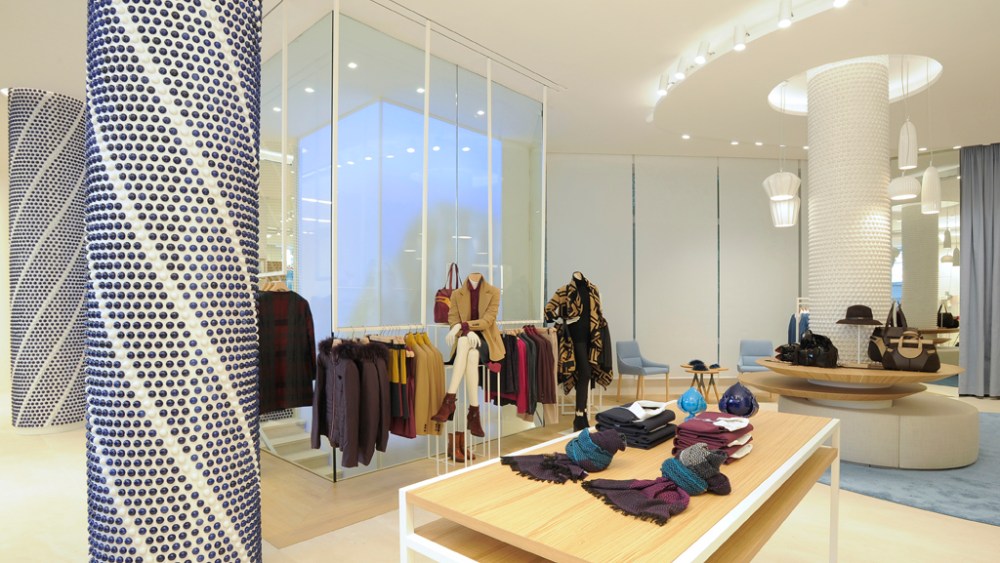
PARIS — After more than two decades in business, Harmont & Blaine is opening its first Paris flagship on Wednesday. It will be the brand’s first directly operated stand-alone unit outside of Italy.
The casualwear firm, recognizable for its trademark dachshund logo and preppy look, has moved into 35 Boulevard des Capucines, an area chockablock with like-minded labels, including Lacoste, Hackett, Manfield, Gant and Tommy Hilfiger.
“Paris is interesting because it is a big market, but it’s also interesting from an international point of view. If you want to do business in this industry and you are not in Paris, you are basically not doing business,” noted chief executive officer Giulio Guasco during an exclusive walk-through of the new venue.
Related Articles
Guasco said the opening represents the first milestone in the label’s “2.0 development plan,” which is to put the company into a more global context.
You May Also Like
The brand currently logs 80 percent of its total turnover in Italy.
“Founded 20 years ago by four brothers, the company is still a family business. But the brothers were clever — they knew if they wanted to grow, they needed to move out of a family and into a more managerial structure, which his why they opened up to [outsiders],” said Guasco, who joined the brand a year ago, having previously worked for Tod’s and Ralph Lauren, shortly after Italian private equity fund Clessidra S.G.R. SpA took a 35 percent stake in the firm.
The exec said he hopes to squeeze the label’s dependency on the local market to 60 percent within the next 5 years.
“We are looking into a second Paris store, perhaps for 2017, and are opening in Cannes in spring 2016,” he revealed, noting that the company is also in talks to develop wholesale accounts at French department stores Galeries Lafayette and Printemps, while the northern French resort Deauville and the French Atlantic coast were interesting from a franchise perspective.
“We also expect Spain to be big for us, but in Europe that’s it. We prefer to focus on fewer markets and go deeper rather than spread out and stay shallow,” he explained.
Next on the executive’s list is the U.S. “But instead of getting a flagship in New York like everybody else, we will start from the South. We have great brand awareness in Latin America, Mexico especially, and so we are targeting the Sun Belt first, moving from Florida to California. One exception is the Hamptons. That’s because we have had good experience with resort locations,” he observed.
Harmont & Blaine’s first step in the region will be a shop-in-shop at Brickell City Center, slated to open in mid-2016. “While most development projects are on the outskirts of Miami, this one is in the middle of the city’s financial district, so it’s very exciting,” said Guasco, who is also targeting department stores such as Nordstrom and Macy’s along with around 50 specialty stores in the area.
Further down the road, the brand has plans to go east to Mainland China, moving beyond its current outposts in Hong Kong and Macao.
The 4,300-square foot Paris venue, meanwhile — featuring ceramic works from Capri, blue marble and light oak, in line with the brand’s heritage — will stock the label’s complete range of men’s, women’s and kid’s looks, including footwear and accessories.
Though more than 90 percent of business currently come from men’s wear, Guasco said he sees much potential in developing Harmont & Blaine’s women’s line, which launched in 2010 but accounts for only 7 percent of the company’s turnover.
“Men often shop with women, and quite frankly, every time a woman enters the store, she is a potential customer. Also, the roots of this brand are in the Mediterranean — in Sorrento and Capri — and I’m arguing that’s a more female image,” said the exec who in February hired Marianna Cimini, formerly with Max Mara and Tod’s, to design the women’s line.
The first collection under her helm will bow for spring 2016.
According to the ceo, Harmont & Blaine in 2014 registered 75 million euros, or $99.7 million at average exchange for the period, in sales, with a profit margin of 12 percent. “And we expect to close 2015, which has been somewhat of a transition year for us viewing the managerial changes, retail expansion and a difficult environment in Russia, where we lost 50 percent of our business, a few points ahead of that number,” he added.
The label’s bestsellers remain its multicolored, mixed-media men’s shirts, accounting for 27 percent of total sales, followed by polos, pants and knitwear.