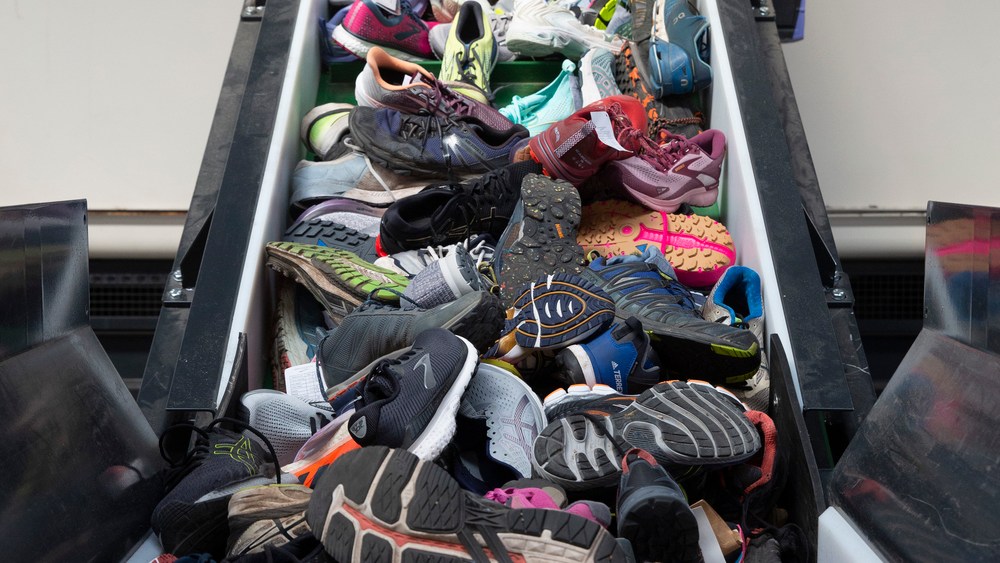
The biggest issue with keeping hundreds of millions of pairs of shoes out of landfills each year is that they’re not designed to be recycled.
Such as especially the case with sneakers, which can be cobbled together from as many as 60 wholly disparate parts, each designed to coddle, protect or perform, from leather uppers to EVA midsoles to the individual metal eyelet through which a cotton or polyester shoelace can be braced and secured. The entire point of their construction is to make sure they don’t fall apart.
Related Stories

That doesn’t mean we shouldn’t try, said Yuly Fuentes-Medel, founder and executive director of The Footwear Collective, a nonprofit consortium of nearly a dozen boldface footwear purveyors, including Brooks Running, Crocs, Ecco, New Balance, Reformation, On, Target and Vibram, that are providing both money and expertise to tackle the problem together.
You May Also Like
On Wednesday, the organization announced that it will be working with Goodwill South California, which operates more than 100 locations in L.A., Riverside and San Bernardino counties, to collect 30,000 pounds of end-of-life shoes for testing. The idea, Fuentes-Medel said, is to identify the materials, perhaps through a kind of AI data modeling, and figure out how they can best be recovered and funneled to secondary markets at scale. A slate of innovators that are currently being onboarded will be revealed in the coming weeks, she said.
Since The Footwear Collective coalesced two years ago around the pursuit of collective action, the fact that the Footwear Futures Project is a “movement powered by people” is only apt, Fuentes-Medel said.
From Oct 1 through 31, anyone can drop off a pair of shoes at a participating Goodwill South California outlet. (A list of stores can be found at footwearfuturesproject.org.) Those that are still in good nick will be resold through the charitable retailer’s existing network. Whatever’s unsellable will be delivered to the project for sorting, reuse and recycling.
California made the most sense as a starting point because of its historic extended producer responsibility, or EPR, legislation—the first in the United States to hold textile producers liable for the cost of their products’ entire life cycle, including their diversion and disposal. Over on the East Coast, Goodwill Industries stores have begun forming regional textile hubs to collect, sort and aggregate post-consumer textiles they cannot sell to serve as grist for textile-to-textile recyclers such as Reju. Buoyed by policy tailwinds, the Golden State has an even greater incentive to do the same.
“One of the things about recycling is making sure that you have enough material to make it profitable,” said Margaret Frericks, director of foundations and sustainability at Goodwill South California. “And we at Goodwill have so much material. But we can’t do it alone. Once the system is set up, it will require all of us to work together.”
The Footwear Futures Project is a launchpad in more than a few ways, Fuentes-Medel said. There are plans to head out to Asia so that The Footwear Collective works not only at the point of disposal of the products but also at their creation. Could repair be part of the process? How can the organization increase the value of the materials, some of which are incredibly low-cost, that are coming out of these shoes? Can it reconcile the “different realities” of each state to create a nationwide infrastructure?
For the moment, however, more immediate questions demand attention. The main complication with “this,” whatever “this” may be, is that there isn’t an organized, harmonized way to do it unlike with other sectors, such as automotive, which thinks nothing of mining old cars for new parts, she said.
“How do we make it easy for people to really use their own behavior and really use places where people are already donating?” Fuentes-Medel said. “And how can we, as the collective, help the Goodwills of the United States to get more sophisticated and collect the data to understand what they are receiving and decide where to send it. It’s about building the methodology to really scale up sortation. The big vision is how can we make the United States a system that is recovering materials from shoes?”
Another industry from which she draws inspiration is aviation. The way Fuentes-Medel sees it, shoes are an essential form of transportation.
“When the airlines came into the market in the 1940s, they couldn’t all have their own airport, right?” she said. “Airlines need to organize themselves in order to use these shared airports as their main infrastructure. So we’re operating in a similar economic model, where, what are the points where footwear companies need to share infrastructure while building economic models that will be sustainable along the way?”
It won’t be easy, admitted Frericks, though the fact that anyone is even trying to do anything with shoes is an accomplishment in itself. Landfill costs in California continue to rise from their already exorbitant levels, she said. And as much as Goodwill tries to offload unsellable goods to salvage or aftermarket buyers, there is always stuff remaining that it doesn’t know what to do with.
“God bless the people that are trying to figure this out, because it is a really complex problem,” she said. “But it’s one we have to solve.”