
NEW YORK — Textiles are everywhere.
That’s the message Matilda McQuaid hopes to convey through her exhibition, “Extreme Textiles, Designing for High Performance,” on display April 8-Jan. 15, 2006, at the Smithsonian’s Cooper Hewitt National Design Museum here.
“I’m out to show that textiles can be anything,” said McQuaid, exhibitions curator and head of Cooper Hewitt’s textile department. “This show is about the extreme applications for textiles that many people are not aware of.”
She should know. McQuaid began toying with the idea of an extreme textile show in 1990, when she worked at the Museum of Modern Art. It was there, while researching past shows, that she came upon the museum’s 1956 “Textiles U.S.A.” exhibition and initially became inspired.
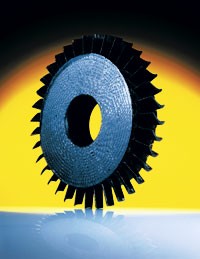
The new show includes some 150 pieces from the worlds of architecture, apparel, medicine, transportation, aerospace and the environment. “Everything in the show was created for purely functional reasons, which is key,” said McQuaid. Many of the looks highlight different textile structures and techniques — including weaving, knitting, braiding and embroidery — that are being used today and for the future.
One example, a polymer technology that has resulted in fibers that are stronger than steel yet retain their flexibility, has been used in the strongest rope ever fabricated, the Marlow Superline. It features a break load of 2,000 tons. Also using the technology are soft polyester slings capable of lifting 50 tons, which are replacing steel chains for heavy lifting.
One of the most noteworthy architectural projects included in the presentation is the Carbon Tower. Created by architect Peter Testa, the 40-story office building prototype is made entirely of carbon fiber and composite materials. An involved set of techniques literally weaves and braids the building together using robots that move up the structure floor by floor. “It’s a little sci-fi, but Peter has really been working to make this something that could be feasible in the next 10 years,” said McQuaid.
Other technologies, such as those used in the space program or the military, are also explored. For example, the U.S. Army’s Objective Force Warrior Program integrates electronic systems into the basic soldier uniform, enabling the possibility of undergarments that continuously monitor the vital signs of the wearer. The challenge here, said McQuaid, was to “try and integrate what the military has done without being pro-war.”
Related Articles
You May Also Like
Ways to do that include examples of civilian applications for the technology, such as a heat blanket made by Malden Mills or the Met 5 jacket by North Face, a polyester fleece jacket with conductive heating fibers, she added.
In fact, the idea of transferred technology is something that is seen throughout the exhibition. “It’s important to note how the technology gets to you and me,” she said. It’s shown, for instance, how technologies used to create NASA’s custom space suit are now being integrated into apparel worn by firefighters and polar explorers.
Perhaps most impressive to McQuaid are textiles currently being used in the field of medicine.
“I was surprised at how beautiful some of the embroidered textile implants were,” she said.
Also fascinating, she added, was how structures used to create the implants were intrinsic to their function. For example, an embroidered construction mimics the movement of ligaments and muscles in the body. “There were specific reasons why certain structures were used — a woven as opposed to a braided one, for example — that interested me a lot.”
Overall, it’s the idea of functionality that’s at the core of the show. “We are a design museum, after all,” she said, “and design covers so much territory. It infiltrates all areas of science and engineering. Among design, science and technology, there is a lot of gray area and that’s exactly where design is really happening.
“With this exhibition, I wanted to bring design back to a ‘Design 101’ idea,” she concluded. “It’s bare bones really, what good design is.”