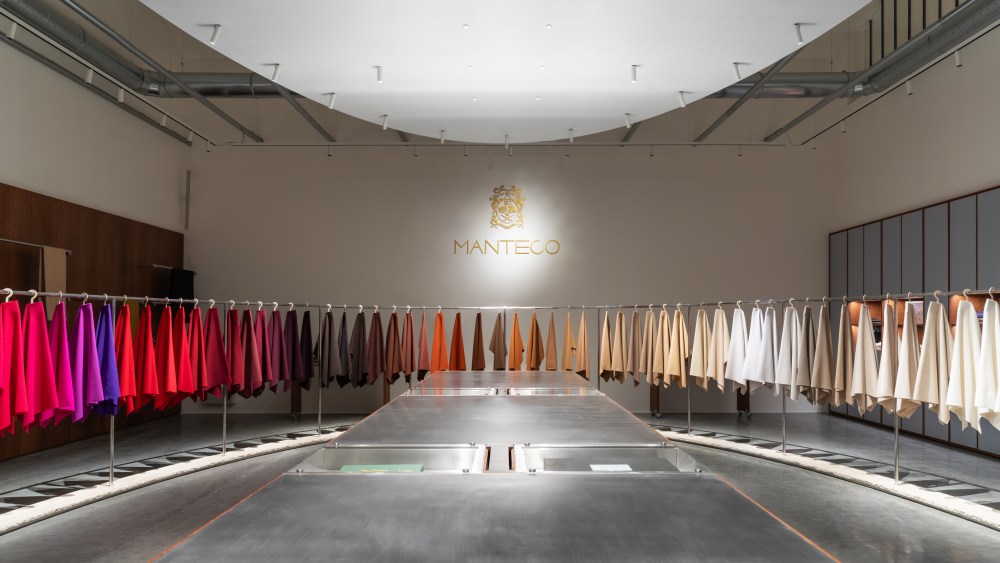
PRATO — Manteco, the Tuscan wool mill founded in 1943 by Enzo Anacleto Mantellassi, has added another milestone to its rich history as a leading brand in sustainability.
On Thursday, it inaugurated its new space called “Casa Manteco” located at Montemurlo, in the textile district of the city of Prato, in the Tuscany region.
“Casa evokes hospitality and a sense of belonging. It is a place where people feel recognized and part of something,” said Franco Mantellassi, president of Manteco.
Related Articles
“The company has never been just a place of production, but a space of human relationships and community, shaped by the contribution of clients and collaborators alike.”
You May Also Like
The design of the new space was overseen by the Milan-based design studio Formafantasma, founded in 2009 by Andrea Trimarchi and Simone Farresin. It aims to present to the public and clients all the steps of Manteco’s production and the brand’s family history.
“The choice to collaborate with Formafantasma was based on the fact that we found many values that align, and they were able to conduct in-depth research to tell a story and represent it with beauty and charm,” said Marco Mantellassi, co-chief executive officer of the company, alongside his brother Matteo and nephews of the founder.
“We would define the project as a narrative and research infrastructure. It is not a finished exhibition, but an open system that organizes materials, processes and knowledge in a way that can be explored and reconfigured,” Trimarchi said.
“In this sense, it reflects our approach to design: we often work with archives, production systems and supply chains, aiming to make visible the relationships between material, labor and cultural and ecological context. Casa Manteco makes the company’s technical and manufacturing expertise accessible, demonstrating how sustainability and circularity are not abstract principles but structural practices embedded in the industrial process,” Farresin continued.

The Galleria celebrates the company’s family heritage, starting from 1943 with historical photographs, interactive videos and production tools unfolding through non-linear sections, illustrating the origin of Prato’s textile district, Manteco’s scientific approach to circularity and sustainability, and the process of wool enhancement. The journey continues through the Sala Tessuti, an experiential showroom designed to explore collections and encourage creative exchange. This is also where collaborations and special drops are showcased.
The Archivio, opened in 2018, was created by restoring a former spinning mill and houses more than 100,000 Manteco fabric samples. The Giardino, featuring native plants from the Tuscan Mediterranean scrub, is an area for gathering and exchange.
Visitors can then explore the Circularity Lab, where each phase of the company’s path toward circularity is showcased. This space brings to life Manteco’s reduced-impact wools: MWool, ReviWool and MCashmere. ReviWool, made from valuable co-product fibers, generates 65.6 percent less CO2-equivalent emissions, water use, and energy consumption than virgin wool. MWool, from mechanically recycled garments and waste, reduces climate change impact by 99.2 percent, water use by 99.9 percent and energy consumption by 93.3 percent compared to generic virgin wool fibers. These reductions are verified by peer-reviewed life-cycle assessments and certifications.
Inside the Lab is Recype, an innovative mechanical process that creates thousands of colors by blending fibers without additional dyes or chemicals. Reclaimed materials from Zero-Waste and Project 43 initiatives are also showcased, offering tangible proof of a responsible and circular approach to production.
The Lab also serves as a research hub where raw materials and yarns are scientifically examined to test their properties and ensure the highest quality and durability standards in fabric production.