
PARIS – The tradition at Boucheron is to reward staff with a no-expense-spared night on the town after the sale of a piece worth 1 million euros or more.
Jean-Christophe Bedos, president of the Gucci Group-owned jewelry firm, has splurged on three such evenings since July – including one to celebrate a sale of 5.7 million euros, or $6.7 million at current exchange.
High jewelry – fabulous creations of more than $200,000 – has enjoyed unprecedented success this year, and Boucheron was hardly the only company to benefit.
All across the Place Vendôme, the trade’s chic nerve center here, companies from Cartier to Van Cleef & Arpels have reported stellar sales. “It’s an historic year,” said Van Cleef & Arpels president and chief executive Stanislas de Quercize.
Executives said the ultrarich have spent with alacrity unmatched since the beginning of the Nineties. Luxury in general is riding a resurgent wave, and Europe’s main houses report double-digit growth. Most predict, barring any surprises, that the roll will continue. Wealth is growing at record paces and the new rich want to spend their cash.
The number of individuals worldwide with a net worth, excluding their homes, of at least $1 million rose 7.3 percent last year to 8.3 million, according to a study by Merrill Lynch and Capgemini. Their assets grew 8.2 percent to $30.8 trillion.
Significant gains in wealth came in Singapore, Hong Kong, Australia and India, while higher oil and commodity prices padded wallets in the Middle East and South Africa.
But while executives agree the wellspring has propelled business, there are other factors, too.
As recently as a couple of years ago, some companies doubted the long-term viability of high jewelry. Thousands of hours of manual labor are needed to create many pieces; high-quality stones are increasingly rare, and margins are not as attractive as in other accessories and watches.
Overall customer interest in important pieces waned. Some said high jewelry would fall victim to changes in the way people lived. There just weren’t enough galas at which women could flaunt important pieces, and most actresses borrow what they wear on the red carpet.
Related Articles
You May Also Like
High jewelry’s closest equivalent, haute couture, was teetering, too, suffering from changes in the way women bought clothes. “If you would have told me even last year that high jewelry was going to make a spectacular comeback this year, I would have laughed,” said Boucheron’s Bedos.
Yet it has, with gusto. Van Cleef, for instance, unveiled its biggest collection of high jewelry to clients last month in Hong Kong and it was greeted with the “best success for this type of sale for us ever in Asia,” de Quercize said.
Boucheron, too, presented its biggest high jewelry collection, in July. Most of the 30 pieces sold in the first two months. By September, 90 percent had found owners.
“I have two pieces left today,” said Bedos, who added the house has introduced new pieces into the collection.
Cartier earlier this month unveiled an exceptional 13-piece high jewelry collection here to mark the reopening of its flagship store. Cartier president Bernard Fornas said many items – costing as much as 23 million euros, or $27.1 million – were already spoken for immediately after the launch.
Forty more pieces were produced to back up the main collection, said Fornas, who added the house’s Caresse d’Orchidees line, unveiled this past fall, largely sold out before the holidays.
Cartier is widely considered to have the biggest high jewelry business. Sources said it has had very high double-digit growth in the category this year.
“I have bought a lot – a lot – of stones around the world,” Fornas said. “We know the market is there.”
He continued, “A lot of people want beautiful things. There’s a lot of cash around: Look at the private aircraft business. It’s booming for aircraft at $50 million and $100 million, without even thinking of upkeep and pilot costs.
“People want to have the impossible. They want the incredible.”
Price resistance has deteriorated. While the million-dollar mark used to get a you’ve-got-to-be-kidding roll of the eyes, today, prices stretch into the eight-figure range.
“You can talk a million dollars today without someone laughing at you,” said Catherine Bove, director of Chopard’s Madison Avenue boutique.
“Prices like that are the norm. Before, a few years ago even, you’d just get laughs and people would look at you like you were crazy.”
Executives said part of the boom is driven by the rarity of their wares. Record prices, they said, are being paid at auction for modern and contemporary art. Why not for one-of-a-kind stones in artistic settings?
“In a standardized world, where you are bombarded by sameness, when you find things that are one-of-a-kind, and you can buy it – people want that,” said de Quercize.
“People are more sophisticated,” he continued. “Look at the number of people who go to museums. More people are in the know. There are more connoisseurs. There’s this hope and desire to stand out.”
“Beauty and quality have no price,” Fornas agreed. “You have to show that you are different. People today want to show what they have. They want to have the impossible, things that no one else has.”
But beyond uniqueness – and the lasting, heirloom nature of high-jewelry – houses have shown an unprecedented level of creativity this year. That, of course, has been equally important in reinvigorating the trade.
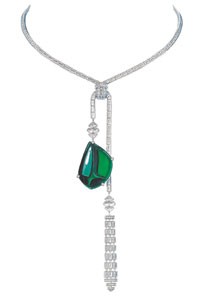
Gone are classic diamond necklaces. Exoticism, colorful opulence and baroque flourishes are in. Cartier’s colorful diamond-encrusted orchid brooches, or Bourcheron’s exotic emerald and diamond necklaces are examples.
“The business has reinvented itself,” said Bedos. “Nothing that is so-called traditional sells in high jewelry today. It’s not just a plain old diamond necklace. It’s the incredible necklace. I couldn’t sell a plain diamond necklace today to save my life.”