
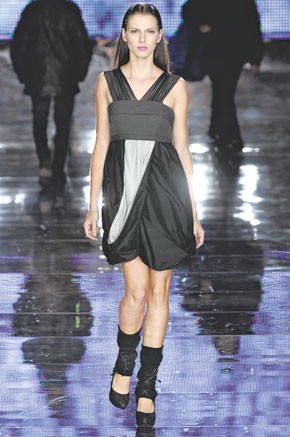
SAO PAULO, Brazil — In Brazil, conventional wisdom says that if the upmarket Sao Paulo Fashion Week doesn’t have competitive prices, head instead to the more mainstream Fashion Rio. But at this season’s showcasing fall collections, visitors found more similarities in price as well as style at the nation’s two major fashion events.
At SPFW, buyers found that designers’ dollar-based prices, which had eased in the last few years, were on the high side but still competitive with Europe’s, where the euro has risen against the dollar. Buyers at Fashion Rio, where cheaper apparel forces them to work with tighter margins, didn’t find prices as low as they had expected.
The latest editions of these biannual events, both open to the public, attracted the usual-size local and foreign crowds. SPFW, Jan. 24 to 29 in the nation’s fashion capital, drew 70,000 visitors and around 30 foreign buyers, mostly newcomers. Organizers said about 10 percent of attendees were trade.
The Jan. 14 to 19 Fashion Rio, in Brazil’s tourist capital, boasted 80,000 attendees, about 10 percent to 15 percent distributors, agents or retailers, including 78 foreign buyers.
Nearly all SPFW foreign buyers were European, looking for clothes to compete with their euro-priced apparel. American buyers may have stayed away because SPFW ended two days before the start of the New York runway collections, and a few North American buyers who had frequented SPFW migrated to Fashion Rio.
The only U.S. footprints left at SPFW were made by Rush, a Los Angeles boutique, and a shoe buyer from Bergdorf Goodman. Other foreign retailers included Yeung from Ghent, Belgium; G2 in Milan; gallery/store from Florence and Rome; Carouzos of Athens; White from Lisbon; Le Grand Bazar in Cannes, and Piaff from Beirut and Qatar. International buying consultants included Boutiqueye, based in London, and Diptrics, a Tokyo fashion distributor.
Collections at SPFW, for 37 established designers, and Fashion Rio, for 44 emerging houses, were unusually similar, according to industry observers.
“Designers at SPFW and Fashion Rio didn’t introduce any innovation. At both events, the trend was more somber than usual — patches of color amidst a lot of black, white and gray, a new winter color here. And there was a bigger-than-average mix of light and heavy winter clothing,” said fashion consultant Gloria Kalil. “Both of these trends show that Brazilian designers are catering to a more globalized market.”
Related Articles
You May Also Like
Key designers at Fashion Rio were Colcci, Mara Mac, Maria Bonita Extra, Santa Ephigênia, TNG and Walter Rodrigues, a top São Paulo designer who shows at the Paris ready-to-wear collections. Animale, Alessa, Cavendish, Coven, Cantão, Drosófila, Graça Ottoni, Juliana Jabour, Márcia Ganem, Redley, Sommer, Totem, Theodora and swimwear labels Blue Man and Lenny also showed.
SPFW’s main houses were Fause Haten, Gloria Coelho, Isabela Capeto, Lino Villaventura, Reinaldo Lourenço, Neon, Tereza Santos, Tufi Duek’s signature Forum line and Alexandre Herchcovitch, who also shows in New York at 7th on Sixth. Other labels were Andre Lima, Cori, Caio Gobbi, Cavalera, Fabia Bercsek, Gisele Nassar, Huis Clos, Iódice, Lorenzo Merlino, Maria Bonita, Osklen, Patrícia Vieira, Ronaldo Fraga, Triton, Uma, Vide Bula and Zoomp. No swimwear brands were represented.
Fashion at the shows was also similar: lots of Sixties, A-line dresses and cleavage-enhancing styles. At SPFW, the A-shape accentuated Isabela Capeto’s black and gray silk dress with metal appliqués; Neon’s X-shape, strapped, purple silk jersey dresses and a Huis Clos gray wool dress over black tights.
At Fashion Rio, A-shape enthusiasts included Colcci, with a blue silk shirtdress; Maria Bonita Extra, with a thin-strapped, red and blue silk dress with a ballooning bottom, and Juliana Jabour, with a red and purple dress in viscose and Lycra spandex jersey.
Several retailers welcomed the styling as well as the competitive prices. Julio Garcia from Milan’s G2 said Tereza Santos’ black wool fringe, knee-length skirts and Forum’s black, harness neck, silk dress with an open back, “had the clean, neutral-toned, sophisticated look that our young Italian clients are looking for. And given the quality of both labels, prices weren’t too high.”
Giulia Tieran, a buying agent for tony Italian boutiques, also cited the muted tones but was less enamored of the prices.
“Tereza Santos’ black, white and gray knit wool skirts and dresses and Gloria Coelho’s draped silk dresses in neutrals are perfect for the Italian market, where women tend to add colors with accessories, like a red bag or a green belt,” she said. “But prices could be a bit lower, because Italian buyers aren’t yet acquainted with these Brazilian brands.”
A few European buyers were disappointed that the collections didn’t sport as much color and innovation as they have in the past. “I was hoping for special colors and more creative styling,” said Biba Folleat of Le Grand Bazar. “The Cannes winter is warm and gets lots of Middle Eastern clients wanting lively hues, which I can’t find here now. I’ll come back in June for SPFW’s more vibrant summer collections.”
Buyers seeking vibrant colors or lighter weights found them at Neon, Forum and Patricia Vieira, whose forte is fine leather apparel.
“I love Forum’s silk mini-dresses with bright yellows and purples or with light- to dark-gold sequins,” said Hillary Rush, owner of Rush. “They’re perfect L.A. day-to-evening wear, and although dollar-based prices are a bit high, they’re cheaper than in Europe. Last October in Paris, I was completely outpriced.”
Sophia Carousos of Carouzos in Athens said, “Neon’s vibrant mosaic-print silk caftans and dungaree dresses are a perfect match for our customers who want Mediterranean colors and light weights. So are Patricia Vieira’s glove-soft, nappa leather tops, skirts and dresses. Neither designer’s prices are cheap, but they’re reasonable.”
Nabil Houssami of Piaff cited Tereza Santos for lighter- and heavier-weight options, because, as he pointed out, “Beirut has four seasons.” He also liked the prices. “SPFW designers sell in dollars and Lebanon trades in dollars,” he said. “That makes them cheaper than euro-priced European styles, now that the euro has gone up.”
SPFW veterans agreed that dollar-based export prices, which had increased over the past few years, had leveled off. That’s because, although the dollar has been devalued 35 percent against the local currency, the real, since mid-2004, it was weakened by only 8 percent in 2006.
“In the last few years, when SPFW prices began going up, return foreign buyers started becoming more conscious of the increases,” said Diptrics’ London consultant, Robb Young. “But more recently, as prices have plateaued, these buyers have acquiesced or gotten accustomed to them. Also, the higher euro has made the more stable, dollar-based Brazilian prices more competitive.”
Dominique Yeung of Yeung agreed. “SPFW prices are high, but my clients have acclimated to them, provided the quality is there and the design suits their tastes. This is true for designers like Reinaldo Lourenço, whose punkish metallic tunic worn over a black cotton dress, and Gloria Coelho, whose black wool jackets and capes with crystal appliqués, appeal to my younger clients.”
Karen Harries of Boutiqueye gave another reason most foreign buyers had stopped bristling at Brazilian prices: “Top SPFW labels have shown they are not temporary, one-trick ponies but rather brands that translate, in terms of quality, design and label longevity, to an international market.”
Still, many foreigners found Fashion Rio a cheaper alternative to SPFW, but not cheap enough to give them the margins they wanted.
Nichi Kashimara of Madame Killer, a New York shop, went to Fashion Rio instead of SPFW, his usual venue, “in search of lower-priced alternatives, which I found, but at prices that were higher than I expected, meaning lower margins.”
Kashimara liked Drosófila’s long fitted cardigan dresses and Redley’s plaid draped jersey casual numbers. Miyuki Maeda, a Paris buying agent for Japanese department stores and distributors, preferred Cholet’s tonal black-to-red geometric-print jersey dresses and flared tunic dresses and Lucidez’s flower-print jerseys but also had price concerns. “The brands I liked must compete with Chinese lines in terms of price, quality and design,” said Maeda, “and because the quality and design of lower-priced Chinese clothes are improving, I’m not sure Brazilian brands will, after freight costs, taxes and import duties, be price-competitive.”
Melissa Bee, a buying agent with the AGA Group, which represents Canadian specialty retailer Holt Renfrew, voiced similar concerns. “Prices of more established brands at Fashion Rio were higher than I had expected, which is why I was attracted to newer designers with lower prices,” said Bee. “I liked Apoena’s trapeze and kimono-cut shift dresses with hand embroidery in strong colors and Gisele Barbosa’s hand-embroidered jackets and dresses in more subdued colors.”
Fiona Burns, of Closet Fever, a Melbourne boutique, said that the high prices at Fashion Rio’s main houses prompted her to place orders with new designers. She bought $12,000 worth of apparel from Magathus, a brand with funky, faded-color cotton streetwear. “Magathus items cost me around $80 apiece, with taxes, duties and freight costs, boosting prices 40 percent, to $110 an item,” said Burns. “But I can retail them for $220 each.”
Foreign buyers at Fashion Rio found cheaper labels — like Magathus, Apoena and Gisele Barbosa — at its 71 on-site showrooms for designers with and without runway shows. They generated 340 million reals ($156.7 million at average exchange) worth of domestic orders and 29.3 million reals ($13.5 million) in foreign orders, up from 304 million reals ($140 million) domestic and 24.5 million reals ($11.3 million) from foreigners placed at the January 2006 event.
At SPFW’s 68 on-site showrooms, domestic orders increased by 20 percent and foreign orders rose by 10 percent over those placed at the January 2006 edition. Graça Cabral, a SPFW organizer, attributed the rise in domestic and foreign orders to “more stable prices, continued quality and design, and a greater diversity of showroom brands.”