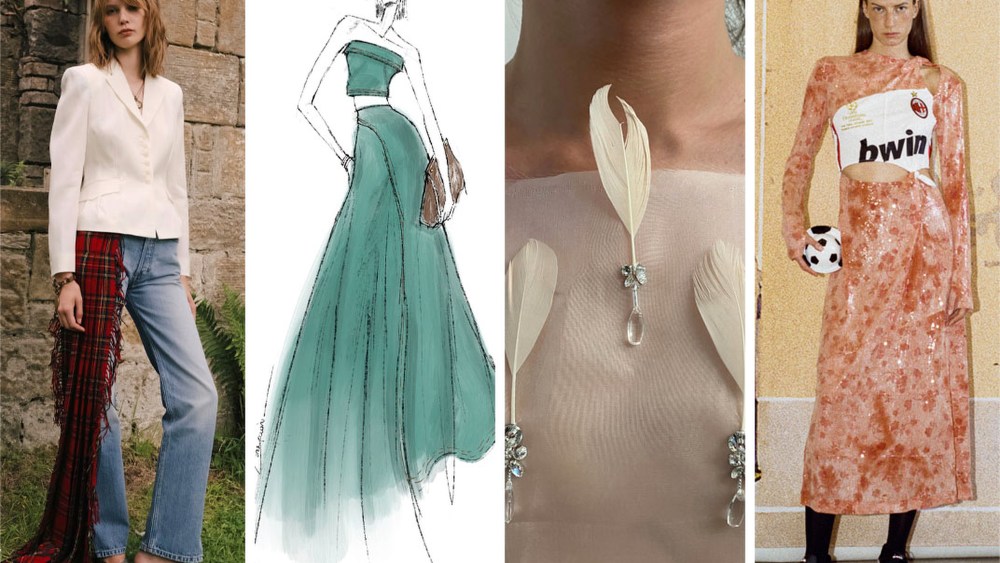
Ahead of New York Fashion Week‘s official start on Thursday, WWD caught up with a few emerging designers to learn more about their backstories, businesses and what they’re most looking forward to.
Rùadh

Ask Jac Cameron her favorite part about design and she’ll say, blending creativity with technical skill, which is why so much of her work has been in denim.
Related Articles
Born in Glasgow, Cameron moved to New York City at age 20 where she began her career interning for Marc Jacobs. Over the years, she’s become a fixture in the denim market, first at Abercrombie & Fitch and Madewell, then Calvin Klein jeans and finally at AYR. Needless to say, while the name of her latest project Rùadh is Gaelic for “red,” Cameron’s blood runs indigo.
An interest in ethical sourcing and sustainable manufacturing led her to launch the brand direct-to-consumer in October 2024. Starting with 11 pieces, all in her textile of choice, the Rùadh wardrobe now includes handwoven knits and sturdy leather outerwear, which will be stocked at premium retailers like Bergdorf Goodman and Net-a-porter come fall.
You May Also Like
Denim still anchors the line, though Cameron plans on upping its fashion quotient for her NYFW debut. “Our spring 2026 collection represents a more fully realized, evolved vision,” she said. Describing Rùadh’s aesthetic as “timeless utility” expressed through strong silhouettes, she believes her Scottish heritage sets it apart. “Rùadh is deeply shaped by the landscapes of my childhood: rugged, poetic and quietly powerful.”
Hence the Cameron family tartan will weave its way through a few looks at her standing presentation. And the set, a collaboration between interior designer Madelynn Hudson and florist Rana Kim, will transport guests from TriBeCa to the verdant Highlands mountains. There will also be a campaign film screening, shot on location at an 18th-century castle. According to Cameron, it’s “a true expression of Rùadh’s identity as it stands today and where it’s headed next.”
Mel Usine
Before gaining post-grad experience in studios on both sides of the coast (Rodarte, Proenza Schouler and Gabriela Hearst), Mel Usine’s Stephen Biga majored in fashion design and culture & media at The New School with a concentration on identity politics and experimental cinema.
Biga branched out on his own in 2024, separating the name “Mèlusine,” an aquatic nymph in European folklore often depicted as a mermaid, in two. According to him, it’s symbolic of the medieval romanticism he conjures through his work. “There are elements of historical dressing that I came across in my research, which I revitalized in a way that feels modern instead of vintage.”
Key pieces in his debut collection include the Philippa top, a take on a poet’s blouse with an elasticized peplum for easy movement, and a long-sleeve gown named Veronique. Cut two ways, it will be shown in lace with a sheer jersey lining and in a silver metallic knit resembling the chainmail of the Knights Templar. “It looks like it would be heavy, but it’s as light as a feather and feels like silk on the skin,” Biga contended. “With Mel Usine, we want to show things that look and present one way, but feel another way when the body interacts with it.” Prices start at $595 and go above $5,000 for special pieces like this one.
While Biga doesn’t have any stockists lined up, he said there’s been interest and he plans to bolster Mel Usine’s sales through direct channels, launching “with strategic items that we think are important for us to take on as stock.” At NYFW, he’s eagerly anticipating the industry’s reaction to Mel Usine, especially that of his peers. “The most important element to all of this for me is the world-building,” he said before firmly declaring: “Mel Usine is ready to exist in the world now.”
Heirlome
Monterrey, Mexico, native Stephanie Suberville came to New York to attend Parsons. Bouncing around the contemporary market, she rose through the ranks at Rag & Bone, Elizabeth and James and Argent, where she still serves as creative director. But what Suberville has her eye on with Heirlome, cofounded in 2022 with her husband Jeffrey who manages the business end, is a more elevated reflection of her Spanish cultural heritage.
Each season, Suberville takes on a local Mexican artist as a collaborator, from potters and painters to woodworkers, reinterpreting their “artesenia” as placement prints, which are throughout her collection of relaxed evening wear and sharp tailoring. A self described minimalist with a flair for rounded volumes and an abundance of fabric, she said: “We try to stay away from things that look like you can buy it directly from the artisans themselves as we’re trying to support, not compete with them.”
Katie Holmes and Angelina Jolie are among Heirlome’s A-list fans and the line counts 34 points of sale internationally, including Moda Operandi and Le Bon Marche in Paris. Ranging from $490 to under $4,000, the prices “reflect the high-end fabrics we use, and the level of skill that goes into each of our pieces,” Suberville said. Skirt sets are her bestsellers, especially those in the artisanal prints, and she’s excited to introduce her collaborators for spring: a father-daughter duo whose floral designs were also reinterpreted in crochet (like on the sketch seen here).
A candidate for the CFDA Vogue Fashion Fund, Suberville’s first formal presentation will be intimate with just two models. “People will be able to touch and really experience the clothes up close,” she said. “It’s a great way for us to showcase the hand work and tell the story of the artisans.”
Zimo
SCAD graduate Zimo Yan headed up the design team at 3.1 Phillip Lim, eventually trading New York for Shanghai where she worked at a well-established local brand. That drastic move, she says, “expanded my perspective on production and global markets,” motivating her to start Zimo at the end of 2021.
A blend of Yan’s East Asian identity with references to ‘90s youth culture, Zimo is built around what Yan defines as “documentary wear.” “By working with deadstock materials and overlooked objects, we give new life to what might otherwise be forgotten, turning them into garments that allow you to “wear your memories,” she explained. Deconstructed dresses made from vintage towels are an example, but for her spring 2026 collection, Yan tore-up old soccer jerseys, giving them a glam touch with florals and sequins.
Zimo is priced in the $200 to $1,000 range for ready-to-wear with more elaborate outerwear pieces going up to $1,800. “We want to stay accessible enough for young creatives while still reflecting the artisanal work and sustainable processes that go into each piece,” Yan said. While Zimo has limited wholesale distribution, Yan is focused on engaging her niche audience through e-commerce and pop-up experiences, which she hosts once or twice a year in New York where Zimo’s studio is based.
Over the past few seasons, Yan has been showing the collection in Paris, but said she’s excited to return. “It felt important to come back home to NYFW and reconnect with the community here. For me, New York has a culture of openness and experimentation that matches the spirit of Zimo.”
Amir Taghi
Oscar de la Renta alum Amir Taghi founded his namesake label just prior to the pandemic. It was “a moment of pause,” he said, allowing him to work intimately with the women he caters to. “My client is a real woman with a life, with work, with places to be. She comes to us because she wants clothes that serve her while expressing who she is.”
By 2022, Taghi was ready to commit himself more fully to building a brand. “The identity was growing clearer, our direct-to-consumer base had become a strong community and I was ready to move forward,” he continued. Wholesale followed a year later with partners including Neiman Marcus, Elyse Walker and the Conservatory, but Taghi insists the same intimacy instilled into the brand from the beginning “continues to guide everything we do.”
Taghi’s focus is on classic sportswear with a refined air, something he picked up on from de la Renta as well from watching the Southern ladies he was raised around in Houston. Colors and prints are inspired by his family’s Persian roots, and this East-West juxtaposition will be on full display in his spring collection, bringing together the glamorous style of Iranian songstress Googoosh with the clean lines of American architect Frank Lloyd Wright. Think angular workwear jackets and harem pants, tapestry-inspired scarf tops and day dresses with full skirts in a brown and navy palette.
Taghi said he waited to show on the official calendar during NYFW until his business was on solid footing and his vision fully formed. Press previews will be held at the WSA building downtown. “Now feels like the right moment. I look forward to welcoming attendees into my world.”
Dwarmis
Born and raised in Santo Domingo, Dominican Republic, Dwarmis Concepcion’s developed a feel for textiles early. Her father imported them into the D.R., but it was the women in her life who had the greatest impact on her as a designer, she says. Concepcion’s mother predicted she’d work in fashion and her aunt, a musician in Latin America’s first all-female merengue band, taught her about rhythm, informing the way she feels clothes should move with the body.
Outside the family tree, her mentees Tory Burch, Ulla Johnson and Rachel Comey instilled in Concepcion a taste for American sportswear. She describes Dwarmis as the synthesis of that training “infused with Caribbean warmth.” Her spring collection presented at the Cristina Grajales Gallery, will emphasize set dressing, like the teal sculpted bustier and languid wide-leg trousers Concepcion previewed a sketch of here. There will be airy, pleated fabrics with subtle sheen for catching the light while dancing. “My customer is a global woman. She’s “creative, entrepreneurial, and values pieces she can dress up or down and truly live in,” Concepcion said.
Ranging from $250 to $1,200, Dwarmis is exclusively available online, but Concepcion has her sights set on attracting retailers during NYFW. She feels her brand is missing an interactive component, especially after receiving positive feedback from pop-up shops in New York City, Santo Domingo and Mexico City. “I meet clients in the fitting room, understand how they move and what they love — it’s fun and personal,” she said. She’s also proud to be representing Latine designers. “After refining our product, this felt like the right moment to present the brand on a larger stage, celebrating my Dominican roots.”
Jamie Okuma
Born in Glendale, Calif., and currently residing on the La Jolla Indian Reservation, Jamie Okuma comes from a line of female makers. Her grandmother was a painter and her mother Sandra was a graphic artist at MCA records in Los Angeles where she produced album covers for Lynyrd Skynyrd and Cher among others.
Trained by her mother, the Luiseno, Shoshone-Bannock, Wailaki and Okinawan artist-cum-fashion designer started her own career while in high school. She later attended the Institute of American Indian Art, going on to exhibit work at the Heard and Santa Fe Indian Art Markets where she took home a total of seven Best in Show awards. Okuma’s more elaborate quilted and handbeaded couture is collected by national museums like The Smithsonian and The Metropolitan Museum of Art.
Almost anyone, though, can collect her affordably priced ready-to-wear, which consists of caftans, sheaths and casual separates with Indigenous prints under $600. “My customers are those who value authentic Native American design and want to support artisans and their families including mine,” she says. “They seek authentic cultural expression and wear my art as a proud statement of beauty and solidarity.”
The first Native American to join the Council of Fashion Designers of America, Okuma is now also the first Native American to join its official fashion week calendar, an honor she described as being “pretty cool.” She will present her spring collection digitally. “Each piece honors my identity while offering a modern, wearable expression of my culture for all,” she added.
Taottao
Yitao Li earned her BFA at FIT before completing foreign exchange programs at both Central Saint Martins in London and Polimoda in Florence. While developing her own custom creations on the side, Li worked as a design intern with stints at brands like Thom Browne and Monse, eventually returning home to Shenzhen. There she was able to focus solely on her own solo endeavor, ironing out sourcing and production, which led to Taottao in 2022.
A riff on her Chinese nickname, the brand evokes “playful rebellion,” she said. “We make garments that balance sensuality with subtle loudness.” According to Li, her signatures are anime-inspired prints and fabric manipulation, which are often hybrids like fusing denim with lace. Those who wear Tattao “embrace individuality and aren’t afraid to stand out,” she said, and include musicians like Halsey and the K-pop group Babymonster.
Taottao’s slashed kilt skirts, patchwork corsets, baby T-shirts and acid wash jeans with heart-shaped cutouts have a Victorian pirate girl vibe by-way-of Y2K. For spring, plaid and bows will be recurring motifs. Ranging from $70 to $400 with accessories and footwear starting at around $185, Taottao’s main channel of commerce is online direct-to-consumer, but this NYFW Li said she’s planning to “expand partnerships with specialty retailers that share our niche community.”