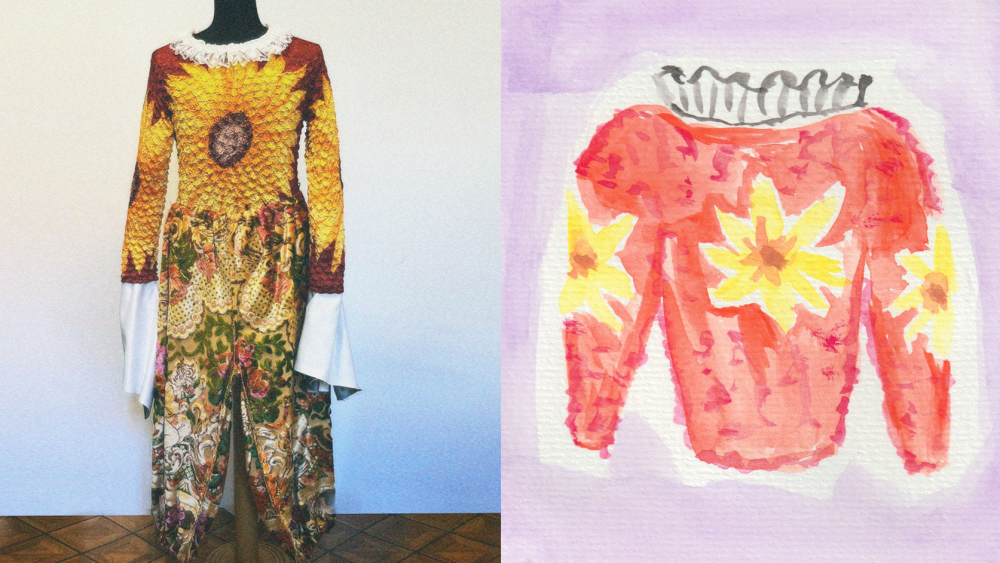
MILAN — If these are challenging times for established brands and luxury players grappling with consumption slump and retail havoc, this is all the more true for indie labels and emerging talents trying to carve out a space in the fashion landscape.
While some are making strategic and cost-saving decisions optimizing productions, editing collections or skipping presentations, Italian indie brand Lessico Familiare is taking a leap, returning to stage a show during Milan Men’s Fashion Week.
Related Articles
The brand, which with its sustainable ethos and quirky aesthetic has always sat on the edges of the fashion sphere rather than aiming at its epicenter, will resume the more traditional format after seasons of happenings and irony-filled events. It will return to the runway with a show titled “New Age,” to be held on Jan. 17 at 4 p.m. CET at Istituto Marangoni’s shiny new campus housed at the historic Palazzo Turati here.
You May Also Like

Yet the title doesn’t refer only to a new chapter for the brand — which last year was among the recipients of the Camera Moda Fashion Trust grants and previously got the endorsement of Dover Street Market Paris — but is also a nod to a certain pop star.
“I saw a meme that read: ‘I’m chasing what Madonna was feeling in that moment,’ referring to the ‘Ray of Light’ era,” said Riccardo Scaburri, who founded the brand with Alberto Petillo and Alice Curti.
“The title is a direct reference to the metropolitan spiritualism of the late ’90s [and] early 2000s, embodied and sung by Madonna in ‘Ray of Light.’ It also evokes the true New Age of the ’70s, escapism and stereotypical spirituality of today,” Scaburri said. “It’s an ironic reflection on all the healing processes we’ve recently embarked on, the daily rebranding of our lives, yet also an opening to the future. We’ve always been melancholic and have always and only looked to the past. With this collection, we tried to balance nostalgia [wondering]: ‘Yes, but now?'”
Switching from the hourslong presentations of the past, the founders wanted to chase “a flash, an instant that isn’t necessarily comprehensible. A wave of energy. That’s why we chose to return with a fashion show: it lasts a short time, but if it overwhelms you, it stays with you forever,” Scaburri said.
The choice of the venue came naturally to the brand. “We believe that the place where a ‘New Age’ can be born is school,” he continued, adding that Istituto Marangoni’s new location “symbolizes the education of designers, tailors, creatives” and highlighted its courtyard, “open to the street, [which represents] where all revolutions are born.”
A whiff of rebelliousness will percolate in the event, as Scaburri underscored how the brand’s approach to the format “is always that of a guerrilla show,” without too many complications involved — seating included.
A sense of unexpectedness has always marked the brand’s presentations. In the past, these ranged from a tongue-in-cheek dinner endorsed by Sunnei to a fancy breakfast at Le Progrès café in Paris’ Marais with Forte_Forte. Lessico Familiare made its debut on the Milan Fashion Week schedule in June 2022 with a bridal-inspired collection paraded in the streets of the city, followed by the coed “Cocktail” range unveiled at Fondazione Sozzani in Milan.
Like in previous events, the casting of the upcoming show will include friends and muses of the founders rather than models. They will sport a collection poised to filter pop culture inspirations through Lessico Familiare’s whimsical filter.
In sync with the brand’s Millennial universe of references built via glossy magazines, TV series marathons and 20th-century literature, Scaburri teased inspirations ranging from “Marta Marzotto in a caftan everywhere” to “’Orlando’ but with a Stanley Cup instead of a sword,” in addition to Madonna.
While staying true to the brand’s froufrou nature and costume-y lexicon rich in bows, ruffles, flounces, cocoon shapes and patchwork, the designers will explore slimmer proportions and bring their upcycling approach closer to ready-made experimentation, with elements juxtaposed without being deconstructed. Lightweight knitwear, raw-edge brocades, stiff satin, dark sequins, 3D textural manipulations and exposed wadding will also feature in the collection.
“Lessico is a bit like a dictionary, changing but recognizable. We’ve often been told to change some key elements, but we haven’t, and that’s fine with us. It grows organically, aware of the industry around it but not following it,” Scaburri said. He added that the biggest lesson learned over the past year was “not having to justify or motivate every piece and choice: I like it because I like it. It doesn’t always have to be consistent; something can just fit in.”
After meeting while attending the NABA fashion, art and design school and taking different paths, Scaburri, Petillo and Curti decided to launch Lessico Familiare in 2020 by looking at what their domestic environment could offer. Hence curtains, mats and discarded clothes were initially upcycled to turn a “familiar lexicon” — which is what the brand’s name means in English — into new artisanal pieces and one-off creations.
The trio has always considered the label a domestic project rather than a proper fashion brand, as it follows no season but embraces experimental initiatives instead.
For a long time their pieces have been mainly available on the brand’s e-commerce, due to the artisanal, handmade production. Yet over the past year the label has evolved in terms of distribution, propelled by the visibility granted by Dover Street Market in Paris and few retailers in Japan.
“The event at Dover Street Market made us realize that — though still very niche — we don’t exist only in our studio. Having the opportunity, through Carla Sozzani and Adrian Joffe, to share our story there has infused us with a new energy, both global and intimate,” Scaburri said. “For the first time, we collaborated with a showroom — Tora Tora — which fully understood the project’s philosophy, and we’re working extensively with Japan. We’ve created unique pieces for various stores, including miniature reproductions of some of our key items.”
With the 50,000 euros in funding received via the 2025 Camera Moda Fashion Trust grant, the brand is planning further events to share its vocabulary with a larger audience. “Digital, online and websites aren’t our options. We can post beautiful images, but the magic happens in the conversation,” Scaburri said.
Asked about the biggest challenge for an indie brand like his right now, Scaburri pointed to pragmatic needs, including “maintaining our space, rent and bills.” On the other hand, he highlighted the freedom of doing “everything we love without having to answer to anyone else” as a pro.
“We don’t have an ultimate goal. We like to navigate by sight, without objectives. We know what we don’t want. We’re achieving the best goals spontaneously,” he said. To this end, he mentioned a recent collaboration with director Carolina Cavalli on select costumes for her movie, “The Kidnapping of Arabella,” which premiered in the Orizzonti section at Venice Film Festival last year, with lead actress Benedetta Porcaroli nabbing the prize for best actress.
“We’d like to continue collaborating with film because it takes you to a different dimension every time and forces you to turn off your phone,” Scaburri concluded.