
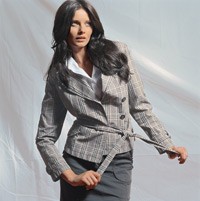
DUSSELDORF — Moderate women’s wear companies were out to shake off their staid image at this year’s CPD show.
The exhibition, which ran alongside a men’s wear and a bodywear fair, saw traffic rise 5 percent compared with last year’s event, to 46,000. A key point was renewed interest in the moderate sector, where numerous labels have started using new silhouettes and more sophisticated materials.
“It’s as if someone has just flicked a switch and these labels have suddenly woken up,” said buyer Peter Schütte. “I’ve come across new ideas and the craftsmanship I’ve seen here has been fascinating.” Fellow buyers were so happy with the new materials and cuts on offer, said Schütte, that they were wandering through the halls with “gleaming eyes.”
A boom in dresses, skirts and smart separates, such as pretty chiffon blouses, will make next summer more feminine than ever. Detailing is kept to a minimum, with same-color stitching or traditional patterns such as elegant floral prints, polka dots and Vichy checks.
As a result of the restrained details, high-quality natural materials have become more important than ever: soft cotton, linen and silk mixes abound, with minute metal thread sometimes woven in to give a subtle shine. Colors are muted, with neutral colonial-inspired sand, olive and stone tones, or dusty pastels, with flashes of interest provided by Mediterranean apple green, or maritime blue and red.
One of the more dramatic turnarounds was the transformation of Hucke Woman to Hucke Berlin. The relaunched label’s first collection, for spring 2007 was on display in Düsseldorf, turning a staid middle-aged brand into a fashionable label. The head of Hucke’s women’s wear division, Thomas Fritsche, said the new look had been very well received, with old clients who had stopped buying from Hucker years ago returning to place orders.
Trouser cuts are straighter and narrower, colors more daring and crushed linen and cotton materials more contemporary. At the same time, though, the label is trying not to alienate older customers by going up to a size 48 and offering cuts that cater to more mature physiques.
In time for its 60th anniversary, the traditional German brand Hirsch, founded in 1946, has also relaunched, with a collection that could be worn equally by a fashion-conscious 50-year-old or a more classical 30-year-old. The label is also careful to cater to its core older consumer by designing clothes that cover problem areas: waists are looser, trousers cut more generously round the thigh and sleeveless dresses cover the upper arms with a few inches of chiffon. The label also avoids any kind of miniskirt.
Related Articles
You May Also Like
The relaunch has been accompanied by a marketing campaign and a new stylish logo in the shape of antlers, giving a nod to the company’s name — “Hirsch” is the German word for deer. In the next three years, the company hopes the new image will help increase annual turnover from its current 30 million euros, or $38.1 million, at current exchange, to 40 million euros, or $50.8 million.
Meanwhile, German giant Gerry Weber has pursued a more gradual course by slowly introducing more modern cuts, colors and materials over the last four seasons. The label now offers silhouettes that wouldn’t have been seen at this level of the market two years ago. The company also now produces a younger line, G.W., which is more obviously influenced by current trends. “We want to win new, younger customers, without scaring off our traditional buyers,” said Gerhard Weber, the company’s chief executive officer. “We don’t want to change our consumer, but rather bring them with us by offering an appropriate fit and quality materials. And you have to do that gradually season by season. The biggest mistake is to suddenly bring out a collection which the consumer looks at and thinks, ‘What on earth is that? I can’t wear that?’ Changing things too quickly can be deadly.”
Apanage is also modernizing by broadening its range to include styles and fits, while Danish labels such as Fransa and Brandtex are expanding aggressively into the German mid-market by becoming more fashion-conscious. The tactic is working for Brandtex, which has seen a growth in sales of 25 percent per season for the past three years.
So what is motivating traditional brands to shake off the cobwebs and become more trend-focused than ever? One reason is demographic, believes Brandtex’s ceo Claus Sorensen. “The 40-plus age group is growing all the time, they have more money than ever and they are more fashion conscious than they have ever been.”
Claudia Andresen, head of marketing at Hirsch, agreed. “A 60-year-old consumer today is not the same as a 60-year-old consumer 20 years ago,” she said.
“These women have grown up wearing fashionable clothes,” said Axel Dorn, ceo of the Hucke group. “There is no reason why they would suddenly start going down the classic route. They still want to be modern and trend-orientated — just with certain modifications made to take age into account.”
In light of this shift in attitudes, Hucke’s transformation was not so much of a choice as a necessity. “We were losing turnover because we were orienting ourselves round this classical woman, in a suit or blazer, who doesn’t exist anymore,” said Hucke’s Thomas Fritsche.
In addition, the fact that younger consumers have started to dress more smartly has further diminished the style gap between older and younger women. According to Knud Hjort-Madsen, managing director of Fransa, this means manufacturers need to think differently about how to categorize consumers.
“We don’t really talk about age anymore. We talk more about someone’s style,” he said. “And you don’t necessarily change your style as you get older. I’m 52-years-old — 10 years ago a managing director of my age would not have worn jeans at a trade show. But I grew up in jeans, so I’m not going to suddenly stop wearing them.”
Of the 46,000 visitors who attended the fair, which was held between July 23 and 25, 40 percent came from abroad. This compares with 28.7 percent non-German visitors in July 2005. Although some exhibitors said they were disappointed with the numbers of visitors, Frank Hartmann, ceo of Igedo, which organizes the event, said he was happy with the turnout, in particular with the success of the new men’s wear and bodywear shows.