
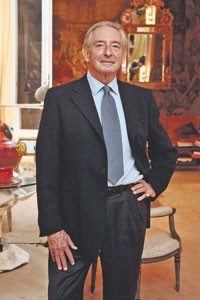
PARIS — Prince Michael of Greece knows his fair share of yarns about the royal jewels of Imperial Russia. After all, as the grandson of Grand Duchess Olga, the ill-fated aunt of Tsar Nicolas II and King George I of Greece, he has been steeped in their history.
“There is nothing royals like talking about more than jewels,” he says.
So it was almost a no-brainer for the prince, who is 67, to apply his expertise and fastidious eye to a handsome coffee book, “Jewels of the Tsars: The Romanovs & Imperial Russia” (Vendome), which has just been translated into English.
The affable Prince Michael has penned numerous tomes on his family’s history. His latest effort is meant as a particular celebration of the inimitable glamour and excess of the Romanov princesses.
“The Russian jewels were the most sumptuous in the world,” offers the prince, sipping tea on a recent evening in his art-filled apartment on the Left Bank here. “And the story of the ladies that wore them is fascinating. All of the women were beautiful, which — you can believe me — isn’t the case with every royal family. Then there’s this delicious mystery surrounding the fate of the jewels before and after the revolution.”
Prince Michael’s book runs chronologically, beginning with Catherine the Great, whom he says instituted the Romanov’s over-the-top taste.
“Everything starts with Catherine,” says the prince. “There was this rigid medieval style before her. Mostly the jewels were worn by men. But Catherine reset the crown jewels and suddenly they weren’t only rich but also fashionable.”
Power and glory was the subtext Catherine sought to deliver. Countless court visitors went home to recount stories of the awe-inspiring size and number of her jewels. “They were Western in their design, but Eastern in their sumptuousness and sheer size,” offers Prince Michael.
Despite the taste for public show, many members of the Imperial family proved modest in private.
Catherine, for instance, never liked wearing jewels away from official appearances. During the reign of Alexander I, fashion turned simpler and most jewels were stored away. But by the time Nicholas I came to power, in 1825, jewels again were the court’s ultimate expression of power.
Related Articles
You May Also Like
“He wanted the family to show that they were the biggest empire in the world and its grandest dynasty,” explains the prince.
That dictate remained the family’s unspoken motto up to the revolution. “That’s where all of the mystery and the intrigue starts,” says Prince Michael.
When the Bolsheviks swept to power, the jewels were seized. Initially, it was decided they were to be sold to raise much-needed money. But Leon Trotsky, who had asked Carl Fabergé to make an inventory of the jewels, had different ideas. Pieces judged small or insignificant could go under the auctioneer’s hammer, but important historical pieces would be saved. A so-called Diamond Chamber was created in the Kremlin, where most are still kept today.
In 1922, Christie’s held a spectacular sale of Russian crown jewels, many of which were purchased by European royals. Gladys, the Duchess of Marlborough, for instance, bought a pearl and diamond tiara that later was acquired by Imelda Marcos.
But many of the pieces sold were later dismantled by their new owners, with their stones being reset according to the fashions of the day by jewelers from Cartier to Harry Winston. More mysterious was the fate of three boxes of jewels that the Imperial Family took with them when they were sent to Siberia before being killed.
One of the boxes was recovered by the Soviets when they got word that it had been entrusted to a priest for safekeeping. He was duly tortured, and the jewels — some 80 important pieces — were recovered.
“No one knows what happened to the other two boxes,” says Prince Michael. “They’ve never been found. More gruesomely, the assassins who shot the Imperial Family had a hard time killing them simply because jewels had been sewn into the linings of their clothes. Those, too, have disappeared. Where did they go?”
But not all the tales surrounding the jewels’ fate are as grisly.
Several years ago, Prince Michael managed to buy back two stones that were part of a diamond and turquoise tiara that belonged to his mother but which had been sold well after the revolution.
“I had them set in a bracelet for my wife,” he said.