
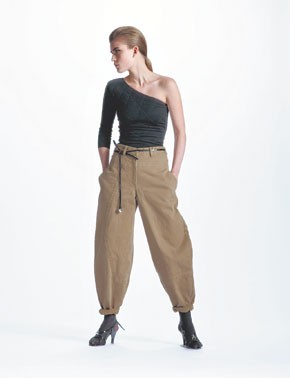
COPENHAGEN — Move over, skinny; the carrot is taking root.
New shapes — styles loose at the hips and tapered at the ankle (known as the carrot), or high-waisted baggy jeans with pleated fronts — were key directions at the CPH vision trade fair and shows held during Copenhagen Fashion Week.
Since Scandinavia has been a hotbed for new fashion trends, particularly in the jeans department — the slim fit was introduced here nearly a decade ago — international buyers were taking note at the fairs and fashion shows, which ran concurrently here Feb. 7 to 11.
Buyers lauded the labels for displaying forward-thinking styles and affordability, despite a strong euro compared with the dollar and the yen.
Vendors said an increase in exports resulted in an upswing in Scandinavian fashion.
“Scandinavian design gives customers runway looks for ready-to-wear prices,” said Betty Riaz, owner of Boston-based Stil (Style in Danish), which sells Danish contemporary fashion lines such as Heart Made, Margit Brandt, By Malene Birger, Baum und Pferdgarten, Cash Copenhagen, Won Hundred and Muthe plus Simonsen.
Riaz, who will open her third Stil location in Boston this September, said she cashed in on value despite the strength of the euro. “People are getting tired of seeing the same Marc by Marc Jacobs or Phillip Lim dress. Danish labels provide a fresh option,” she added. Riaz said knitwear, fur and a juxtaposition of fabrics were among the Danish delights at the show, as were ponchos, cropped capes, tulip-shape dresses and blouses with bell sleeves.
“Scandinavian labels provide an option to buy affordable styles that you can’t find in every store,” agreed Jan Busch Carlsen, the show’s organizer. While only a small number of American buyers attended the show, buyers from the U.K., Germany, France, the Netherlands, Scandinavia and Japan were out in force.
“There is an exchange of trendy street styles between Japan and Scandinavia,” said Yvonne da Silva, buyer for Monki, whose four Swedish stores sell Scandinavian and Japanese labels as well as its own in-house brand. “While styles are very different, they both offer clean silhouettes with an experimental twist.” Da Silva said she would place orders with Fifth Avenue Shoe Repair, Won Hundred and Hope.
Related Articles
You May Also Like
“The overall style in Scandinavia is very casual,” said Kaori Kagawa, executive director and buyer for the merchandising division at Agosto, a high-end retailer with 13 stores in Japan. “We only purchase from the most edgy designers here.”
Kagawa made a special stop in Copenhagen to see Danish label Annhagen’s runway debut. Indeed, the collection’s deconstructed — albeit a bit tricky — knitwear and somber silhouettes designed by Dianna Opsund Bay offered a hardened Gothic antidote to the plethora of cutesy contemporary brands offered and was a favorite of retailers looking to balance their buys.
“She brings something new to the runways here,” agreed Nicolas Jones, co-owner of the Surface to Air store in Paris. Jones said Stine Goya, Wood Wood and Annhagen were among the more directional brands shown during the round of fashion events here, while Velour, Pudel, Fifth Avenue Shoe Repair, Hope and Won Hundred offered strong commercial contemporary appeal.
However, retailers said that although Scandinavian collections corresponded to the current rock ‘n’ roll trend, they questioned designers’ ability to reinvent themselves in the future.
Attendance rose 12 percent over the 2006 session, to 30,119 visitors, 53 percent from outside Denmark.
The country’s fashion fairy godmother, Crown Princess Mary, presented an award to Sweden’s Sarah Törnqvist, the winner of Designers Nest, a fashion show of selected budding designers from Scandinavia’s leading design schools.
Young talent is a key element in attracting retailers on the hunt for unknown names to round out their collections. Fledgling Danish designer Stine Goya’s elaborate prints in crimsons and bright blues brought a fresh touch to the sophisticated collections at the show.
Swedish and Danish premium denim gurus agreed the wide-leg baggy jeans inspired by the Sixties and Seventies with pleated fronts and classic washes would offer a welcome alternative to the skinny fits.
“We are going to balance out our skinny fits with looser anti-fits with pleated fronts,” said Nikolaj Nielsen, president of Won Hundred. Nielson said the brand was increasing its international retail reach at a record pace.
“International buyers are starting to realize they still get better value, despite the strength of the euro.” A billowing baby-doll dress for 56 euros, or $73.70 at current exchange, wholesale, and wide-leg jeans for 60 euros, or $78.95, wholesale, were among buyers’ favorites.
“We are not trying to replace the skinny; we just want to offer a new alternative,” said Alexander Graah, co-owner and designer of the Gothenburg, Sweden, denim label Dr. Denim Jeansmakers. Graah is also adding baggy denim styles bunched at the waist to his cheap-yet-chic premium denim collection.
“It’s inevitable that trends are eventually exhausted,” said Jonas Eriksson, the designer behind the premium denim brand Pace, who added baggy fits and classic looks to his women’s denim line for next fall. Eriksson expects even flared jeans to make a comeback within five years.
Many vendors said sales at the show had doubled compared with last season’s, driven by an increase in international retailers. “We are in an international expansion phase,” said Ann Ringstrand, designer and owner of Hope, based in Stockholm.
Premium denim labels said they were adding more runway-inspired styles and upscale detailing to push their denim collections into the high-end contemporary category.
Acne Jeans, for example, said it would showcase its fall fashion line at trendy Colette in Paris. Acne was a pioneer of the skinny fit, and its avant-garde styles in denim for next fall include banana-shape jeans and printed denim.
Androgynous looks continued to define collections in Copenhagen. “We are very inspired by the men’s wardrobe,” said Helle Hestehave, designer for Baum und Pferdgarten. Hestehave, who codesigns the collection with Rikke Baumgarten, balanced masculine styles like tailored tuxedo jackets with feminine fabrics such as fine silks, jerseys and velvets.
Feminine flare was the focus at Denmark’s Day Berger et Mikkelsen, where short casual dresses had intricate embroideries, and Mads Nørgaard took a harder approach to feminine frill with darker tones and very short and slim styles.
Scandinavian knitwear novelties also dotted the fair’s floor, as well as the runways. At CPH Vision, Sweden’s Dagmar offered intricate handcrafted needlework, while Denmark’s Iben Høj showed a delicate array of high-end cashmere and silk knitwear creations with intricate lacing.
“Knitwear is part of the culture here,” said Paola Suhonen, designer of Ivanahelsinki, based in Helsinki, Finland. Suhonen showed off a colorful, ethical and eco-friendly collection of heavy wool dresses woven in Finland’s Lapland for 149 euros, or $196, wholesale.
“In the end, it’s about elegant clothes at affordable prices,” said Didder Rønlund, Denmark’s fashion legend who, at 81, has been covering Danish fashion for over 60 years and was the first Danish journalist to attend the New York fashion shows. “Everyone should be able to buy into a little bit of luxury.”