
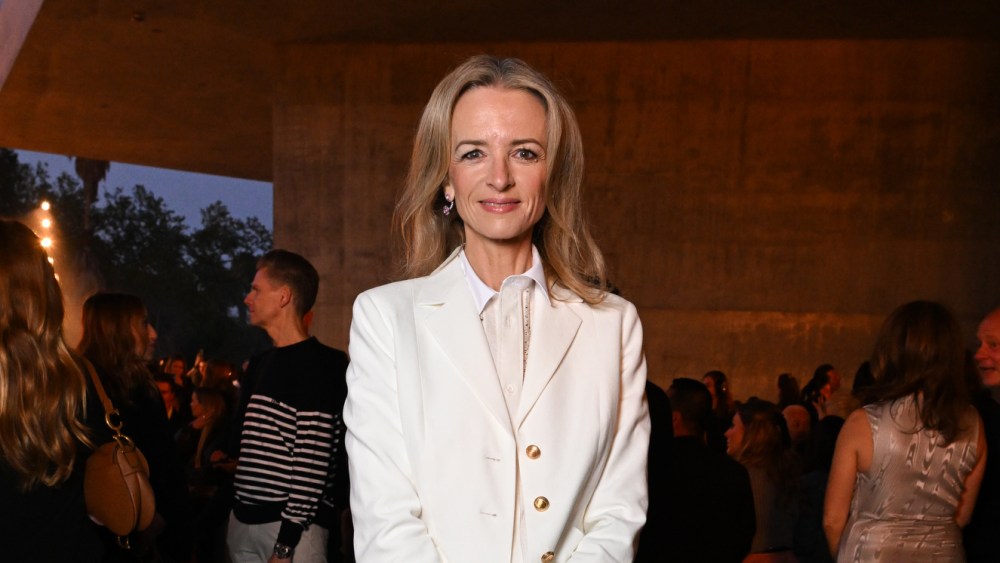
Delphine Arnault sits in the garden of the Polo Bar at the iconic Beverly Hills Hotel talking about her whirlwind trip, which began in the Far East — with stops in Macau, Hong Kong, Beijing, Seoul and Tokyo — and now has brought her to Los Angeles for Jonathan Anderson’s first cruise show as creative director of Christian Dior.
“I have had three Wednesdays,” the chairman and chief executive officer of Dior said, smiling. “Wednesday in China, then on the plane and now here in L.A.”
Related Articles
And her travels were to continue after the show that evening, since she was then off to New York for more meetings before heading back to Paris a few days later.
The Asia trip was important, but more so are her stops in L.A. and New York, for America is the “It” market for Dior at the moment, as it is for most luxury brands given other once fast-growing regions, like China and the Middle East, are dealing with economic resets or, in the case of the latter, the disruptions of war.
You May Also Like
The brand had been planning the L.A. show for about a year and accelerated the process once it opened its House of Dior on Rodeo Drive last September.
“The American market is essential for us and we invested a lot in this market with the House of Dior in New York and the House of Dior on Rodeo.
“We discussed a lot with Jonathan where to do the cruise show and we decided together that L.A. is an amazing place and that the LACMA is an extraordinary place, especially the new building,” said Arnault, who praised the museum’s collection and pointed to Francis Bacon’s triptych “Three Studies of Lucien Freud” and Henri Matisse’s ceramic wall piece “La Gerbe” as among her favorite works.
So the show Wednesday was an important one — further indicated by the fact that Bernard Arnault, chairman and CEO of LVMH Moët Hennessy Louis Vuitton, also was in town for it.
The event was the first time in two years that Dior held a show in America, the last one being in April 2024 for pre-fall under then-artistic director Maria Grazia Chiuri. The L.A. show was meant to further underpin the brand’s growth in the U.S. but also reinforce Dior’s historically strong links to America stretching back to the early days of the founder himself. As Arnault said, Dior early on recognized the importance of the U.S. market and also the growing power of Hollywood and its stars, including Ava Gardner, Marilyn Monroe and, of course, Marlene Dietrich.
“Mr. Dior — did you ever read the book ‘Christian Dior and I?’ It’s a short little book but so nice,” Arnault said. “So he came to the U.S. — the New Look was created in 1947 and he came to the U.S. his first year, the same year, in 1947. It was a very important market for him; he saw the importance of this market.”
She picks up her cell phone, which has a pink — a few shades brighter than Dior pink — case and searches it. “He says, ‘American clients played an essential role in the international success of his house. They buy fast, they buy a lot and they understood immediately the Dior style.”
Dior himself quickly took to L.A. and Hollywood, praising its “modern glamour with the sun, the cinema, the villas, the pool, the bathing suits and the stars. He was fascinated by the energy of California.”
Tapping into that energy — and the state’s clientele — is all part of Arnault’s and Anderson’s strategy to propel Dior to the next level of growth. Anderson pointed out that the day after the show would mark his one-year anniversary at the brand and while he has already shaken it up, he also admitted he is still learning.
He also somewhat shrugged off what at times has been harsh criticism of his designs — often set up in the guise of some kind of designer-style cage fight between him and Matthieu Blazy of Chanel. He admitted his Dior might not be for everyone but stressed it is a process and that while not everything he is doing now might be an immediate hit, “The money will come, and it is coming.”
As he told a group of fashion journalists at a preview of his new collection: “Working with Delphine, we are trying to reconfirm what Dior can be in the next 10 years.” In fact, sources said he has prepared a detailed strategic plan covering the next decade and has presented it to not only Arnault, but other top Dior executives as well as LVMH senior management.
“I am a very impatient person but I am learning to be patient. It is like taking a chateau you have bought and restoring it. And there are then moments that you ask, ‘Why did I buy this chateau?’”
Arnault also said Anderson is impatient — and “very competitive. I know a lot of competitive people and he’s one,” she said, smiling.
But she is equally confident that what Anderson is doing is the right path for Dior and insisted that sales of his collections have been extremely strong, especially in the U.S. “We launched his first collection Jan. 2 and it got a wonderful response from longtime customers and new customers too. There are a lot of products out of stock and we are working on replenishing them.”
The CEO, like Anderson, sees these days as early steps in the process of building the new Dior, one she has said is undergoing a “cultural revolution.” Asked what that means exactly, she said that Anderson being given purview over women’s ready-to-wear, accessories, haute couture and menswear is the first time in the house’s history that one designer is overseeing all categories.
“It is the first change of designer in 25 years so it is an evolution, a dynamic,” she said, adding that she had long talks with Anderson before choosing him and that part of the process is that “show after show [he is] taking the codes of the house and refining them, getting a little more precise.”
But she, like Anderson, also pointed out that Dior customers are often “loyal to the brand, to the designer of course, but to the brand. And we are very cautious. Nothing makes me more happy than coming here and seeing our customers wearing the styles” of both Anderson’s designs but also from the past.
As for how as CEO copes with the immense global uncertainty, from wars to the economic slowdowns and the struggles in luxury, Arnault said the main key is “you have to be agile. Both as CEO and as a brand, which has to be pretty consistent. You have to have a vision but also how you adapt to everything that is happening in the world. Also, it’s operational excellence — how you ensure you have the right product in the right place at the right time. And it’s operational excellence for the customer, making sure that whether she is buying a lipstick or haute couture, it is the same.”
Arnault has had a long relationship with Anderson, recognizing his talent as part of her other role scouting young designers for the group and years ago urging LVMH to recruit him for Loewe. Her duties as head of the LVMH Prize for Young Designers bring her in continual contact with new names, some of whom win one of the three prizes and some — such as Virgil Abloh and Demna — do not but nevertheless develop major careers.
Asked what attracts her to a young designer, she turned thoughtful before going on to list how challenging it is and how during the judging process for the prizes “it is a mix of product, talent and the person speaking about their brand in a very interesting way. The product must succeed of course.”
“There is so much competition. Being a designer is very entrepreneurial but it can also be very lonely,” since young creatives often don’t have anyone to lean on for advice.
She later points out that while Anderson has been around now for some time. “He’s 41. Very young and I am sure there is a lot of future that we can play together.”