
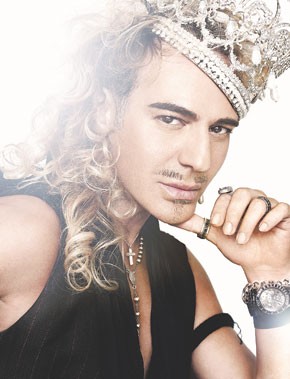
ASTRONAUT, SWASHBUCKLING PIRATE, BOXER, naval officer, superhero. With every runway bow, John Galliano personifies Christian Dior’s essential claim to fame: the New Look.
And over the last decade as its couturier and central creative force, the British designer has shocked and confounded, thrilled and captivated — electrifying a celebrated but bourgeois house and catapulting it into fashion’s big leagues with his imagination, technique and daring and theatrical approach to design.
Not bad for a club kid from South London via Gibraltar, who showed up at his first Dior executive committee meeting shoeless and in dreadlocks, but ultimately charmed the socks off all in the room with his manners, warmth and humility.
Mindful of his wild side and bold personal style, Galliano is the first to admit he might not have been the obvious choice to take up the mantle of one of 20th-century fashion’s most iconic and famous houses — and he confesses he is still startled and blessed by his good fortune. “Even today, I often pinch myself when I walk through those doors on Avenue Montaigne,” he said over a lunch of sushi, diet Coke and fruit salad. “Not in my wildest dreams would I think that I would be in the position that I am in today.”
At 46, fresh from a spa vacation in the Maldives, Galliano was in high spirits, buff and tan, wearing a vest over his bare torso, rumpled jeans and a pair of scuffed, beaten-up boots that call to mind his infamous “tramps” collection from 2000 that enraged homeless groups. In an interview, the designer mused about the many striking parallels between himself and the house founder, reflected on 10 years of headlines both triumphant and damning, and spoke frankly about everything from his men’s wear counterpart, Hedi Slimane, to his penchant for self-transformation.
To be sure, Galliano said he has been in awe of Dior’s legacy ever since he was a student at Central Saint Martins in London, where “Dior was — is — a god to students worldwide.”
“More and more I’m realizing that he laid the blueprint for fashion as we know it today, and the staples of a woman’s wardrobe today,” the designer marveled, rattling off such innovations as licensing, designing separate collections for specific international markets, launching accessible products like perfumes and stockings, and making fashion shows the “temple” of fashion expression. “And this was achieved in 10 years and continues today.”
Related Articles
You May Also Like
One of the founding designer’s habits of which Galliano is particularly fond was his penchant for what he dubbed a “coup de Trafalgar.” In every collection, Dior would insert an outfit or an idea that was deliberately incongruous and unexpected, giving a jolt to his audience and to the fashion world.
Galliano has been delivering his own brand of fashion thrills since his graduation collection, titled “Les Incroyables” and inspired by a brief period of fashion extremes in postrevolutionary France. It is still remembered by fashion cognoscenti as one of the most fully realized, intricate, bold and original student collections ever (and it was immediately picked up by Browns in London). With his theatrical flair, romantic inspirations of epic proportions and a commitment to bringing a couture-like finesse and character to his signature ready-to-wear, Galliano immediately became one of the darlings of editors and retailers, famous for his bias-cut gowns, innovative tailoring and a cheeky, streetwise edge.
But commercial success didn’t come as easily. Galliano, based in London, struggled throughout the Eighties and early Nineties, with a succession of backers. But he had to close his business three times after they withdrew their financing because of slow sales growth. Finally, he decamped to Paris and set up his business in the Bastille, although times remained tough.
Still, even with modest means, Galliano coaxed wonderment. In 1994, working on a shoestring budget, he arranged Victorian sofas and broken crystal candelabra at the beautifully decaying hôtel particulier of Sao Schlumberger. The spectacle had supermodels posing in mini kimonos, fur-trimmed wraps and wispy skirts, and ranks as one of the most transporting and memorable fashion happenings of the decade. It would be the beginning of a more stable financial situation for the designer, especially after his technical virtuosity and knack for making fashion headlines attracted the attention of luxury titan Bernard Arnault, chairman of LVMH Moët Hennessy Louis Vuitton.
“Mr. Arnault is a true visionary to put someone like myself in my position,” Galliano remarked. “Many houses have copied that since.”
Arnault placed Galliano at Givenchy to replace its retiring founder, Hubert de Givenchy, and the designer received bouquets and darts for a debut collection based on tuxedo looks and elaborate gowns in 18th-century proportions. But he demonstrated an immediate ease with high fashion and an ability to generate buzz and inject youth into a storied house — even if his brief tenure there did not add up to a commercial blockbuster.
After only a few seasons, Dior executives started paying discreet visits to Galliano’s Bastille digs, culminating in a secret offer from Arnault to move over from Givenchy and take up the design reins at Dior, succeeding a string of legendary design talents: Yves Saint Laurent, Marc Bohan and Gianfranco Ferré. “I nearly fell off my chair and I said, ‘Yes!'” Galliano recalled with fresh amazement. “I couldn’t say anything to anyone. I was sworn to secrecy because Mr. Ferré hadn’t finished his contract. I had to respect Mr. Ferré. It seemed like an eternity. Everyone was going mental.”
Indeed, designers very openly jockeyed for the job in the pages of this newspaper and others.
Answering critics who thought Galliano’s style might be too wild for Dior, Arnault told WWD at the time of his appointment: “Galliano has a creative talent very close to that of Christian Dior. He has the same extraordinary mixture of romanticism, feminism and modernity that symbolizes Mr. Dior. In all of his creations — his suits, his dresses — one finds similarities to the Dior style.”
Once he was installed in October 1996, Galliano’s mission was clear: to wake up and modernize Dior, to carry on inventing more “New Looks” and restore the “controversial edge” that catapulted the founder to everlasting fame.
“I very quickly had to learn and make things happen, while respecting the legacy of Mr. Dior,” the designer said. “The one thing we wanted to do, Mr. Arnault and myself, is to take the house into the 21st century.…Mr. Arnault and I were passionate about creativity and that was the way forward, that’s the way to fuel the house: innovation with luxury.”
He quickly applied his couture skills, romantic vision and flair for showmanship to the house with the force of a locomotive — and, on one occasion at least — an actual train, the “Diorient Express,” which roared into Gare D’Austerlitz in Paris laden with high-fashion Pocahontases.
Galliano was admonished for that 1998 spectacle and ordered to rein in his extravagance, a tug-of-war that has marked his Dior career. In those years, observers estimated the cost of a Dior couture show, including the collection itself, could be upward of $4 million to $5 million.
The designer insisted he was simply carrying on the legacy of Dior himself — even if he has run much faster than his predecessors. “But times are moving faster now,” he explained. “Fashion is faster now with the dot-coms, the media for exchange is so much faster now. I think that’s how the house has kept at the top.…The one thing that really turned me on about the house was that I wanted to invigorate…produce a new look, a ‘wow’ look — to bring back the controversial edge that Mr. Dior had at the time.”
Born to a Spanish mother and Gibraltarian father, Juan Carlos Antonio Galliano was exposed to fashion early, given the Mediterranean custom of dressing up children as a way of showing them off. His mother taught him how to flamenco on her kitchen table and costumed him for the part. As a youngster, illustration and design were Galliano’s chief loves, which he was allowed to pursue in earnest at fashion school in London. At the time, he also moonlighted as a dresser at the National Theatre, where he learned the intricacies of tailoring and developed his taste for the theatrical.
Asked about similarities between himself and the house founder, Galliano enumerates many: A love of women, English tailoring and fabrics, femininity, reinvention, new looks and flowers (although Galliano leaves the latter to his gardeners). Both men are noted for their sense of humor, love of the arts and for hanging out with key cultural figures, whether in music, art or Hollywood. Galliano’s inner circle has included the likes of Gwen Stefani, Drew Barrymore, Charlize Theron and Monica Bellucci. “Soul-wise, I feel very close to Mr. Dior. I can’t put it into words,” he continued. “When I went to the house of Dior, I just felt the fit was good — much better than my fit at Givenchy.”
A crucial moment came in 1999 during the July couture, when Dior decamped to the Orangerie in Versailles, set out a runway of liquid gel and sent out an army of women in tough-chic, haute hunting looks for what became dubbed the “Matrix” collection. It was the moment when Dior strategically set the haute couture at the apex of its creative hierarchy, an expression of Galliano’s full-throttle creativity, which could then inspire the house for the next six months, its rtw, accessories and even the beauty business.
Three months later, Dior grabbed more headlines with a rousing, hip-hop flavored, Lauryn Hill-inspired show — with some fencing and jockey moments thrown in for good measure — that included the Saddle bag, a Galliano creation inspired by a dress from the Matrix couture. It became his first best-selling handbag.
While Galliano allowed the characterization of those shows as “rupture” moments, he also hastened to add that each collection was a commercial success. The hip-hop collection, for example, arrived precisely at the onset of logo mania. “I got it at the right time,” he said.
More recently, Galliano provoked puzzlement, and took a few barbs, for an uncharacteristically tame spring 2007 Dior collection of pale suits and dresses, dubbed the “back-to-basics” collection, thanks to the Christina Aguilera soundtrack, and derided as “dull as dishwater” by some critics. “A commercial success again,” Galliano retorted. “It was my reaction to the demands of the different markets. And very loud and clear, they were asking for suits. So the emphasis was put on suits, along with very beautiful cocktail dresses. I think a lot of the criticism was aimed at the suits. The rest of the collection was really gorgeous. I mean, I love the collection. I thought it was fine and the stores are happy.”
That said, Galliano confessed he remains his own harshest critic. “When a sleeve isn’t pitched properly, you are not going to be able to tell, but I know. So any criticism that comes after that pales in comparison.”
To be sure, Galliano is proud of many achievements over his decade at Dior: more than quadrupling the rtw sales at the house, building product ranges to support its network of some 215-and-counting stores and unifying its image across fashion and beauty — one of the few in the industry granted such a wide creative swath. For example, Galliano was instrumental in the launch of Dior Addict, from the fragrance itself to the ad campaign, and he more recently directed Theron in print and television spots for the blockbuster scent, J’adore.
“I can only react in a positive way when I hear that a bag’s a number-one seller, or there’s a waiting list for this jacket, or this perfume did better than another brand’s perfume in December, wow!” Galliano said. “I’ve never started a collection until I’ve had the commercial results come in globally, so we know how to build, where to improve…where to put the brakes on [logos].…My job is to assimilate that and make my collection hang as a whole in a contemporary way in a new look.”
The house’s 60th anniversary is an occasion to revisit Dior’s rich heritage, and Galliano often refers to the founder, exemplified with his show in 2005 that marked the centennial year of Dior’s birth, proving Galliano has absorbed the brand essence and could riff widely and effortlessly on this work.
“I think it’s become instinctive after having buried myself so long in the archives and trying to understand the codes of the house, but now it’s become a lighter, instinctive way of working, and trying to understand Dior’s clients today, and not always looking back and in the past,” he said.
Creative daring has certainly marked the Galliano era at Dior. He not only ratcheted up production values for fashion shows — a live choir one season, a troupe of tumbling Tibetan monks another — but solicited fierce emotional reactions, occasionally of the negative kind. Most famously, his “tramps” collection — a parade of elegantly tattered dresses inspired by the homeless people Galliano sees while jogging along the Seine — provoked outrage, with human rights and homeless advocates, some dressed in their own version of garbage bag couture, protesting outside Dior’s Avenue Montaigne store and landing the incident on the front pages of newspapers around the world. The designer felt no need to apologize — characterizing his critics as “bourgeois people, condescending and smug” — and his boss and others defended the show. “A gust of genius blew through the room,” was Arnault’s take.
“I never set out to provoke for the sake of provocation,” Galliano explained in the interview. “But if I provoke an emotion, or a debate, then that’s part of my job….Originally, the inspiration [for the tramps] was ragtime balls, where the aristocracy would dress up in rundown clothes as part of the party spirit. And you know, I grew up with images of Charlie Chaplin and all the rest of it. I was playing with the romantic side and poetic notion of it all — all of which was perhaps a new vocabulary for fashion. I think that’s why that one kind of moved off the fashion pages and moved onto the political pages, which I thought was slightly hypocritical when you think of all the designers who have taken inspiration from Gypsies and nomadic tribes.”
The designer has also raised eyebrows with his advertising campaigns for Dior, for which he took responsibility in 1997. One of his early collaborations with photographer Nick Knight had Brazilian bombshell Gisele Bündchen in a sweaty, sexy entanglement with model Rhea Durham, prompting cries of lesbian chic. “That was really, you could say, the beginning of full-throttle forward,” Galliano joked. A few seasons later, Bündchen was sweating again in a Dior campaign, this time also smeared with grease, fixing an old Cadillac.
Galliano’s many hits have largely overshadowed the misses, and his trips to India, China, Japan, Turkey, Egypt, Middle Europe or even within France have brought rich rewards to his audience — and created some of the most arresting fashion show visuals ever. The designer’s immersion into the story lines behind his collections — be it the hidden life of Wonder Woman, the soirees of the Marchesa Casati or the paintings of Clovis Trouille — is absolute, and that’s what makes his shows so rich, if, at times, inscrutable.
Along with Karl Lagerfeld and Marc Jacobs, Galliano carries one of the heaviest workloads in fashion, designing not only couture, runway, accessories and pre-collections for Dior, but also women’s and men’s collections under his signature label. Last year, he added a second sportswear line, Galliano, licensed to IT Holding, to his repertoire. Not that he views his creative output as burdensome. Rather, he said the plethora of design responsibilities has the effect of sparking ever more ideas and energy.
“It’s when I feel my most alive. I’m completely charged with electricity,” he said. “I never worry about the blank page because there is so much inspiration.”
He called Dior and Galliano his “two lovers,” one from a long line of blue bloods, another accustomed to long lines at Brixton’s hottest nightclubs. Both, he said, possess femininity and romanticism, his two watchwords. Asked to identify some highlights of his reign at Dior, Galliano was flummoxed where to begin, mentioning among the magical moments dressing the late Diana, Princess of Wales, for the ball for the Metropolitan Museum of Art’s Costume Institute in 1996 — his first Dior dress to hit the red carpet. “I love the late nights. I love working with the atelier,” he said.
“The creative process is the most fun — finding solutions to technical problems. I love the product committee meetings. I love working on the coherence of the house. I love the people that work here. I love Dior, period! I’ve never felt happier, or as energized.”
Which is a good thing, as the goals the designer has set for himself and Dior are formidable.
“There are new markets to conquer and we are conquering,” he said. “We have the loyal following: We have the mothers, we have their daughters, we have the fashionistas. Now, we’re reaching out to this other echelon of people as more and more stores are arriving. I’ve got to reach out to them, which is a big task. There’s so much — I just see it as the beginning, really. I’m looking forward to the next 10 years.”
For the record, Galliano swept aside persistent rumors of a simmering rivalry with Slimane, saying that he once wore a black Yves Saint Laurent suit by Slimane to take his bow at Dior and suggested Arnault snap up the design talent. “I just thought this guy knew where men’s wear was going and what was right at the time,” said Galliano. “I heavily advised that he was the right one at the time for that job.”
The odd tailored ensemble aside, Galliano is usually seen in more outlandish attire — a little-known similarity between himself and the house founder.
Archival pictures show Dior arriving at a 1949 ball in Paris given by Etienne de Beaumont dressed as a sort of “lion king,” complete with a staff and flowing robes. Galliano said his own chameleon ways are related to the creative process, as he and members of his team immerse themselves in the themes and story lines of his next collection. “I’m living it, I’m breathing it. Inevitably, if it’s right, you become it,” he said. “But I don’t sit for hours planning this outfit.”
Any other big misconceptions about John Galliano? “Yes,” he said. “I don’t spend all my life at the gym. I’m not constantly at the hairdresser’s changing the color of my hair. And I’m not constantly on a camel on research because if I was, I wouldn’t have achieved what I’ve achieved in the last 10 years.”