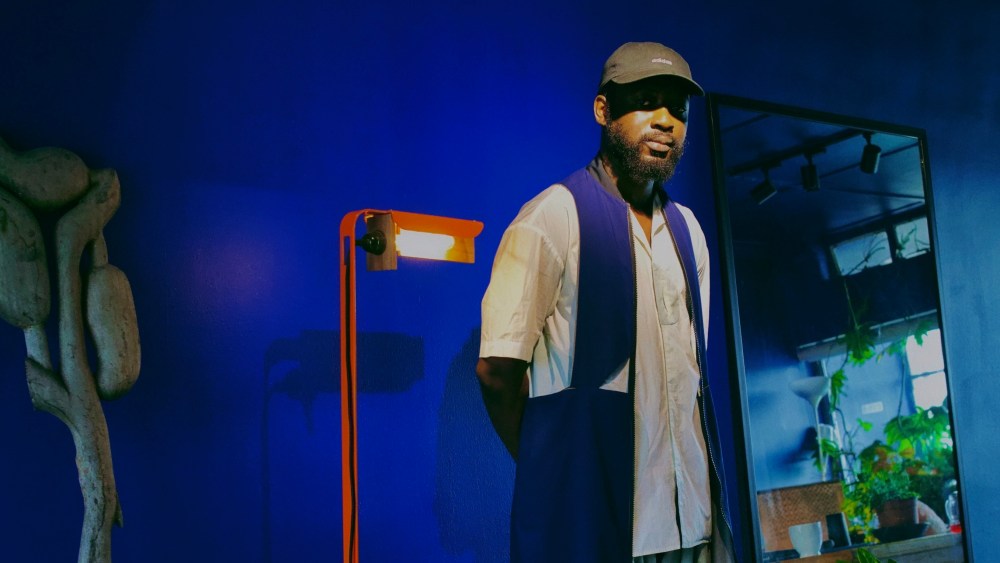
Lagos Space Programme isn’t an intergalactic mission, but the future-facing fashion label born in Nigeria is on a mission to create more space for African fashion — in all of its breadth, reach and depth.
And Adeju Thompson is the creative mind behind it all.
“A lot of the work that we do in the studio is centered around the idea of highlighting this alternate African narrative. I think a lot of times there’s a preconceived idea of what African fashion is, and I think LSP seeks to disrupt these ideas,” the 32-year-old designer told WWD, still in the City of Light after his Paris Fashion Week debut, where he showed his “Cloth as a Queer Archive” collection.
Related Articles
“There’s this general idea about how African fashion is viewed in terms of aesthetics. It’s not like I think it’s wrong, it just doesn’t define who I am as a creative person. For instance, a lot of fashion in Nigeria and on the continent is very maximalist and when people dress up they dress up to impress and that’s kind of the culture…But for me, I’ve always been this outsider and I feel like a lot of clothes I create are really much more about celebrating your identity and dressing for yourself.”
You May Also Like
The Lagos-based and -produced brand deals in gender-free, multidisciplinary design with an aim of “decolonizing fashion,” according to Thompson, and bringing more light to the continent’s contribution to the industry.
Illustrating that point, he said, “I love Japan and Japan is a place I draw a lot of inspiration from, but it’s very important that we highlight that there are parallel movements that have happened around the world without much interference from other societies. We have a deep history of indigo dyeing in Nigeria as well.”
When people see LSP’s indigo designs or wide-legged trousers and remark, “oh that’s very Japanese,” he takes it as an opportunity for education. “I’m like no, these pants are a replica of traditional Yoruba trousers [called kembe]…When I look at these pants, I frame this as kind of indigenous engineering and it’s really the way for me to look and study how these clothes are made and understand why the people made clothes this way, why are they cut this way and why are the panels so wide, what is the thought process behind that? And that’s really what gets me as a designer.”
With his recent International Woolmark Prize win, Thompson said he has been able to tap into The Woolmark Company’s network of suppliers to source fabrics from Italy to Japan and Switzerland. That, he said, “really sort of gives me this edge in the way that a designer, an emerging brand similar to me wouldn’t have access to, so it’s a wonderful privilege. I source fabrics from around the world but a lot of techniques is what really sets it apart from other brands. If I get a really beautiful silk-wool blend, I’ll bring it to Lagos and I will do my indigo experiments on it. There’s a lot of experimentation that goes into the fabrics.”
The prize winnings are set to help Thompson scale the business and hire the right minds to help see his mission progress and the label see greater global reach.
But the designer’s dad keeps him grounded.
“I remember at the [Woolmark Prize event], I had a sit-down with my father and he was like, ’I’m really proud of you and I’m glad that you won it, but I just want to let you know that winning the prize is not the prize. The prize is what you do with the prize. That is what you want.’”
Here, in the latest installment of “10 Questions With,” WWD finds out just what Thompson wants when it comes to people’s feelings about LSP, the first law he’d introduce for fashion if he were its ruler, and his five-year plan for being “this fab gay guy living his best life.”

1. If the fashion industry were a country and you were its ruler, what’s the first law you’d introduce?
Adeju Thompson: The first law I’d introduce would probably be just for fashion to be less disposable. I know it’s sort of like, Adeju, you could do better, but for me, when I create the work that I do and I spend months and years sometimes doing a lot of research, and the fact that my work could just be disposable and just [on to the] next thing is something that really bothers me. I really would like people to slow down in fashion production, also in fashion consumption and be much more deliberate, buying things that you need and being more understanding.
One reason I’m so excited about how I’ve framed LSP is that I have so much connections in the art world. I have some of my work in institutions and I’m having a show at the ICA [Institute of Contemporary Arts] in February and I really enjoy how I can interact with my research and really enjoy the work that I do and really get into it…It’s more than just skirts and trousers, it’s very serious conversations happening out here.
And that’s not something I get a lot in fashion and I think it’s because of questions like — OK, cool this print is centered around this research or I do it as a queer archive — ‘OK, how much is it?’ And that’s fine, I want to sell the skirt. But I also want you to understand why this is so significant….For instance, conversations around queerness and masculinity have always been monopolized by the West, and I like that I can share these conversations from an African perspective. That’s really what Lagos Space Programme seeks to do.
2. Tell us the story behind the name Lagos Space Programme.
A.T.: For the 500th time [laughs], I came up with the name because I really wanted a name that reflected this ideal of an indigenous space program, but also looking outwards. When you think about space, space is the last frontier and it’s this idea that a lot of the research I do within my work, you can’t really put it in a box, I’m always collaging different ideas; some of them are from the continent, some of them are outside of the continent. It’s really about expressing myself in a way that’s authentic. The clothes work so well in different contexts and that’s a conscious decision. I’m always exploring global codes.
And I think that’s something that the name really sort of encapsulates; it’s a vast idea.
For instance, this collection was inspired by me exploring Eurocentric dress codes with Yoruba styles, and that feels natural to me. And next season, I could explore something entirely different and build two different worlds together to produce something fresh, and that’s what really moves me as a designer.
3. What do you think people automatically assume when they look at you and what’s the truth?
A.T.: I’ve met a few people and they were like, “Oh my god, I didn’t realize you were so fun!” And I’m like, “OK, wow.” I look quite serious sometimes but I can be very messy. Like, I party, I cut loose. I think we all have our armor when we navigate the world so I’m not going to let loose with everybody, but it’s nice when I do it and they find it very funny when I’m hanging out, being very snappy and, I don’t know, giving high gay. It’s really interesting, people’s reaction, like, “I didn’t realize you had this side to you.” And I’m like, “yeah, I have range.”
4. Walk us through a typical day in your life.
A.T.: Well, I work where I live, I have a studio apartment. So, I wake up in the morning, probably play with my dog and my cat, my fur babies. I probably make myself a tea [fusion, green or herbal], I’m not really a coffee person. I will probably go check my emails and because I live where I work, I will probably say around 9 a.m., I’ll let my staff into the office and just get on with work. On a normal day, I probably just spend the entire day in the studio. Then in the evening I could hang out with friends. It’s very boring. So I can understand why the person told me, “I didn’t realize you were so fun.”
Also, I’m a plant dad, so I have like 150 tropical house plants. You’d find me every other moment fussing about something with the plants, are they OK? What’s their problem? Why is it brown? I do that a lot.
I could also read in a day; I have a vast library of art books and fashion books, and books on archetypes or cultures around Yoruba. I could be deep in research. I just surround myself [with] things I love, so it’s never really a very structured day, it’s more about what I’m in the mood to do at the moment.
5. If you could dine with any three fashion icons, living or passed on, who’s at your table and what would you tell them?
A.T.: I am obsessed, obsessed with Yoko Ono. And a lot of people find that very weird, but I just find that she’s such a badass. And I just really enjoy her artistic practice and the way she frames her work, but I also am very impressed with her style, and just how she always looks so effortless and so cool. Yeah, like her. She is someone who I’d love to sit down with.
Also, my friends have rolled their eyes at me at times around this, too: I thought Queen Elizabeth was kind of a badass. Obviously, I’m a Black person and I understand the British royal family and I understand colonization. But I always say to my best friend, I’m an aesthetic monarchist, I love what it’s giving — who doesn’t love a queen?
I enjoy people who have a very clear idea of who they are.
Third person? I don’t think I find him in general to be a style person but there’s a picture of the former president of Nigeria, Olusegun Obasanjo, at the White House in full Yoruba [clothing]… he’s just, we call it, giving high Yoruba. There’s this term we use in Yoruba, we call them Yoruba demons, they’re just doing the most. I would love to sit down with Obasanjo and be like, how could you?! It’s just this amazing picture and there’s Jimmy Carter, the president of America, just in this boring suit and here’s my president in a full-on handwoven cape with a cane just there looking like god knows what. I’m so impressed by that image. And President Obasanjo is in his 80s [he’s 86], I’d love to ask about that image. But I’m just so impressed that these are the people I come from.
6. When people think of Lagos Space Programme, how do you want them to feel?
A.T.: I just want them to understand how much work I put into it. I grew up watching the Raf Simons shows early in the ‘90s and the Yohji shows and the Comme shows. Those shows really moved people and I really want to create something similar with Lagos Space Programme.
7. If you could choose to do anything in the world for one day, what’s on your agenda?
A.T.: Be the lead singer of a rock band playing a stadium concert.
8. You have the opportunity to go back in time to change something — what it is it?
A.T.: I’m very proud to come from Nigeria and I always tell people Nigeria is an important country with a very complex history. As Nigeria gained independence in 1960, it was a lot of young, earnest people who wanted the best, but there was a coup [in 1966] and things went downhill there. If I could change anything, I would tell the guys, bad idea. Whatever you guys think you’re fighting, it gets worse in 40, 50 years, just let it be. I just hope that there will be a time in history when Nigeria will reclaim its promise. It’s a wonderful country.
9. If you could only eat one meal for the rest of your life, what would it be?
A.T.: To be honest, no, just no. I’m somebody with a hearty appetite, I love food — that’s something I’ve enjoyed doing for the past two months while I’ve been in Europe, eating food from every conceivable culture that I could find. I don’t think there’s one thing I’d want to eat for the rest of my life, no, no. I’d get really bored of it really fast. I’m a quintessential Gemini, so I need to be stimulated.
10. Where do you see yourself in five years?
A.T.: I always tease my friends, [saying], oh yeah, I’m in my soft life level 1000 gay era and I feel there’s still so much to do. I’m at this point in my life, I feel very confident and very sure of my voice but I feel like in five years’ time I’ll be more settled…I’ll be 37 and I just feel this idea of being a lot more confident, being very aware of my voice, creating something people are very proud of.
I’m always working on myself, always fine-tuning things, learning. And that’s what I’m doing right now, building a language around LSP. That’s something that’s important to me as a designer, this idea of what is my point of view? I feel like in so many ways, this is it. Even though I have a point of view, there’s a confidence in the way I navigate my point of view and I like that I can keep on adding to it.
What does that look like in five years’ time? I guess we’ll see. But I think in five years, I just want to be this fab gay guy living his best life.