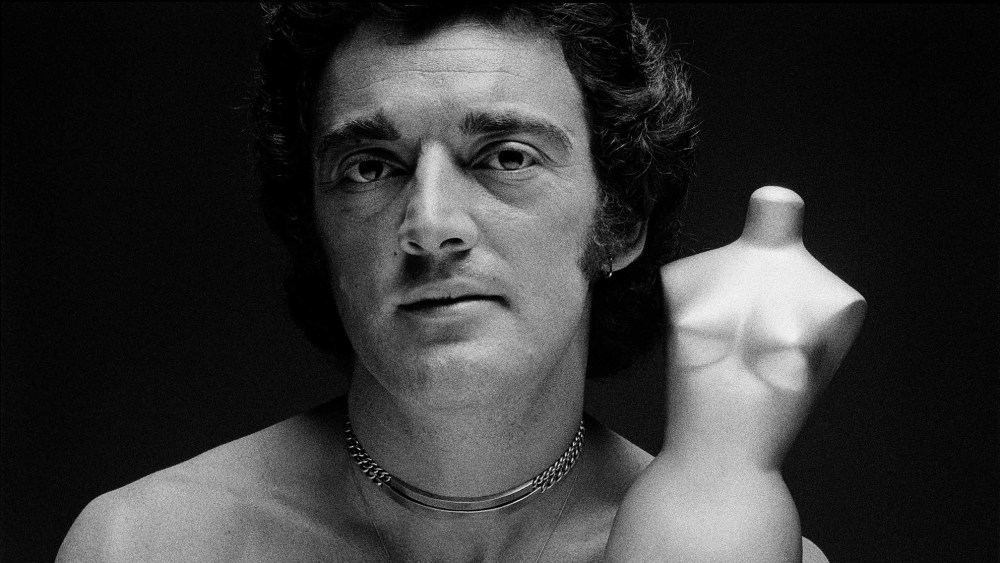
PRATO, Italy — Prato’s Museo del Tessuto in Tuscany is paying homage to Walter Albini, a pioneer of Made in Italy fashion design, through the exhibition “Walter Albini. The talent, the designer,” running until Sept. 22.
Drawings, photographs, jewelry, fabrics and clothes tell the story of Albini’s career that spanned more than 20 years, between the late 1960s and early 1980s.
“It’s an historical and philological work on Walter Albini’s life. Only by studying it from the beginning is it possible to understand the graphic talent and how he opened the doors for prêt-à-porter collections in Italy,” explained fabric historian and curator of the museum Daniela Degl’Innocenti in an interview. The exhibition was curated by Degl’Innocenti with Enrica Morini, fashion historian and lecturer at IULM University of Milan.
You May Also Like
Related Articles
Their two-year research led to the reconstruction of Albini’s entire creative history. “With this exhibition we wanted to line up in chronological order all the steps, from his education to the last collections,” Degl’Innocenti said.

The exhibition unfolds throughout 10,800 square feet. The first years of his training, from his beginnings as a reporter for magazines such as Corriere Lombardo, are retraced on the ground floor.
“In all of these drawings, his passion for the ’20s and ’30s is evident [including] how Chanel was such an inspiration for his creativity. The simplification of the sartorial cuts were always a reference for him,” said Degl’Innocenti.
“The last part of the research was maybe the most difficult one because we had to find the garments and certify that the collections were designed by Albini. These brands, which were showing at Pitti in the ’70s, usually didn’t give credit to the designer behind the collections. Only in 1977 did we have the first documented collaboration with Krizia on Vogue,” she said.
In 1971, Albini presented an ambitious project in Milan in the Sala d’Oro of the Circolo del Giardino along with distribution company FTM (Ferrante Tositti Monti). This was a collection entirely designed by Albini, but produced by five companies, each competent in a different sector: Escargots, Basile, Diamant’s, Callaghan and Misterfox. He made three collections through 1973 with Misterfox, Basile, Callaghan, Escargots and Diamant’s (later replaced by Sportfox).
In those years, together with Krizia, Ken Scott and Missoni, they decided to move their prêt-à-porter presentation from Palazzo Pitti in Florence to Milan in order to engage a different audience with different economic standings.
On the upper floor, visitors can see the Walter Albini brand creations presented in London, Venice and Rome between 1973 and 1974, and garments from his second Misterfox line. After closing the company with Papini, Albini resumed his work as freelance designer.
Albini’s career began a new phase in 1978 with clothing distributor Mario Ferrari allowing him to also become a producer, reappearing on the Milanese catwalks with the label Walter Albini. The last exhibition hall on the first floor presents the years 1975 to 1983 with Alta Moda, the collections created in collaboration with Trell, Mario Ferrari, Lanerossi and Lane Grawitz.
“Studying Walter Albini was an opportunity to understand the complexities of an authentic fashion creator who experienced the enthusiasm, fragility and contradictions of a system that would become Made in Italy, but which at the time was being born and seeking out its own identity,” said Morini. “The answers came from in-depth (and long) research work involving scholars from different specializations, who I thank for their commitment, but above all for the passion with which they approached the great designer’s work.”
A big part of the showcased material comes from the Walter Albini Collection of the Museo del Tessuto, acquired thanks to a large donation by Albini’s collaborator Paolo Rinaldi that was received between 2014 and 2016. It includes more than 1,700 objects encompassing jewelry, sketches, drawings, photographs, documents, books, clothes and fabrics belonging to the designer — a collection that documents his interests, creativity and design ability.
One of the main loaners among public institutions was the Study Center and communication archive (CSAC) in Parma to which Albini himself gave custody of his collections in 1969. Also, very fundamental for the research were private lenders like A.N.G.E.L.O. Archive, Carla Sozzani Collection — Sozzani Foundation, Ilaria De Santis Collection, Madame Pauline Vintage archive and photographers Vittoria Backhaus, Alfa Castaldi archive and more.
The spaces were curated by the Florence-based architecture firm Guicciardini and Magni Architetti, which has collaborated with more than 50 museums and 80 temporary exhibitions in Italy.
Founded in 1975, Museo del Tessuto is billed as the largest cultural center in Italy dedicated to the enhancement of ancient and contemporary art and textile production, carrying on the memory of a tradition that has been inherent in the city of Prato since the Middle Ages. The museum plays a crucial role in providing education to textile and fashion schools and schools of all levels. Last year, educational activities involved 3,800 students. In 2022 alone, more than 800 people participated in workshop activities designed for families.
In the past few years, there has been a significant increase in the organization of temporary exhibitions with a specific objective: to promote and enrich the understanding of ancient and contemporary fabric, costume, and fashion such as the “Gianfranco Ferré’s white shirt” exhibition in collaboration with the namesake foundation and “Between art and fashion in synergy with the Ferragamo museum in Florence,” among others.