
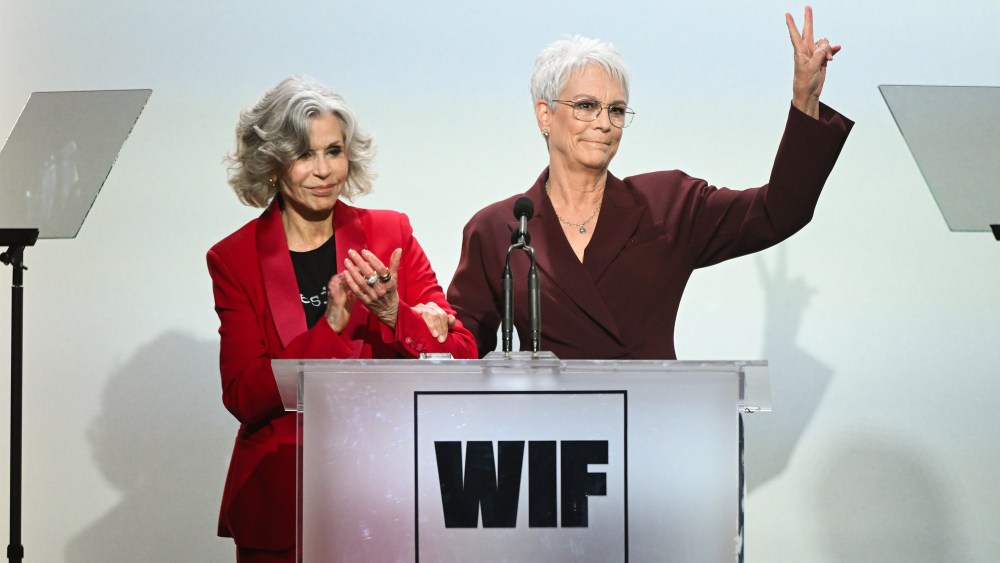
Women in Film embraced the theme of unity on Thursday night at The Beverly Hilton, honoring the power of collaboration, inclusion and storytelling to advance gender equality in Hollywood.
The evening — with Max Mara as the presenting sponsor and E.l.f. Cosmetics as visionary sponsor — highlighted the achievements of women who continue to reshape film and television.
Comedian and actress Atsuko Okatsuka opened the ceremony with a burst of laughter and energy.
You May Also Like
Related Articles
“Women,” she declared, drawing immediate laughs with her delivery. “Highly regarded, respected rulers of the world. It’s why we’re here tonight. We’re doing too well.” The room erupted again.
“It’s honestly exhausting having this much power,” she continued, sending another wave of laughter. “The good news is we have each other. We have each other — and air.”
The audience was in on her playful rhythm. “We have air, and that’s good. Air helps us breathe. And snacks. We have snacks.”
With sincerity, she went on, “But for real, for real, look at us. We are crushing. We are powerful. You are surrounded by women, fellow women, who have trail-blazed in their fields.”
Jamie Lee Curtis was the first honoree, receiving the Jane Fonda Humanitarian Award from Jane Fonda herself. The award, named for its inaugural 2021 recipient, recognizes Curtis’ humanitarian impact and artistic work.
Fonda, dressed in a tailored suit and a black T-shirt with the word “resist,” spoke about the meaning of humanitarianism.
“It’s compassion for others, and we are in the business of compassion and empathy,” she said. “In order to become someone else, in order to portray another human being, we have to have a lot of empathy…but given today’s reality, humanitarianism and empathy are essential forms of resistance.”
Referencing the current political climate, the 87-year-old actress and longtime activist warned that the First Amendment is under threat. “It’s the bedrock of democracies, and it’s being taken away from us.”
Fonda went on to explain that on Oct. 1, she helped relaunch the Committee for the First Amendment, originally formed during the McCarthy era by Hollywood actors to defend free speech. “That was about one small part of government robbing us of our First Amendment right — now it’s the entire federal government. It is far, far worse than what existed back in the ‘40s and ‘50s.”
The committee has attracted 2,500 members, a sign of renewed engagement, Fonda said. She urged everyone in the room to join the cause. “It shows that people want to rise up and fight back, and we want to make that possible within our industry. All regimes are held up by pillars of support. If you can erode the pillars of support, the regime collapses.”
Both Fonda and Curtis are daughters of Hollywood icons — Fonda of Henry Fonda and Curtis of Tony Curtis and Janet Leigh. Jamie Lee Curtis acknowledged the legacy she was born into and looked back on using the platform to champion causes from children’s health to LGBTQIA+ rights. And in a week that saw the election of two new women governors — Abigail Spanberger of Virginia and Mikie Sherrill of New Jersey — Curtis reflected on the moment through her work.
“Art can premeditate life,” she said, drawing a parallel between their victories and her new film “Ella McCay,” which follows a young woman’s rise in politics. “I feel hopeful.”
WIF chief executive officer Kirsten Schaffer addressed the audience with a mix of candor and optimism, acknowledging the turbulence of the year, from industry layoffs to “assaults on immigrants and, of course, on women.” She cautioned, “There are people in positions of great power who would like to erase us…silence our voices, diminish our power.”
Schaffer said WIF’s mission remains vital, noting that early 2025 statistics show only about 4 percent of top-grossing films are directed by women. She also announced a goal of raising $50,000 to sustain WIF’s advocacy and education programs — with Max Mara pledging to match donations up to $20,000 in honor of its 20-year partnership with the organization.
“If there was ever a room of people with the tenacity and creativity to imagine our way out of this moment,” Schaffer said in closing, “it is this room. It is all of you. So, let’s use our pens and our voices to stand up for each other, especially those who are marginalized because undivided, we do have the power.”
As the program unfolded, Tessa Thompson, Nia DaCosta, Dede Gardner and Gabrielle Nadig were honored with the Crystal Award for Advocacy in Film for their feature “Hedda.” Thompson, who both stars in and produces the adaptation, was recognized alongside the women for creating space for women’s voices on and off screen, reimagining how stories are told and who gets to tell them.
In television, Mara Brock Akil, Judy Blume and Regina King received the Crystal Award for Advocacy in TV for their work on Netflix’s “Forever,” a series that centers on women’s experiences. The award acknowledged their ability to use entertainment as a platform for connection.
Maude Apatow, meanwhile, was recognized as the WIF Max Mara Face of the Future, marking her debut as a director with “Poetic License,” as her parents, Judd Apatow and Leslie Mann, looked on with pride. Known for her performance in “Euphoria,” Maude Apatow has emerged as a multihyphenate talent — an actor, filmmaker and founder of her own production company, JewelBox Pictures, which aims to elevate women’s stories across genres.
The evening concluded with Kristen Wiig receiving the inaugural WIF Icon Award, presented by her “Palm Royale” costar Kaia Gerber, who praised Wiig as a performer who “defies categorization” and “finds the heart inside of the absurd.”
Visibly moved, Wiig reflected on her path from sketch comedy to screenwriting and producing, crediting those who believed in her early on — including her father and Paul Feig, who helped bring “Bridesmaids” to life. She spoke candidly about fear of failure and the creative risks that come with storytelling.
“I still have things in my career that I really want to do — that I’m scared to do,” she said. “Maybe we just make a collective pact with each other that we’re going to do it anyway.”