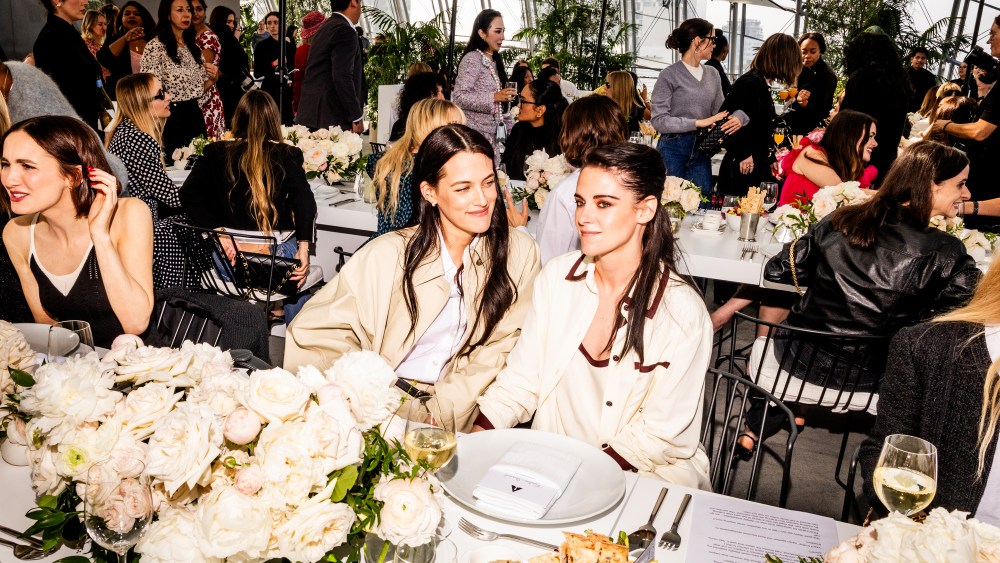
Before the speeches began and the wine was poured, one voice cut through the chatter at the Academy Women’s Luncheon.
“We’re in a lawless time,” Indya Moore said. “We need to stand up.”
Hosted by the Academy of Motion Picture Arts and Sciences in partnership with Chanel, the annual gathering drew female filmmakers, actors, costume designers and studio heads to the Academy Museum of Motion Pictures on Tuesday to celebrate mentorship and creativity, spotlighting this year’s Gold Fellowship for Women recipients, Alina Simone and Marlén Viñayo.
Related Articles
For Chanel, supporting the event continues its long-standing commitment to empowering women in film — one that began with Gabrielle “Coco” Chanel’s early collaborations with filmmakers.
You May Also Like
But as the crowd discussed progress in Hollywood, Moore’s voice carried a different weight.
“I think everybody who’s not speaking out thinks that they don’t have to, and I think it’s disgusting,” she said firmly, referring to the government’s escalating policies, ICE raids, attacks on trans rights and what she described as a growing indifference to human suffering. “We need to stop this pipeline of investment and complicity and this culture of carelessness, of vanity. We’re so self-obsessed and it’s embarrassing.”

Her words came with urgency: “It’s not enough to just be loved for your work. You need to love the people who love your work….If we continue to neglect the reality that we’re seeing unfold, it’s unacceptable.”
For Moore, who stars in Jim Jarmusch’s “Father Mother Sister Brother” — alongside Tom Waits, Adam Driver, Charlotte Rampling and Cate Blanchett — the intersection of art and activism is inseparable.
“Working on ‘Father Mother Sister Brother’ was one of the most beautiful opportunities that I ever had,” Moore said, softening. “This film healed my family.” During production, she had been helping a family evacuate from Gaza. “Every single life is an entire universe. Every single person is a galaxy. Everyone’s life is sacred and worth protecting.”
Nearby, Kristen Stewart — who later delivered a keynote speech — paused for the cameras in head-to-toe Chanel, ever the house’s muse. She spoke about her directorial debut, “The Chronology of Water,” adapted from Lidia Yuknavitch’s memoir.
“There’s just unearthed privacy that when shared is pure liberation,” she said of the project. “To be able to get it up on its feet and let it scream and dance and fall over but then get back up….If we can aspire to dream away from the things that hold us down, that’s what I got from the book and I thought the movie could just take that further.”
Reflecting on what directing had taught her, she continued, “It’s pretty easy to do an impression of what’s been successful before you, because acceptance is something we all crave. But to function from a place of true desire and making sure you’re sourcing your own authorship of that…forging your own path, it’s easy to say but difficult to do. When I look back on making this movie, I wonder about the times in which I accepted the answer no.”
Her tone sharpened. “Never do it,” she said. “Never. Even if you think you’re being somebody who sort of is trying to grease the wheels of productivity, you have to be going to the place that you want to go.”
Embeth Davidtz could relate, having made her directorial debut with “Don’t Let’s Go to the Dogs Tonight,” based on Alexandra Fuller’s memoir.
“It’s definitely better than it used to be. It’s not there yet,” said the longtime actress of the industry’s progress with women. “There’s definitely a male attitude of waiting for female filmmakers to prove themselves. They’re shocked when you do. We still have a ways to go.”
Directing taught her the quiet strength of empathy, she said, “It really pays off. Actors respond to kindness. They relax and deliver their best work when they feel supported.”
Barbie Ferreira also has stepped into new territory as a producer, taking on dual roles in “Bob Trevino Likes It” and “Mile End Kicks,” both of which she stars in.
“I learned a lot about micro-budget indie films…I learned a lot about how to make a movie right and do a character study without any money,” she smiled. “We pulled it off.”
Tessa Thompson, producer and star of “Hedda,” a reimagining of Hedda Gabler directed by Nia DaCosta, echoed that sense of creative ownership.
“Hedda Gabler has mystified, enraged and fascinated audiences for over a hundred years,” she said. “But Nia’s take, really centering women throughout the story, makes it a story that’s not just about Hedda’s interiority, but about parallel pathways to personhood.”
Leaning in, she added, “Primarily something that Nia and I were interested in was exploring this female rage. And I think if you look across Hollywood iconography, there’s not that many narratives that allow us to really unearth and talk about that.”
On the industry’s evolution, she said, “Relative to when I began over a decade ago, there’s just more women in positions of power across industry lines, and I think that’s hugely important.”
Warner Bros. Motion Picture Group chief executive officer Pam Abdy spoke optimistically about the state of Hollywood: “In 2026, four of our films are directed by women. We have ‘The Cat in the Hat’ by Erica Rivinoja, ‘The Bride!’ by Maggie Gyllenhaal, ‘Wuthering Heights’ by Emerald Fennell and ‘Practical Magic 2’ by Susanne Bier.”
Inside the museum, Amy Homma, director and president of the Academy Museum of Motion Pictures, emphasized why these conversations matter.
“It’s so important for us to not only preserve film history, but to celebrate it in ways that uplift and amplify voices from our community, including, of course, women-identifying individuals,” she said.
Current exhibitions, she added, invite guests to step inside the production designs of Sarah Greenwood and Katie Spencer, from the dreamscapes of “Barbie” to the fantasy of “Beauty and the Beast.”
Earlier, among the first to arrive, Kate Hudson reflected on the balancing act between her worlds as an actress, entrepreneur and recording artist.
“I kind of just move with where my creativity is moving me, which is kind of all over the place at times,” she said.
The pandemic, she noted, marked a creative reckoning. “COVID-19 was the big moment where I was like, ‘Am I happy with my creative output? If I die tomorrow, am I satisfied?’ And the answer was no. That’s when music became a bigger highlight for me…I just follow my heart.”
And where was her heart now?
“In my bed,” she laughed. “I went out last night for my wrap party for ‘Running Point.’ We were out so late. It was so much fun…but really, my mantra right now is just create, create, create. I’m writing a lot of music and stories. That’s where my heart is.”