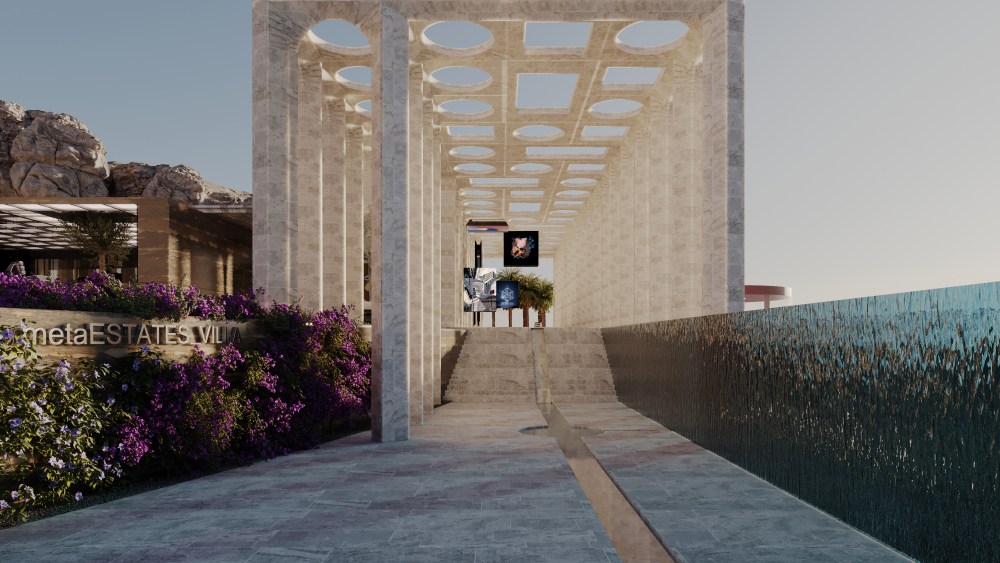
It’s been four years or more since the fashion world clocked the work of architect-turned-menswear designer-turned-architect again Luis Fernandez. But it may be interested in his latest creation: MetaEstates_Villa, a luxe waterfront virtual venue that just dropped publicly via NFT.
The space boasts a rather unique feature: interoperability. Instead of being limited to one metaverse, owners have a choice of where to place their villa — be it Spatial, Decentraland, Cryptovoxels, Unreal Engine 5, Nvidia Omniverse or other places. The options span 10 virtual platforms, at least so far, with more to come.
This flexibility comes courtesy of MetaMundo, a virtual tech platform gaining attention for its “open metaverse” approach.
Related Articles
“We partnered up with MetaMundo and made that deployable-ready for all the different open-source metaverses. So if you have land in Decentraland, you can drop it in there. If you have land in Cryptovoxels [and etc.],” Fernandez explained to WWD. “And because all the metadata is refreshable, as new platforms come on board, we’ll start to update those as well.”
You May Also Like
The approach aims to solve a fundamental issue: fragmentation. Today’s metaverse is not a single place, but multiple environments, most of which don’t work together. That may change one day — it would have to, in order to form the seamless, connected wonderland that Meta’s Mark Zuckerberg envisions. But for now, the metaverse remains a disjointed patchwork of platforms.
That’s a significant obstacle for brands, particularly for those hoping to establish a universal or consistent virtual presence. They can build one digital storefront or headquarters for one environment, but they would have to build it over and over again to cover other games or virtual worlds. Each platform has different specs, file types and even land or plot sizes, so it’s not a one-size-fits-all situation.
Enter MetaMundo. As a serial entrepreneur with a background in developing digital tools for architects, cofounder Mark Studholme understood the technical challenges and decided to take them on.
Over time, his team ended up developing an “in-house conversion pipeline,” he told WWD.
Building 3D spaces, especially with beautiful settings and refined details, usually yields massive files that can be tough to deal with. MetaMundo takes those “seed” files and creates more adaptable master files, which are capable being retooled for numerous metaverse platforms. It’s a complex process involving an array of file types, including those used by the likes of Pixar, Nvidia, Epic and others. But ultimately, it means the system can meet a broad range of specs, from the highest fidelity — think award-winning animation and gaming — to low-fi environments such as Roblox and even augmented reality.

The platform is also constantly expanding compatibility to include more file types and metaverses. In other words, current owners of MetaMundo NFT venues, including Fernandez’s villas, will have more virtual worlds where they can place them over time.
“That’s the future-proofed version that you get in this NFT,” said Studholme, though he admitted that it doesn’t come without plenty of effort, including human intervention. The company is working toward fully automating its pipeline, but “at the moment, I would say, it’s 60 percent automated and 40 percent [manual].”
Last month, MetaMundo launched a 3D NFT marketplace offering metaverse scenes as well as assets for use across Decentraland, The Sandbox, Cryptovoxels and Spatial. The company targeted art galleries or public spaces, such as music venues and parks, but owners can use the scenes however they wish — as long as they don’t violate the NFTs’ terms.
For MetaEstates_Villa, the owner can throw parties or hang out with up to 50 friends, or use it commercially as a showroom, for business meetings, as an event space and for other purposes. But there are limitations. According to Fernandez, buyers own the NFTs, but not the intellectual property. It’s similar to buying a music disc or MP3, but not actually owning the rights to the song itself.
That may not matter to buyers drawn in by the villas’ unique interoperability — or the charms of their open aesthetic and design ethos.
Working with an architectural designer known simply as “The Line,” Fernandez fashioned a sophisticated space with beautiful views, towering columns and a swimming pool, which repeats the water theme of the surrounding ocean directly on the grounds. Imagine a heightened fantasy version of a Pacific coast getaway, with the clean lines and minimalism that Fernandez is known for balanced against the dramatic cliff side views.
Architecture fans may note a Frank Lloyd Wright sensibility to the landscape, or a Mies van der Rohe-like spirit in the interior’s use of natural stone. But it’s all filtered through Fernandez’s lens.
A self-described “hybrid-creative,” he racked up notable credibility in fashion as cofounder of Number:Lab, creative director of Craft Atlantic and CFDA member. But even before he dove into fashion — where he may one day return, he hinted — he trained as an architect and worked on high-profile retail projects.
“I first started designing retail stores as an architect. I did a lot of the Barneys stores back in the day,” Fernandez said, referring to his time as project architect for Barneys New York’s flagship stores in San Francisco and Las Vegas. “I think that that — coupled with my experience of building a brand, selling product, creating product — has informed a lot of my approach to designing metaverse spaces in the sense of, what are we doing in there? What’s the utility of it?”
This contemplation is apparent in the villas. The effort took more than a year to materialize, which seems like a lengthy period. Even a few real-world venues took less time to design. But this stretch was as much a waiting game as a creative phase. “This project has been 18 months in the making, and a big part of that was waiting for technology that allowed me to do something that was much more high fidelity and much more refined than what exists out there,” the designer said.
The patience is unusual, compared the frenzied pace of digital property development. Buildings, campuses, even penthouses seem to be cranked out at amazing speed in what looked like a metaversal land grab. The real question, though, is if people are actually buying them.
A recent study by research firm Technavio estimated that the virtual real estate market would grow by $5 billion by 2026. A McKinsey report predicted that four years later, in 2030, the market would balloon up to $5 trillion. But the bubble appeared to be bursting, with land prices plummeting a whopping 85 percent. That’s partly due to cryptocurrency’s volatility, which brings good, bad and often dire news, depending on the day.
The other part is demand. Is there any? There was, at least based on the string of high-profile, high-value land deals at the end of last year. In November, Tokens.com’s Metaverse Group picked up a 116-parcel estate, which equates to roughly 6,090 square feet, in Decentraland’s Fashion Street, hoping to lease virtual space to fashion brands. Then it came back to pick up more land, ponying up another $3.2 million. The same month, Republic Realm shattered the record with a $4.3 million sale in The Sandbox.
If the craze is abating, the effect on projects like MetaEstates_Villa may be hard to predict. Fernandez’s latest NFT doesn’t actually include the sale of land, but it does require land ownership if purchasers want to enjoy the space. Otherwise, they’re just staring at a set of VOX, GLB and other Web 3.0-ready files.
So far, investors like Peter Martin, producer, VR director, futurist and the chief executive officer of metaverse developer “0,” aren’t deterred, buying one of the 100 NFT villas made available this week. At press time, a little over a quarter of them have sold for 0.5 ETH each (or $924.71, as of this writing).
Either way, projects like this highlight the need for interoperability across virtual worlds. MetaMundo and Fernandez may be early to this game, but these types of efforts are crucial if the metaverse is to become the next evolution of the internet, as promised by tech executives like Zuckerberg and many others. In the future metaverse of the Meta founder’s dreams, visitors can gather, enjoy experiences and bring along their digital clothes and collectibles wherever they go.
The Meta CEO should be paying keen attention to this type of work. He’s been betting big — perhaps betting everything — on what, so far, seemed like a pretty nebulous promise.
Now, however, it all seems just a little more plausible.