If you purchase an independently reviewed product or service through a link on our website, WWD may receive an affiliate commission.
In this article
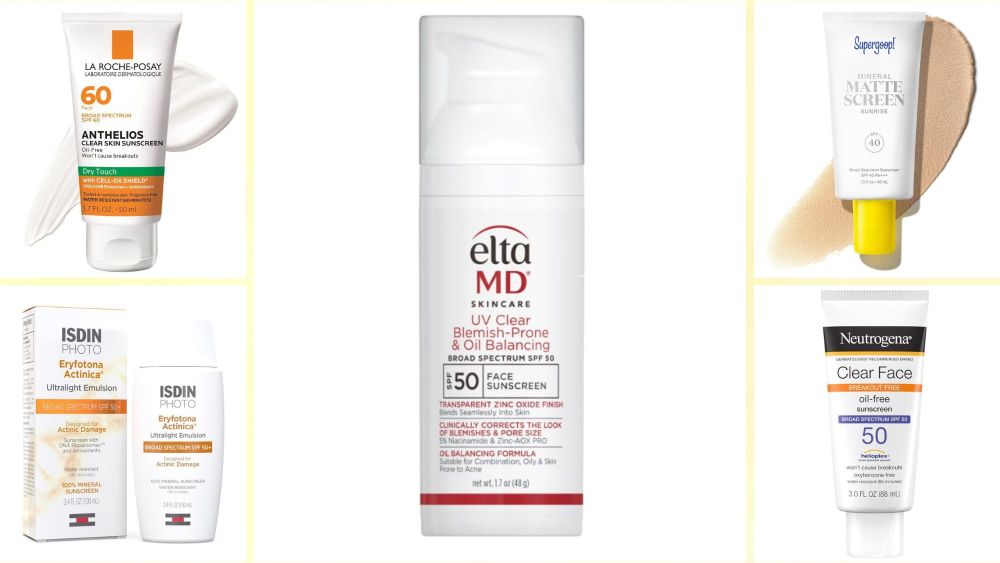
Best Sunscreens for Acne-Prone Skin 2026

La Roche-Posay Anthelios Clear Skin Dry Touch Face Sunscreen SPF 60
The weather’s on the up and up, the UV index is climbing, and you’re probably thinking about the best sunscreens to stock up on before summertime’s official arrival. Picking out a sunscreen that works to protect you from harmful UV rays, goes on smooth and clear (no white cast here!), and can even layer seamlessly under makeup feels easy enough, but complications arise for those of us dealing with acne-prone skin.
Related Articles
There’s a well-known stigma surrounding sunscreen in this particular community, propelled by the myth that the product exacerbates existing breakouts and increases the chances of new ones popping up. We’re here to tell you that this is only the case with oily-and-greasy sunscreen types that clog up pores and don’t take blemished skin into consideration. Another false belief in need of some debunking? That spending time in the sun, sans sunblock, can effectively dry out pimples. According to the Florida-based practice Water’s Edge Dermatology, sunlight does dry the top layer of the skin, but this triggers a process in which the body “produc[es] even more oil to compensate for what was lost” — paving the way for more breakouts, as it happens.
And before you interject, treating acne with light therapy (think blue-light LED gadgets like masks and wands) is not the same as pulling up a lounge chair and putting your face in direct sunshine during the hottest hours of the day. One method kills acne-causing bacteria; the other manufactures the ideal breeding ground for it.
It’s also important to remember that many acne serums and spot treatments are photosensitizing, making your skin more sensitive to UV rays and creating the perfect storm as it relates to sun exposure. If you’re on any kind of medication for your acne, be it over-the-counter or doctor-prescribed, regular sunscreen application becomes even more vital.
In essence, sunscreen should be a non-negotiable across all skin care routines, and the very best sunscreens for acne will keep it calm from Memorial Day to Labor Day and beyond. We’ll go into the specifics — what’s the SPF sweet spot? What sunscreen ingredients should you avoid if your skin is quick to break out? What’s the difference between chemical and mineral sunscreen formulas? — a bit later on. For now, a tight edit of sunscreens for oily, sensitive, and acne-prone skin that you should be shopping in 2026.
We tapped board-certified dermatologists to help us round up these bestselling selections, making sure to include everything from makeup bag mainstays to new-this-month releases like EltaMD’s UV Clear Blemish-Prone & Oil Balancing Face Sunscreen.
Thank us later for your clear, radiant, and burn-free complexion this summer.
Sign up for WWD Shop’s newsletter to get the scoop on the best in beauty and style with in-depth reviews of exciting new releases and buyer’s guides to find the products you need to try ASAP.
EltaMD UV Clear Blemish-Prone & Oil Balancing Face Sunscreen SPF 50
EltaMD has been a go-to in the skin care regimens of everyone from Drew Barrymore to Gwyneth Paltrow for many years now, and just last month, the brand announced the rollout of its most innovative sunscreen to date: the UV Clear Blemish-Prone & Oil Balancing SPF 50, which delivers broad-spectrum UV defense, yes, but also actively works to correct visible blemishes, tighten pores, and balance oil levels. Thanks to these previously unheard-of benefits — secured via the powers of ingredients like niacinamide, antioxidants, and zinc oxide — this extension of EltaMD’s highly popular UV Clear line is our editors’ first choice for acne-friendly sunscreens in 2026. Better yet, it’s also vetted by experts, with EltaMD being the #1 dermatologist-recommended sunscreen brand.
This baby absorbs with a transparent finish, leaving no residue in its wake whatsoever, and won’t interfere with makeup such as foundations or bronzers. Its impressive ability to fix, and not just soothe, skin imperfections over time is backed by a clinical study, too, which found that the fresh release reduced visible blemishes by 65 percent, cut back on visible oil and shine by 61 percent, and decreased visible pore size by 25 percent.
All over the world, individuals with acne are singing the UV Clear Blemish-Prone & Oil Balancing Face Sunscreen’s praises (it holds the #1 spot in Amazon’s “Facial Sunscreens” category, after all). Hop on the bandwagon this spring — your skin deserves it.
Editor testing and review notes: “The sunscreen’s barely there scent was neutral enough not to aggravate my sensitivity to fragrances typically found in the beauty world, while still emitting aromatic freshness. When I applied it on my face, the EltaMD sunscreen went from white to invisible in no time at all, bestowing upon my cheek a slightly mattified look yet still salvaging glowiness. On a purely sensorial level, the product beats out its rivals, and it doesn’t hurt that the proprietary technology it runs on helps block five environmental aggressors: blue light, smog, and diesel included. I got my hands on the sunscreen more than a month before it went live in a B2C capacity, so I was able to observe its longterm blemish- and oil-eliminating prowess firsthand. I’m noticing less net-new breakouts, less redness, and an overall tighter appearance as it relates to my pores. At under $50, this EltaMD gem becomes even more of a must-have in anyone’s beauty arsenal.” — WWD Shop Senior Commerce Writer Stacia Datskovska
Price upon publish date of this article: $49
La Roche-Posay Anthelios Clear Skin Dry Touch Face Sunscreen SPF 60
A stellar option for everyday wear, the La Roche-Posay Anthelios Clear Skin Sunscreen will keep your face shine-free from morning to evening: guaranteed. The Amazon’s Choice crowd pleaser (with close to 2,000 five-star reviews at the retailer) contains silica and perlite to absorb excess oil “even in heat and humidity,” per the brand. A clinical study performed by the French-born La Roche-Posay found that this top chemical sunscreen diminished shine and oil by 46 percent, in fact, and it promises to go on in a matte way — living up to that “dry touch” description in its name. Planning on being extra active during the day? You can rest assured that you won’t sweat this stuff off, as the sunscreen is water-resistant for up to 80 minutes.
Editor testing and review notes: “If you’re about to give up on sunscreens due to persistent breakouts — don’t! On the contrary, go ahead and give this lightweight lotion a try. I swear by it because it can stand in as a daytime moisturizer with SPF for acne-prone skin types, being more breathable than the comparable moisturizer-and-sunscreen combo. The La Roche-Posay Anthelios Clear Skin Sunscreen dries down quickly with a matte finish that keeps greasiness at bay throughout the day. What’s not to love?” — Former WWD Shop Commerce Editor Claire Sullivan
Price upon publish date of this article: $20.99
Isdin Eryfotona Actinica Ultralight Emulsion Sunscreen SPF 50+
For those with both sensitive and acne-ridden skin, mineral sunscreens present themselves as the best choice, since they’re less likely to cause irritation by sitting on top of the epidermis as opposed to penetrating it. Not all mineral formulas are created equal, though: Some can feel heavy and greasy, which is a no-go as far as acne is concerned. Enter the Eryfotona Actinica Ultralight Emulsion Sunscreen from Isdin, a sun care company that’s credited with pioneering photoaging research. It distinguishes itself from the crowd vis-à-vis a watery texture with an impossibly featherweight feel, which is incredibly rare to find in a physical blocker. This quality allows the sunscreen to melt onto your complexion for uniform coverage without too much rubbing required (it disappears without a trace after about 30 seconds of massaging, to be exact). As for those inclusions of vitamin E and plankton-derived enzymes? They aid in the repair of already-present sun damage while tackling signs of aging.
Editor testing and review notes: “This Isdin sunscreen has long been a savior for me during summer months or beach trips — its SPF 50 is higher than the SPF 30 I wear the rest of the year, doling out the protection I know I need when I’m out in strong rays. The liquid consistency immediately absorbs without stinging or shine, and it dries down to a demi-matte finish that blurs skin without making it look dull or dry.” — Sullivan
Price upon publish date of this article: $54.80
Supergoop! Mineral Mattescreen Sunscreen SPF 40
Supergoop! is known for creating sunscreens that feel and look so good on your skin, you’ll be itching to reapply them throughout the day — which should be status quo in the first place. Made for every “skin type, tone, age, and step in your routine,” Supergoop!’s roster has been used by the likes of Shay Mitchell and Sabrina Carpenter. A feather in its cap? The pictured Mineral Mattescreen Sunscreen, which is the brand’s leading SPF for acne due to its mattifying action and mineral composition that keeps pores happy. To minimize the potential for a white cast from those UV-fighting titanium oxide and zinc oxide components, the sunscreen grants a subtle, neutral tint in a “Sunrise” shade that complements most skin tones. Going above and beyond, it also contains wild butterfly ginger extract that filters out blue light and free radical–combatting bamboo extract.
Editor testing and review notes: “After testing out this sunscreen for acne-prone skin, I’m convinced that it’s one of the most effective pore-filling makeup primers, in addition to being a skin-saving SPF. Why this is the case? Supergoop!’s Mineral Mattescreen Sunscreen has makeup-gripping abilities that keep my favorite foundation in place, no matter how long I’m wearing it or what the forecast is. That’s more than many sunscreens can say for themselves.” — Sullivan
Price upon publish date of this article: $40
Neutrogena Clear Face Oil-Free Sunscreen SPF 50
Dr. Rachel Nazarian, one of NYC’s most renowned derms, swears by Neutrogena’s Clear Face Oil-Free Sunscreen “because it’s oil-free, non-comedogenic, and incredibly lightweight, so it won’t trap heat,” she explains. One of the best parts of this offering is its breathable, milky consistency, which dries with a matte versus shiny finish and resists water for over an hour after application. You’ll find that the sunscreen — which has been bought over 30,000 times in the past month alone — is also fragrance-free, a feature that those of us with sensitivities will surely appreciate. On a more technical level, it shields from UVA and UVB rays alike, the former being the culprit behind premature aging and the latter causing actual burns.
Editor testing and review notes: “As someone who has combination skin that’s no stranger to flare-ups, I try to prioritize SPFs that don’t leave it with a greasy residue or a parchment paper–like feel. Neutrogena has nailed a Goldilocks balance with its Clear Face formula, which manages to soothe my skin when it’s inflamed from acne and never overwhelms my complexion by being too taxing on the pores. No matter how many layers you put on (and how many times a day you do it), the sunscreen will never weigh you down. That being said, it’s my no-brainer pick for pool days and strolls to the farmers market both.” — Sullivan
Price upon publish date of this article: $12.48
What to Look for in the Best Sunscreens for Acne-Prone Skin
Non-comedogenic formulation: “The term ‘non-comedogenic’ is reserved for products that have been tested and shown not to clog pores,” Dr. Nazarian tells WWD. “Oftentimes this is done with internal testing and isn’t externally verified.” Translation: Don’t believe everything you read on a sunscreen’s label, but do know that we hand-selected only the best of the best for this roundup, meaning the editor-tested and -approved sunscreens are not only (truly) non-comedogenic but also non-acnegenic (formulated to avoid new breakouts entirely).
Ingredients: If you enjoy the lightweight nature of a chemical sunscreen with a silky-smooth, liquidy texture, you’d be wise to gravitate to those “without lanolin, cocoa butter, mineral oil, and coconut oil,” Dr. Nazarian shares. In terms of the ingredients to embrace? If your goal is oil absorption and pore minimization, Dr. Joshua Zeichner, another top-rated dermatologist, suggests keeping an eye out for “silica, certain silicon cross polymers, or botanicals like clay and ash” — all of which are also considered enemies of acne. Another acne-safe sunscreen component is niacinamide, which blesses EltaMD’s latest and greatest and is capable of calming inflammation while regulating oil production.
Chemical vs. mineral composition: Chemical sunscreens (with ingredients like avobenzone, homosalate, and octisalate) work to soak up UV radiation before it can affect the skin. Mineral sunscreens, on the other hand, run on zinc or titanium dioxide: creating a physical barrier on the skin that reflects rays in a mirror-like way. “Both mineral and chemical sunscreens are absolutely fine for acne-prone skin,” Dr. Nazarian confirms, but, as said before, mineral options might lead to less irritation in the long run. Recently, many brands have been coming out with luxurious, breathable mineral sunscreens for acne-prone skin, whereas before this category tended to be more occlusive and heavy. “Choose a sunscreen that has a more cosmetically elegant feel and isn’t too thick on the skin,” Dr. Nazarian advises, no matter if you end up being Team Mineral or Team Chemical.
SPF rating: Daily use of a facial sunscreen with a minimum SPF of 15 may reduce your risk of developing melanoma, the most serious form of skin cancer, by a whopping 50 percent, as reported in a circa-2011 randomized controlled trial published by the Journal of Clinical Oncology. SPF stands for “sun protection factor” and essentially represents the percentage of ultraviolet rays any given sunscreen is able to filter out. The Skin Cancer Foundation takes it one step further than the aforementioned study, stating that “a sunscreen with a minimum SPF of 30 is fine for daily use, but if you’re spending an extended amount of time outdoors, pick a water-resistant formula with an SPF of at least 50.” Another consideration: a sunscreen’s “broad spectrum” identification, which signifies that it safeguards against UVA and UVB rays. All five products on our list fit the bill.
How We Tested and Selected the Best Sunscreens for Acne-Prone Skin
Since 1910, WWD — often referred to as “the fashion bible” — has been the leading industry voice of authority for senior executives in the global women’s and men’s fashion, retail and beauty communities, while also informing the consumer media that cover the market. Today, WWD’s breaking news and trend coverage continues to be a trustworthy resource for both fashion insiders and consumers alike. Our shopping editors continue to uphold WWD’s editorial standards and values with quality, expert-backed product selections.
When selecting the best sunscreens for acne-prone skin, WWD Shop editors interviewed dermatologists to learn what shoppers should be looking for in a good-for-acne SPF formula while also gauging their specific product recommendations. On top of this expert input, our team conducted multiple rounds of hands-on product testing to assess the sunscreens’ performance in context of acne-prone skin types, from oily skin to combination skin and even dry skin.
Throughout each round of testing, we applied sunscreens on active breakouts to ensure they don’t worsen pimples or cause sensitivities. We also evaluated the sunscreens’ effects on healthy, happy skin, tracking whether or not they triggered net-new breakouts or blackheads. The selections on our list are tested-and-approved for their ability to provide essential sun protection and treat acne-prone skin the way it deserves to be treated — finally. Learn more about us here.
Meet the Experts
Dr. Rachel Nazarian is one of the top board-certified dermatologists in New York City, running her own practice on the Upper West Side. Dr. Nazarian has close to three decades of experience in the field and has published numerous articles in medical journals and dermatology textbooks, making her a widely respected doctor among patients and industry professionals.
Dr. Joshua Zeichner works at Mount Sinai Hospital in New York City, where he is the associate professor of dermatology and the director of cosmetic and clinical research in that department, too. His specialties include acne and rosacea treatment, as well as cosmeceuticals, skin care, and cosmetic dermatology at large.
Meet the Authors
Claire Sullivan was the Senior Beauty and Lifestyle Commerce Editor for Footwear News and WWD. She has nearly a decade of experience writing for national media outlets like Martha Stewart Living, Martha Stewart Weddings, InStyle, and Byrdie. Sullivan keeps her finger on the pulse of all things related to beauty and wellness, including the latest shopping trends that are affecting those spaces. She wrote the original version of this story after conducting rigorous first-person testing on her hormonal acne–susceptible skin.
Stacia Datskovska is a Senior Commerce Writer at WWD. Previously, she worked at ELLE DECOR as an assistant digital editor, covering all things luxury, culture, and lifestyle through a design lens. Her bylines over the past five years have appeared in USA Today, Baltimore Sun, Teen Vogue, Boston Globe, Food & Wine, and more. Prior to joining ELLE DECOR, Datskovska learned the ins and outs of e-commerce at Mashable, where she tested products, covered tentpole sales events, and curated gift guide roundups. She graduated from NYU with a bachelor’s degree in journalism and international relations. Datskovska regularly reports on skin care products worth readers’ time and money.