
It was October 2014 and Pete Nordstrom was seeing Millard “Mickey” Drexler for the first time. “I was nervous meeting him. This guy is a legend,” Nordstrom recalls.
J. Crew’s vertical structure, designing and retailing its own product, differs from Nordstrom’s market approach, putting Nordstrom and Drexler in separate fashion orbits. But it was time to break some new ground for both firms. Drexler’s Madewell division wanted to sell denim to Nordstrom stores, so Drexler invited Pete to J. Crew Group’s headquarters at 770 Broadway in Manhattan. But Nordstrom wanted more — the entire Madewell collection, and he had research indicating that his customers liked Madewell. Drexler didn’t hesitate.
Related Articles
“At the end of the day, you trust your instinct,” Drexler says. “I felt Nordstrom would provide a working partnership and it’s been working real well.”
You May Also Like
Well enough to grow the distribution from 15 Nordstrom stores initially to 30 this year.
Not long ago, a deal of that kind was unimaginable for Nordstrom. Yet the 114-year-old company, always associated with tradition and old-fashioned values like “the customer always comes first,” has stealthily become one of the most innovative retailers around. Years before the competition, Nordstrom got a handle on what drives retail success in the 21st century — the convergence of e-commerce, mobile and store operations to support each other. The company started ramping up the Rack outlet chain long before Saks Fifth Avenue, Neiman Marcus and Macy’s Inc. jumped on the off-price opportunity, and began offering free shipping before the competition did. There has also been a string of out-of-the-box acquisitions in brick-and-mortar and the Internet, including Jeffrey stores, HauteLook and Trunk Club, giving Nordstrom new capabilities and growth.
“There is innovation all around. It often comes from areas you are unaware of. If another company can help us on that journey, we are very interested in that and that relationship could take the form of an acquisition, an investment, or a commercial relationship, and any of those we are open to,” says Erik Nordstrom. “If you look at most of our investments, we haven’t done large acquisitions. It’s not that we are against large acquisitions, but we are trying to add to our capabilities. Online, that’s where a lot of innovation is happening and it tends to happen with start-ups. We look at stuff all of the time.”
In addition, Nordstrom is rolling out a new store design at key locations to advance the shopping experience; bringing innovations to its selling floors like Space, a shop showcasing emerging designer labels, and pumping up designer presentations, though what remains most prominent is the breadth of merchandise and price points — from Prada, Céline and Lanvin to Jessica Simpson, Sam Edelman and Topshop. It’s an appeal that’s wider than the offering at Saks or Neiman’s and distinct from Macy’s, Holt Renfrew and Hudson’s Bay. And it remains a strategic advantage.
Then there is its sheer size. Hudson’s Bay Co., with $11 billion in annual revenues, and Neiman’s, at $5.1 billion, are smaller than the $13.1 billion, Seattle-based Nordstrom, which is shooting for $20 billion in annual sales by 2020. And while it is publicly owned, the Nordstrom family’s continuing deep involvement means the company can maintain a long-term vision for growth that many other retailers cannot afford. Nordstrom aims to spend big to reach its $20 billion goal, setting $4.3 billion in capital expenditures for the 2015-19 period. This year alone, capex is expected to grow to $1.2 billion, from $800 million in 2014. The spending has sometimes been at the expense of short-term profits and to the dismay of Wall Street, though the net profit margin has held up at 5.5 percent over the last 12 months, with operating margins at 10.1 percent last year. Hudson’s Bay, also investing strongly in its business, over the last 12 months has been operating at thinner margins, while Macy’s margins are on par with Nordstrom’s. Over the past five years, Nordstrom’s stock has risen with the market, almost doubling to more than $68 from above $38.
Much of Nordstrom’s increasing costs are associated with building infrastructure and full-line stores in Canada; pumping up key locations in Seattle, San Francisco, Chicago’s Michigan Avenue and South Coast Plaza in Costa Mesa, Calif., and rolling out Rack, which is expected to reach 300 locations by 2020, from 188 currently.
Nordstrom Canada also is seeing losses due to start-up costs of its first three stores, which are in Calgary, Ottawa and Vancouver, though with three stores seen opening in Toronto in the next two years, critical mass is expected to bring the subsidiary to profitability.
“Sometimes we get criticized by Wall Street for the amount that we spend, particularly for the last couple of years, because we look at [retailing] as being so dynamic,” says Blake Nordstrom. “And if we aren’t making those investments, where will we find ourselves in three to five to 10 years from now? We are trying to find the right balance. We’re trying to be sensitive about today’s business, but also be in a position of strength down the road. So that’s why this is an interesting time, because lots of things are coming together within that strategy.
“If we think back over the years in the history of our company, from a milestone point of view, going from the shoe business into apparel, becoming a public company or entering southern California, or really unleashing an e-commerce business, today we think the company is uniquely positioned to take care of the customer.”
“It’s interesting that Wall Street finally started to understand the need to invest and grow smartly. Nordstrom broke the ground on all that,” says Deborah Weinswig, executive director of the Fung Business Intelligence Centre.
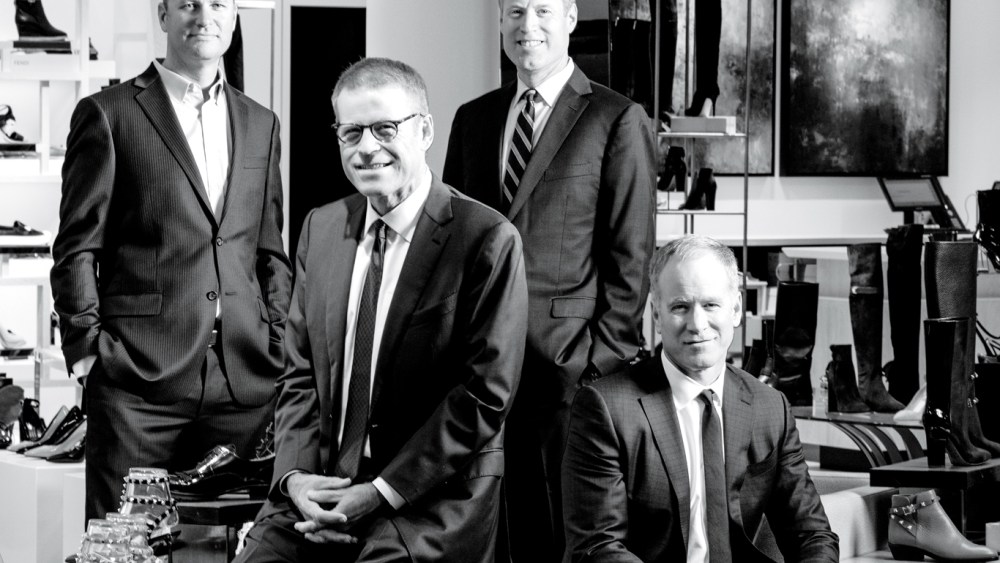
At the Sept. 18 opening of the Vancouver flagship, the three Nordstrom brothers — Blake, Pete and Erik — who share the title of copresident, as well as their cousin Jamie, executive vice president, president of stores, sat down for separate interviews in the store’s Bistro Verde restaurant and bar.
The brothers’ father, Bruce, is chairman emeritus, and the grandson of founder John W. Nordstrom, who at age 16 immigrated to the U.S. from Sweden with $5 and not knowing a single word of English. For five years, he labored in mines and logging camps until earning $13,000 from a stake in a gold mine in Alaska, and investing it in a store in Seattle with his friend Carl Wallin, called Wallin & Nordstrom. The shoe store evolved into a shoe chain that added apparel in the Sixties with the purchase of Best Apparel. A third generation of Nordstroms took over in 1968. The company went public in 1971. The first Rack opened in 1973 in Seattle. Nordstrom expanded to Alaska in 1975, California in 1978, and in 1988, the first East Coast store opened in Virginia.
The Nordstrom brothers were candid about the challenges ahead, like turning the Canadian operations profitable, opening a New York flagship, and the need to get greater productivity from the 120-unit full-line fleet that, like most department stores, has been flattish, last year slipping 0.5 percent. The Rack, on the other hand, rose 3.8 percent; nordstrom.com rose 23 percent, and the nordstromrack.com and HauteLook business was up 22 percent.
They also said the first two Nordstrom stores in Canada, opened over the past year in Calgary and Ottawa, are running ahead of plan; the Vancouver flagship will be a top-five volume generator; brick-and-mortar is here to stay; the company’s women’s business, which long lacked punch, has emerged as a top performer, and e-commerce and Rack hold great promise for growth.
“It is fair to say that there is a lot that we are working on and there is a lot we have been doing to lead up to this moment,” says Blake.
But their biggest challenge lies ahead — and it’s one that will make the usually low-key Nordstrom clan much more visible in one of the world’s most high-profile — and competitive — retail markets: Manhattan. The flagship is a costly gamble that, if it succeeds, will strengthen the retailer’s ties to New York’s designer community and definitively place Nordstrom on the same plane as Neiman’s (which is building its own flagship not that far away) and Saks. If it sputters, though, the blow to Nordstrom’s reputation would be significant.
Operating in New York will be complicated on several levels. For one, the 285,000-square-foot, seven-level site at 225 West 57th Street, at the base of what will be the world’s largest residential tower, will be Nordstrom’s most vertical unit (generally the stores are two or three levels), testing the team’s ability to come up with merchandise and attractions that drive shoppers to all levels. A 7,000-square-foot restaurant on the top floor will help. Then there is the question of vendors — brands with well-established businesses at rivals Saks, Bloomingdale’s and Macy’s might be reluctant to antagonize those retailers by selling to Nordstrom.
“We’re spending real money there,” Pete assures, reportedly to the tune of $300 million to own its portion of the site. “Our opportunity is not to do something completely different but to do what we do in the best way possible. If we could just do a version of [Vancouver] in New York, we’d be thrilled.”
A flagship in Manhattan was once hard to imagine. The prior generation of Nordstroms that led the business were turned off by the high costs, construction hassles and competition associated with New York. However, after the fourth generation assumed control in 2001, the search for a site began in earnest. They scoped out sites on Park Avenue, Lexington Avenue, Fifth Avenue, the East Side, West Side, uptown and downtown and came close on a few, including the former Drake Hotel on Park and 57th Street, 3 Columbus Circle in Midtown across from where Nordstrom now is slated to go, and Hudson Yards under development on the far West Side, where Neiman’s will go. Finally, two years ago at a press conference in Manhattan, the Nordstrom brothers revealed they selected a 57th Street location, Central Park Tower, being developed by the Extell Development Co.
“I was standing there and it struck me they were closing a chapter on their father’s playbook, which was to expand Nordstrom full-line stores across the United States. That was the big play,” says a source close to the Nordstroms. “Now here are these guys having to compete in a modern world, a different world that says growth is about the Rack, going international into Canada, and online. They were walking in their own footsteps, not in their father’s footsteps.”
Formerly regarding Manhattan as uninhabitable, now the Nordstroms won’t be satisfied with just one store in the borough. “It’s also easy to get excited about lower Manhattan,” says Pete. “We’re looking, but something opening downtown before 57th Street is highly unlikely. We don’t have anything downtown, but I wouldn’t dismiss it as a possibility.”
The three-level, 230,000-square-foot Vancouver flagship, says Pete, provides “a good foundation to work with for New York, but we will have new things and ideas we want to implement. That’s the fun part of retailing, the exciting stuff.”
While the store interior and aesthetics will change with the construction of a Manhattan flagship, “The biggest differentiator for us is our continued focus on servicing customers. That’s a main ingredient for any retailer, though we make it the front-and-center issue,” Pete says.
One famous service story the family likes to tell is of a customer who returned a tire to a Nordstrom location in Alaska, converted from a former outdoor equipment store called the Northern Commercial Company, and got a refund even though the clothier never sold automotive products. That might not happen today, and other retailers have been elevating their service to narrow the gap, though at Nordstrom, “It’s been our deal for a long time. That’s how we win,” says Jamie. “Some retailers compete on price, or promotion is their value proposition. We earn customers’ business and their loyalty by giving great service. I think we hire nice people and then we empower them. We put them in front of customers and say ‘do your best.’ An empowered person who understands empathy and common courtesy and respect for people, and is armed with tools and great merchandise, can be pretty good. Sometimes, it’s just about manners.”
The day before the Vancouver opening, Jamie addresses the team. “Rule number one: be nice,” he says. “Rule number two is refer to rule number one. Just be nice. Don’t overthink it.”
Jamie explains Nordstrom’s view as follows: “The way you earn customer loyalty is by building trust with them and trust goes both ways. We show customers we trust them with a liberal return policy. When a big company shows that they trust you, that makes a big impact on customers. If you come in with a tie and say, ‘I bought this tie last week and I think it doesn’t go with anything I own. It’s not for me. I’d like to return it,’ I can do one of two things. I can say, ‘Let me see the receipt.’ Give me your I.D., and put you through the whole police program like a lot of retailers have to do. Or you can say, ‘Sure, here is your money back. I trust you. I don’t need to see the receipt.’ When was the last time you felt trusted by your bank or an airline, or by your cable company? Never. We have an opportunity at Nordstrom to be a big company that shows that we trust you and when that happens, our company gets really small. Our company becomes the person that is standing in front of you. We’ve been doing that for a long time. We are at our best when we are acting like a small, independent retailer, and you only do that when you have empowered people so they can build trust with customers.”
Footwear is another hallmark, stemming from Nordstrom’s origins, while women’s apparel, up until the last few seasons, lacked punch. To correct the situation, designer offerings have been pumped up. “Between a quarter and a third of our stores have a real credible end-to-end designer offer,” says Pete, meaning the same designer labels appear across shoes, accessories, coats, dresses and ready-to-wear. “At least half of our stores have some element of designer.
“The whole idea of being in the designer business, based on scarcity [to create exclusivity and a strong appeal] doesn’t apply itself in all 120 stores. But our customers want the best stuff everywhere,” Pete adds. “We try to make sure the shoes and accessories and apparel work together.”
Topshop Topman, as well as Madewell, were added, in 2012 and 2015, respectively, and Olivia Kim, the former Opening Ceremony executive, joined Nordstrom in 2013 to bring further innovation to the offering. So far, she launched the Pop-In@Nordstrom series of pop-up shops and the Space in-store boutiques, both in select Nordstrom locations.
“Women’s apparel end-to-end — for us it’s been pretty darn good. It’s evolved over the years,” Pete says. “It’s been among our better-performing categories for the last couple of years. Our Topshop business helped elevate our whole younger side. The women’s designer business has been pretty darn good. Coats and dresses have grown. We really have to keep moving stuff and evolving all the time. In women’s, the way we lay it out, we [no longer] have all these hard separate departments that are clearly defined by architecture. It’s a much more flexible area that allows it to ebb and flow,” depending on which brands and categories are trending.
Topshop’s fast-fashion, inexpensive rock ’n’ roll image seems at odds with Nordstrom’s upscale, higher-quality aura, though not when one considers Nordstrom is seeking new audiences. “If you look at the breadth of range we sell, that [Topshop] product fits neatly within our whole expanse,” Pete says. “Topshop has not only attracted new customers, but our existing customers really like it. Topshop has great instincts around trend and fashion. It’s really the foundational brand for a younger part of our women’s business.”
In Canada, says Blake, Nordstrom has put its best foot forward. “You just can’t replicate what you are doing in the States and come across the border, and it was very clear and evident to us, talking to the customer here, that they wanted the best we had to offer. They didn’t want Nordstrom Lite.”
Nordstrom has been doubly sensitive to pricing. Other U.S. retailers entering Canada have been perceived as overpriced. “The Canadian customer is very savvy on that subject,” Blake says. “Literally, 80 percent of the Canadian population is within 100 miles of the U.S. border, so there is a very educated Canadian customer shopping across the border. However, the real issue is there are cost differences crossing the border. The challenge is each item has different duties, so they vary. Let’s say they are roughly 10 percent higher than in the U.S., but it varies. On the one hand, they recognize there are these duties or taxes, but on the flip side, they don’t want to pay more. I don’t blame them. So what we have said is we won’t be undersold in Canada. Yes, the prices are higher in Canada because of those duties, but we don’t want to be undersold by any other retailer just like we say in the U.S. Today, we haven’t had any negative feedback or pushback from customers with our pricing. It is higher than in the U.S., but we believe it is competitive in Canada.”
There are other concerns in Canada, including start-up costs. “That’s one of the reasons why we committed right out of the gate with six stores,” Blake says. “Our m.o. is to open one store and see how it does. If it gets a good reception, we open a second. We were very fortunate that after looking for a long time, Sears [Holdings Corp.] happened to be pulling back, and that Cadillac Fairview [the landlord] was able to get us five of our six locations that Sears had. To have six stores, in spite of these higher start-up costs, if we do it right, we should have the volume down the road. One store, with the costs behind it, doesn’t work. We are also adding Rack in fall of 2017, and over time we will add the e-commerce business,” in Canada. “So when you add that all up, Canada has the opportunity to be a billion-dollar business by 2020,” though, “It takes longer to get to profitability in Canada than it does with our U.S. model.”
With the opening of the Calgary store last year, and units in Ottawa and Vancouver this year, Nordstrom lost $32 million in its Canada subsidiary in 2014 and estimates a $60 million loss this year. Sales, says Blake, are ahead of plan, though he wouldn’t specify by how much. “The only minor thing with Ottawa is that it’s cold there in March and we had a lot of spring merchandise. So we were a little bit slower in that first month, but since then, it’s exceeded its plans and we’re really happy.”
With 120 full-line stores — far more than either Neiman’s, Saks or Bloomingdale’s — “there aren’t a lot more new stores on the docket,” Blake says, noting the three upcoming in Canada, a relocation in Los Angeles, moving the South Bay store to Del Amo; the Oct. 2 opening in the Ridgedale Mall in Minneapolis, and later in October a store in the Mayfair Mall in Milwaukee, plus Manhattan. Also in the works are a new Ala Moana store next year in Hawaii; new stores scheduled for The Domain in, Austin, Texas in 2016; two relocations in San Diego and Los Angeles in 2017 and new full-line stores in Norwalk, Conn., and Carlsbad, Calif. in 2018.
“If you think about the country, and where we don’t have [full-line] stores, maybe you could argue [we should] have one in downtown Boston. There are no opportunities. The second one maybe you could debate is lower Manhattan. That’s it. We think we are in, for the most part, the key locations around the country,” he says.
Full-line stores, industrywide, are running flat, and typically offset by burgeoning e-commerce and outlet divisions. Nordstrom’s full-line units have higher selling costs, are less promotional than others but generate higher margins. “Given health costs going up, wages, whatever, you can’t leverage the business on flat. You are going backwards,” Blake admits. “You have to have low single-digit comps to be able to leverage the business. We have said it’s two-plus. Our full-line business did $7.7 billion in business last year. It’s still the bulk of the business. It’s been relatively flat for the last couple of years, so what’s getting more attention and energy is e-commerce and off-price, which percentage-wise are growing faster. What makes that strategy work is having the best locations in the best centers. Bricks-and-mortar is not going away. We are working really hard to make sure we are making progress and gaining market share…We are investing a lot of money in bricks-and-mortar. We are not tapping out with what’s possible with productivity, but we are not necessarily on the same path of adding more stores,” unlike the rapidly expanding Rack chain.
“Maintaining and evolving the existing stores helps in the multichannel strategy we have,” so an HauteLook customer who bought some things online can return items to the Rack “and then we are able to sell her something else. It creates more foot traffic,” Blake says. “That’s good service.”
Asked if another store format was on the drawing boards, he says, “We have nothing up our sleeve. We think we have a full plate through 2020. So over time, I guess those are questions we will need to ask.”
In the past, “We were making a mistake of looking at two different channels and trying to manage each channel to their fullest potential; however, the stuff that happens between the channels is where the magic is,” says Jamie. “For example, we sell tons of unhemmed pants on our Web site. When pants arrive on someone’s doorstep, they can’t wear them, because they’re unhemmed. What were we doing about it? Nothing. But we are the largest employer of tailors in North America. We do pant-hemming for free in our stores. Here we were shipping all these unfinished pants through nordstrom.com and we weren’t even telling anyone about our tailors. Our customers were probably going down to their local dry cleaner, with a little neon sign saying, ‘we do pant hemming’ and having a crappy experience. Why didn’t we have a postcard in there telling them what we do, or better yet send an e-mail and say we will make it really easy for you and set up an appointment in the store. Maybe we will come to your house — whatever. We weren’t doing that because we were thinking about the business as two different channels.”
Last year, Jamie and Erik swapped jobs, with Jamie taking on stores, and Erik overseeing nordstrom.com. “I think I half-jokingly said to Erik, ‘Maybe you and I ought to switch jobs and that will send a message to everybody,’” says Jamie. “I don’t think he thought I was joking. We started talking about what we could do with our teams, how we can get those two distinct teams to be one focused on customer scenarios, as opposed to channel experiences.”
Every Monday morning at 8 a.m. in conference room 6H at the Seattle headquarters, the four Nordstroms and the rest of the 10-member executive committee sit around the table that was moved from the downtown Seattle flagship that relocated in 1998 to the former Frederick & Nelson site. Nordstrom is family-run — no one Nordstrom takes center stage, and the company is ruled by the executive committee.
“Make no mistake, all of the Nordstroms are very, very actively involved and they all have carved out their roles,” says a source close to the company. “Because they grew up in the business [and are major stockholders, with the brothers each directly owning in the vicinity of roughly two million shares], it means so much to them. There is no next generation. The three brothers work well together, with a very clear definition of responsibility. They have different personalities. They don’t necessarily hang out together, but they do know how to work together. They’re also smart enough to build an executive team with people they trust, from finance to legal. That executive team at the end of day runs the company. It’s not like the three mandate everything. The executive committee is all- powerful. It makes decisions about growth, opening new stores, expanding the Rack. They all weigh in. It’s not like there is Terry Lundgren or Burt Tansky setting the tone for the company.”
“We have a shared understanding of what success looks like,” says Jamie. “It’s a long-term view and not a four-to-seven-year view, which is how most companies look at it. We are making strategic decisions and investments to position this company for the next 50 years. We are not thinking of our tenure as leaders as anything significant in the company. The results are what matter. We believe we are on the same page. The thing that those guys and I share is that we are more interested in results than recognition. I know I feel that way. I know they do, too. The satisfaction of growing this business, with our family connection, is the ultimate satisfaction. This thing changes so fast. If you were sitting here three years ago and asked if Topshop would be in 100 of our stores, I would have said you are crazy, and so I think we have got to keep being curious. Keep an open mind. Keep asking questions of our customers and talking with people in the industry. When we were growing in the Eighties and in the Nineties, and going into new regions in southern California, the East Coast, the Midwest, we were the youthful alternative to a lot of those big iconic department stores that had been the foundations of those communities for a long time. We were the youthful alternative and that served us really, really well. We have got to make sure that we continue to be in that spirit, a youthful brand, and that’s hard to do. I think the minute you lose your focus on that, you are in trouble as a brand. You constantly have to be looking for that next hot brand. The next hot trend. The minute you stop, you’re dead.”
“We have common ambitions for the company,” says Erik. “We are competitive people. We have high standards, but we are different people. We come at things from different perspectives. The one thing all four of us appreciate is that none of us has all the answers. That we are better together. We appreciate each other’s point of view. We don’t have shared responsibilities. We all have our individual responsibilities. Not every decision is made by three or four people. It’s really our whole executive committee coming together. Nordstrom is a public company. This isn’t a family-owned business. It’s not about us. Our cio, our cfo — they’re not customer-facing people, but they talk about the customer all the time and they understand the customer. They understand the business and I think that helps.”
Are there more Nordstroms in the pipeline? “There is no family succession plan,” says Erik, who is 51, while Blake is 55, Pete is 53 and Jamie is 42, though he stresses succession is a priority. “One of the most important roles of the board is succession, so we have long ongoing discussions about succession. We are relatively young. We are not looking to head out to pasture anytime soon, but we absolutely have had long discussions with our board about succession. We have a very explicit process around all top positions to develop backfills for those roles and it’s our goal to have two viable candidates for any given position at any given time.
It’s about what’s best for the company. What’s best for the shareholders. It’s not about family at all.” ■