
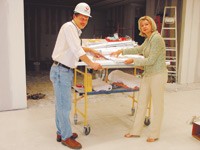
NEW ORLEANS — On a sweltering day after Hurricane Katrina one year ago, Wendy LeGardeur stuffed silk and taffeta eveningwear into her car, trying to salvage the merchandise from her boutique here.
New Orleans was in chaos. All that separated her store, Ballin’s, a fixture in the Uptown district for 25 years, from the Mississippi River was a grassy levee. “It was as if World War III had hit,” LeGardeur said.
Ballin’s, like New Orleans, managed to survive in a year that has been beyond challenging. Other businesses — restaurants, food markets and art galleries — have not been so lucky.
The apparel retailers that endured appear to have survived because of diminished competition, loyal customers who increasingly shop via the Internet, strategies such as geographical diversification, and being located in districts that were spared the most crippling damage.
Electricity, garbage collection and other municipal services have resumed sparingly as neighborhoods stagger back to life. Several of the hardest-hit areas are still mostly abandoned and filled with debris. The city, which had a pre-Katrina population of almost 500,000 and was not in the top 20 U.S. retail markets, now has an estimated 200,000 residents.
Recovery has been slowed by the unresolved details of programs such as a federal plan to compensate people whose homes have been destroyed, leaving many in limbo.
Still, Janet Speyrer, associate dean for research in the college of business at the University of New Orleans, pointed out that the metropolitan region, with 1.3 million people, not the city, was the economic driver before Katrina. Three-quarters of that population has returned and many people have cash from insurance reimbursements. Although 217,000 of 612,000 area jobs were lost after the storm, employment is growing at the rate of 5,000 jobs per month compared with 2,000 per year pre-Katrina and oil and gas and chemical manufacturing are strong, she said.
“It’s not that everything is rosy, but if a small retailer goes out, often another comes back in,” Speyrer said. “Many people had to buy all of their clothing again, all their furniture again. And people like buying things that make them feel good again…casinos are doing the best of all.”
Related Articles
You May Also Like
Although the obstacles are formidable and staying in New Orleans requires faith, fortitude and good fortune, there are nascent signs of retail life.
Much of the Shops at Canal Place, the 260,000-square-foot downtown shopping center, has reopened, including tenants such as Banana Republic, Williams-Sonoma and Pottery Barn. Fashion retailers like Kenneth Cole, Ann Taylor and Georgiou are aiming to open this fall. The anchor tenant, Saks Fifth Avenue, announced a relaunch for mid-November.
Of the six other major city and suburban shopping centers, only one, New Orleans Center, with Macy’s and Lord & Taylor, will be closed permanently. A proposal has been made to create a jazz park on the site of the center and the badly damaged Hyatt Hotel, near the Superdome. The stadium itself, which became notorious as the shelter of last resort, is readying for the return this season of the NFL’s Saints.
The Ritz-Carlton, one of New Orleans’ luxury hotels, is to open in November. And although tourism, the city’s lifeblood, is still a trickle, conventions such as the National Association of Realtors have been scheduled starting in the fall at the 3.1 million-square-foot convention center.
Many in the retail community said that after the initial shock of Katrina, they have been motivated by a seize-the-day kind of energy that has propelled their efforts to expand, either into new metropolitan markets or just across town.
“A life-altering event like Hurricane Katrina forces you to reevaluate and use the energy caused by one door slamming shut,” said LeGardeur, who also has stores in Lafayette and Baton Rouge, La. A new Ballin’s in Jackson, Miss., was opened by general manager Margie Case while she was living there during the post-Katrina evacuation last November. Another store in Mobile, Ala., is to bow in the fall.
“I’ve learned to definitely not put all [my] eggs in one basket,” said LeGardeur, who reported a 20 percent sales gain at her 4,000-square-foot Uptown store, featuring designers such as Marisa Baratelli, Chris Kole and Catherine Regehr.
Similarly, Hemline boutique owner Brigitte Holthausen, with two stores in New Orleans, one in Baton Rouge and units in Houston, Woodlands, Texas, and Kansas City, Mo., has plans to open stores in Lafayette, La., and San Diego. In reimagining her New Orleans retail game plan, Holthausen closed an 800-square-foot location on Magazine Street and moved a few blocks to a site twice as big.
Frock Candy, a 1,300-square-foot Magazine Street boutique owned by sisters Popi Nicopoulos and Dora Cullen, was devastated by roof damage and looters after Katrina, and the sisters initially didn’t plan to reopen. But presented with the opportunity to lease an 1,800-square-foot site three blocks away, the sisters couldn’t resist, and Frock Candy launched in mid-June.
“Like a lot of people, we took the chance to try to do something better, and along the way we’ve broadened our customer base — previously ranging from older teens to twentysomethings — to extend to the mid-30s,” Cullen said.
Among the best-selling items are funky T-Shirts by Heavy Rotation that start at $24, trendy dresses by Sooki for $40, and retro-inspired separates by Sound Girl starting at $36.
Magazine Street also represented an opportunity for Jenny Carr, who was eyeing locations there shortly after opening Snap in the New Orleans suburb of Metairie, La., in 2004. “Post- Katrina seemed like good timing — especially as some good locations became available on Magazine Street,” she said.
Her 1,200-square-foot boutique, which opened in May, is twice the size of her first store and positioned with a slightly younger demographic than the suburban location, Carr said. The suburban location’s sales have not been diluted, and volume for the past three months on Magazine Street has exceeded goals.
But the merchandise mix between the two boutiques takes some fine-tuning, Carr said. Some vendors do well at both Snap locations, including Marc Jacobs, ranging in price from $100 Ts to $500 jackets, and Ya-Ya’s $350 sweater coat. But the Uptown store on Magazine Street attracts a slightly more trend-conscious customer who gravitates toward vendors such as T-Bags and Single in the $150 to $300 price range. The more classic customer at the suburban store tends toward Trovata separates ranging from $80 to $350.
With the growth of the boutique environment on Magazine Street, Per Me owner Tara Rotonti said competition is beginning to stiffen after having lapsed for many months after the hurricane, when so few shops were open. Although logging high-double-digit percent increases compared with last year has helped, she finds herself seeking new resources to reduce a sense of oversaturation of popular vendors such as BCBG and Nicole Miller.
Like Rotonti, many retailers reported that sales were ahead of last year, but that is far from standard. Most merchants have acquired a kind of war-weary wisdom and attention to detail.
For Hemline’s Holthausen, an overall 10 percent drop in sales compared with last year was a relief, because she expected a 50 percent decline. To shore up business, she makes certain to rotate stock among the stores and keep close track of inventories. Among bestsellers are collections ranging from $100 to $500 from vendors like Sue Wong, Nanette Lepore and Diane von Furstenberg, as well as more moderate $50 to $100 ready-to-wear from Hype and Free People.
“Pre-Katrina, we would be doing so well, I wouldn’t necessarily pay attention to these things,” Holthausen said. “But it has taught me to be vigilant and to keep track of what might just be sitting on the shelf and move it to a place where it will sell. This has all been a big lesson.”
Another discipline is to pay vendors by credit card or c.o.d. despite offers to allow net 90 days. “I spent too many wakeful nights post-Katrina worrying about how the vendors would get paid,” she said. “If something were to happen again, at least I know I wouldn’t have to come back from such debt.”
Among the lessons learned is the need for flexibility and forging alliances that previously might not have been considered. In one case, Mimi’s, a high-end boutique featuring Vera Wang wedding dresses and Mardi Gras ball gowns, invited a neighboring retailer, Jean Therapy, to occupy a 1,000-square-foot corner of its 5,000-square-foot boutique when the jeans store was forced to close after a fire.
“I kind of hope they are here for a long time,” laughed owner Mimi Bowen. “The jeans and the dressy ready-to-wear play off one another. I think we drive each other’s sales. We have gained some customers because of their being in-house, and I think they have gained a few of ours.”
A retail marriage of jeans and tops ranging from $50 to $300 and custom designer gowns starting at $1,500 seems symbolic of retailing in the new New Orleans, a place where people have lost so much and have struggled mightily to regroup, Bowen said.
“Everyone is trying so hard, and the people who want to be here are here,” Hemline’s Holthausen said. “The naysayers are gone.”