
NEW YORK — Specialty stores’ open-to-buys might be holding steady, but at this month’s Moda Manhattan and FAME trade shows, buyers reported they are looking more before making decisions, waiting longer to place orders, and then only buying what they love — mimicking the behavior of their own shoppers.
If not ordering for immediate delivery, most buyers were scouting for fall, rather than holiday, at Moda and FAME on May 4 to 6 at the Jacob K. Javits Convention Center. Top-selling items were must-have novelty pieces that stood out in terms of color, shape or embellishment, and that didn’t break the bank.
Carolyn Billet, owner of Maple Street Clothing in New Orleans, shopped Moda and FAME for her two customer bases: “women and college students.” She was looking for early fall with a flat open-to-buy, and ordered novelty knits, boyfriend sweaters and jackets in purples, reds and charcoals at Moda.
Related Articles
“I’m being extremely selective because of the economy, so an item must be something I absolutely love, nothing on the cusp, for me to order it this season,” Billet said. “Fringe items will be trimmed, and I am sticking with manufacturers who have been tested.”
You May Also Like
Thomas George, owner of E Street Denim in Highland Park, Ill., said he “worked a lot harder” at this round of shows, making sure that he was finding the best merchandise for his stores with his flat open-to-buy. But he said he was disappointed by the lack of risk vendors were taking.
“I don’t think we’ve done a great job in our industry to make things exciting, and consumers are probably spending the same amount of money, but they are shifting out of our industry to travel, technology,” George said. “Retailers also have to take some risk, and unfortunately, I didn’t find enough out there that’s moving it forward — anything that was ‘oh my god.'”
Vendors reported strong traffic on Sunday, then a tapering off of visitors when Intermezzo opened. For example, sales were up 40 percent over last year for Don Hurowitz, the New England representative for better lines Maralyce Ferree Design, CTC and Ameeta, which all showed at Moda. He said buyers scoured his lines for “novelty, texture and color.”
“Buyers seem concerned, but they are here and they are buying,” Hurowitz said. “People say they are cutting back, but they don’t actually seem to be.”
New York-based knit resource Bask did well at Moda with standout silhouettes, from trapeze vests to ponchos to swing coats. “We’re selling more short sleeves and sleeveless than ever before, because of the emphasis on layering for fall,” said Bask president Jeff Scher.
Most buyers were ordering for fall or even immediate, rather than the holiday offerings many vendors were pushing. For New York-based Melly M, which wholesales from $68 to $180, 90 percent of orders at Moda were for immediate delivery, according to sales representative Laura Sullivan.
Buyers were not only holding back on spending, but also being careful with the price of items. At Kay Celine, a New York-based line that showed at Moda and wholesales for $45 to $94, “more tops are selling than dresses because they’re less expensive,” said representative Janette Richards. Top sellers all were novelty, featuring embellishments, metallics and prints.
“We’re selling all novelty and anything at a price,” echoed Seena Addeo, sales manager of New York-based David Brooks, which wholesales from $24 to $84.
Buyers parted with their money for novelty and color. For New York-based knit vendor WR 9000, which wholesales from $42 to $98, its biggest sellers at Moda were bright reds, purples and fuchsias, particularly novelty pieces that include fur. But still, according to sales representative Rosanna Balsamo, sales were slow and rarely extended past August.
At FAME, Los Angeles-based young contemporary line Bizz, which wholesales from $25 to $60, was “swamped” with traffic and orders, according to senior sales representative Amy Kim. “The key is a simple body with detailing that sets the item apart,” said Kim.
FAME is now three-quarters young contemporary and junior exhibitors, of the nearly 400 vendors at the show, with the intention of forming a more focused destination for buyers.
Pura Vida, a junior line based in Wooster, Ohio, has been doing FAME since the show started, according to president Raj Arora. He said most people were writing orders, particularly for pattern dresses, “mostly for fall but some immediates.”
Ninety percent of junior line Luv2Luv’s orders were for immediate shipment, according to president Manish Khanna. “Customers are very skeptical about how summer will play out, and they are being very cautious,” Khanna said. The Plainview, N.Y.-based vendor did well with floral and butterfly prints.
“This is not a time to buy,” said Juno Chang, president and ceo of junior line Juno. “Traffic is slow.”
Both shows moved to the upper level of Javits, which allowed them to grow 4.5 percent in square footage as well as in the number of vendors, to about 1,000 between Moda and FAME, according to Britton Jones, president and ceo of Business Journals Inc., which owns the shows. Buyer attendance was flat compared with last May, but Jones said he thought smaller stores that have been hit particularly hard by the recession weeded themselves out, and the retailers that remained “had money to spend.”
“It’s pretty easy to run a great show in a hot market; it’s a little more difficult to run a great show in a more difficult market, and that’s what we just pulled off,” said Jones. “Stores went through a rough period, but saw a rebound in April, and they realize that the best way to improve sales is bring in exciting trends, which they saw at the shows.”
Meanwhile, at the Atelier Designers trade show, which ended its three-day run at the Doubletree Guest Suites in Times Square on May 6, much of the talk centered around the uncertain economy and the ongoing rise in gas prices and the impact on consumer spending.
Trends at the show ranged from a variety of artisanal touches, such as mixing bohemian prints to item-driven collections, with a particular focus on outerwear and blouses.
The Chicago-based Jermikko label was a first-time exhibitor at the show with a focus on statement-making novelty coats and eveningwear. Designer Jermikko Johnson said she was pleased with the traffic. “A couple of people said they would have bought more, but the economy isn’t as strong,” Johnson said. “The point is, they bought.”
Among Jermikko’s bestsellers was a boiled wool blue coat for $418 wholesale, and a brown plush wool coat for $518. Overall, Jermikko’s wholesale price points range from $300 to $798.
Brooklyn-based Ohm Studio designers Julie and Tom Diller were also new to the show, bringing an artsy touch with their handmade collection of almost hippie luxe garments. Bestsellers at the show included a tulle-over-wool quilted jacket for $158 wholesale.
“We have been steadily busy,” said Julie Diller. “At least for us, people aren’t really talking so much about the economy. They said January and February were scary, but it has picked up since then.”
Tom Diller added, “Items are more important than outfits.”
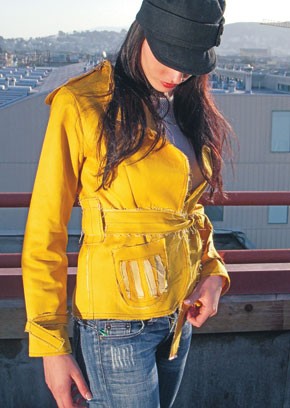
Lola Herrera, designer of Lola of San Francisco, offered a younger, quirkier, downtown aesthetic, with cool yellow denim coats, jackets with front-snap detailing and materials such as cotton twill for coats. Bestsellers included a raspberry herringbone coat at $139 wholesale and an Italian denim coat for $175, as well as hemp denim skirts with hand-pieced silk fragments, for $150 wholesale. Susan Summa, who produces Atelier, said she went into this edition of the show with uncertainty.
“We had no idea what to expect after the February show, with the split market,” Summa said. “The economic news has not been good, but many buyers reported that business has picked up in April.”
As for trends, she noted a move toward items. “So many of the buyers come in and ask me about great shirt lines,” Summa said.