
NEW YORK — In the late Nineties, a handful of maternity designers revolutionized an industry by making fashionable, even sexy, clothes for moms-to-be who didn’t want to shed their style simply because of their change in status.
Until now, though, those stylish moms had little reading matter targeted specifically to them.
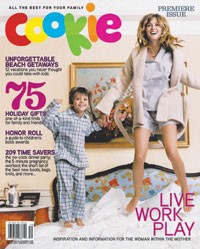
Enter Cookie, a new magazine hitting newsstands Nov. 15, aimed at the sophisticated mother who doesn’t want to give up her Christian Louboutin sandals and exotic vacations because she has a kid — or even two or three.
“It’s permission for moms to retain their lifestyle and sense of adventure,” said Pilar Guzman, the magazine’s editor in chief, who has a two-year-old son named Henry.
Covering travel, health, fashion, beauty, food and home, Cookie, according to its creators, is an entirely new take on a category filled with broad, seven-figure circulation books like Parenting, Parents and Child.
“Those magazines do a great job, but a particular reader was underserved in this market,” said Guzman. “The people who read Condé Nast books, where do they go for their parenting needs?”
Indeed. Incubated within Condé Nast Publications’ Fairchild division, Cookie, a sister publication to WWD, has been described by some who’ve seen it as “Vogue for mommies.” The photography is lush, the layouts modern and clean. In fact, the only design cue that suggests kids is the rainbow-colored, bubble-lettered logo on the cover.
“It’s a nice foil for the rest of the look of the magazine,” Guzman explained.
A digest section in the front of the book, “Smart Cookie,” opens with a short piece on a woman fitting that description. (In the launch issue, it’s Lucy Sykes.) A story on the modern mommy tote — “Wonder Bags” — shows day and night options, from Balenciaga to Kate Spade. A fashion shoot has girls dressing up in their mother’s accessories. There are exotic and domestic family vacation destinations in a range of price points; meals that celebrity chefs eat with their own kids; an entertaining feature for a first birthday party, and health stories debunking myths about colds and breast-feeding.
Related Articles
You May Also Like
“I just think people get overly cautious, overly precious, overly anxious with their kids. And I think that ends up having a negative effect, even in utero,” said Guzman, who described the voice of the magazine as “your most well-informed friend, who is also the least judgmental.”
Cookie launches with an initial rate base of 300,000 and plans to publish six times in 2006.
While its ad page count in the debut (92.5) isn’t quite as robust as the two most recent Condé Nast launches — Men’s Vogue’s first issue had 164 pages and Domino had 106 — Cookie’s publisher, Eva Dillon, said it was unfair to make that comparison, considering the new ground Cookie had to break and the fact that it was a fourth-quarter launch. (Many potential advertisers didn’t include it in their budgets since pages didn’t begin selling until April.)
“In a magazine that is completely new to a category, 92 pages is a smash hit, frankly,” Dillon said.
The first issue, she pointed out, drew a number of new advertisers to the parenting genre, including Burberry, Lexus, Land Rover, David Yurman, Sea Island, Bedat and Neiman Marcus. It also brought new advertisers to Condé Nast, such as Bugaboo, Nestlé Good Start formula, Aaron Basha jewelry, Catimini apparel, Nest bedding and Oeuf furniture.
Dillon said, so far, response for 2006 has been overwhelmingly positive, and, according to Guzman, reader reaction during focus group testing has brought more of the same — even among women outside the target demographic.
“These were not all fancy ladies,” she said of the participants. “I would brace myself thinking some of them wouldn’t get it, that we were going to get clobbered. But they loved it.
“That’s the thing about parenting,” Guzman added. “It’s the great equalizer. Everyone wants the best for their kids.”