
Play ball! Hike! Start your engines!
No matter what phrase one uses, men’s wear companies are playing a new game as they increasingly look to complex sports partnerships to drive sales and build brands.
In the past six months, major nonathletic apparel brands have unveiled far-reaching, and at times surprising, deals with professional sports teams and their players. Izod doubled down on its extensive integrated partnership with Indy Car racing; JA Apparel Corp. and its Joseph Abboud brand inked a deal with the New York Giants, and both Canali and Emporio Armani tapped major sports stars as the faces of their respective spring campaigns.
While the terms and goals of these deals vary, they are all based on a provocative assumption: sports is a more effective, credible and even more cost effective way to reach male consumers than traditional fashion marketing — even if your brand has nothing to do with athletics.
Related Articles
“I have never heard a man say, ‘I’m a huge fan of George Clooney,’ or ‘I love that male model,’ assuming they can even name one,” said Larry DeGaris, director of the Academic Sports Marketing Program at the University of Indianapolis. “I hear men say ‘I’m a Yankee fan.’ Apparel brands are using these sports to tap into a deeper level of passion within the male consumer.”
You May Also Like
The power of sports endorsements to raise awareness and activate sales has been well documented. A study from Brand Affinity Technologies last year found that online ads featuring athletes increased brand awareness 180 percent compared with those with no athletes. In the same year, a survey by Sponsorship Research & Strategy found that 37 percent of NASCAR fans were more likely to buy Wrangler jeans because of its sponsorship of driver Dale Earnhardt Jr. Announcements of major endorsement deals can even boost a company’s stock price, like when Nike Inc. landed LeBron James in 2003. That day the sneaker-maker’s stock rose nearly 1 percent.
Such results have been a boon to sports sponsorships. Though the total value of sponsorship deals fell in 2009, that industry’s trade publication, IEG, forecasts in its annual report that sponsorship spending of all stripes in North America will rise 3.4 percent this year to $17.08 billion. Sports endorsements, which account for the lion’s share of the market, are projected to jump 2.8 percent to $11.6 billion. The annual report does not break out what the apparel sector will spend on sponsorships.
But while sports marketing has proven to be an effective vehicle for mass-level products like Wrangler jeans, could it also be a meaningful strategy for luxury brands, or even underwear?
Canali made a surprising move this spring when the apparel brand tapped Yankees pitcher Mariano Rivera as the face of the current ad campaign. For a brand whose past marketing efforts have focused on sartorial elegance and its Made-in-Italy pedigree, the choice was an unusual one, and posed the question whether a sports figure — even a well-dressed one — could sell suits.
The jury is still out, but initial response is positive, according to the company, which has traditionally used models in its advertising. Consumer reaction has prompted the firm to consider both rolling out the campaign to countries besides the U.S. and possibly renewing Rivera’s contract for the upcoming fall campaign.
“From a brand perspective, it puts on a macho edge, which gives it a much broader appeal,” said DeGaris of the Canali print campaign, which has run in Vanity Fair, The Wall Street Journal and New York Magazine, among others.
Elisabetta Canali, the brand’s global communications director, said the campaign was not about butching up the advertising, “Americanizing” it, or even reaching out to sports fans. “[Rivera] has been a Canali customer for years and we saw in him the same level of passion and positivity that we bring to clothes,” she explained. “We thought also that using an athlete would be new and would drive attention to our brand.”
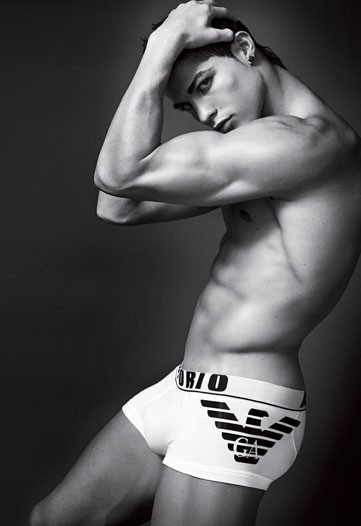
Experts said that it’s not necessarily about the proximity of the product to the athlete (say a sneaker deal for a football star) that makes an endorsement successful, but the ability for that athlete to convey aspects of the brand, as in the muscular eroticism that soccer player Cristiano Ronaldo brings to the Emporio Armani underwear ads, in which he is currently featured. Ronaldo is the second soccer star to appear in the brand’s ads; David Beckham also served as the face (and body) of the brand.
“There has to be a reason for the relationship beyond the individual’s success in a sport,” said Peter Levy, senior vice president and managing director of IMG Fashion Worldwide, whose sterling sports division manages the likes of Indianapolis Colts quarterback Peyton Manning and snowboarder Shaun White. “The athlete should inspire. He should tell a story that uses the assets his personality delivers. It’s how you use them.”
But sports figures are not a panacea for men’s brands, according to Jason Kanner, men’s director at Major Model Management, who said modeling professionals know how to sell clothes and provide aspiration for brands much better than athletes, especially for luxury and designer brands. “I remember years and years ago when [Yankees catcher] Jorge Posada modeled for Wilke Rodriguez; it didn’t work then. I get superstar athletes selling soda pop, watches and cars, but leave the high fashion model work to actual models who can interpret the designer’s vision more cohesively,” said Kanner.
But men’s brands are also doing more than merely linking up with sports personalities — be they good models, or not. Some companies are investing in whole teams, arenas and even entire leagues to increase their visibility and credibility within a certain fan base.
“What’s new in this market is the pervasiveness and sophistication of these campaigns as nonsports brands look to sports to tap sizable, hard-to-reach audiences,” said DeGaris.
Last week, JA Apparel unveiled a multimillion-dollar deal between its Joseph Abboud brand and the New York Giants, which grants the company display advertising during games, a suite for corporate events, rights to use the stadium, and access to the coaches, players and a database of 160,000 fans.
“The more traditional way would be to hire an athlete for advertising, but we didn’t want to do that,” said Marty Staff, chief executive officer and president of JA, whose tie-up with the Giants is the latest partnership between the brand and professional sports. JA also has promotional deals with the National Basketball Association and coaches in the National Football League. “This is a new way to communicate with our consumers. They are so spoken to that a lot goes out the window. You have to find new ways to reach them — be it direct mail or targeted marketing — and sell them in an intense way.”
Staff added that by supporting a team and a facility as opposed to a personality, a company spreads out the risk. “Athletes can be polarizing,” he said.
A bit of an understatement when one considers the recent example of Tiger Woods, whose much-publicized infidelity became a gaffe for his sponsors — including Gatorade, Accenture and Gillette, all of whom dropped Woods as a spokesman once the allegations came to light. His highly public fall has become a parable for the risks of athlete endorsement.
“It’s a risk you take,” said Mike Kelly, executive vice president for Phillips-Van Heusen Corp., who has managed the company’s first major push into sports marketing, notably Izod’s purchase of the naming rights to the New Jersey Nets arena in 2008 and a multifaceted agreement with the Indy Racing League. “You need to have escape clauses built in. Partners don’t always perform for you,” said Kelly.
“Are we happy with the Nets’ record? Not exactly,” Kelly admitted of a team that has the worst record in the NBA this season. “But even though they are moving to Brooklyn in 2012, we will still keep a relationship going.”
Izod is planning to open a retail space in the Nets’ new arena and will maintain the rights to the Izod Center in New Jersey, which will continue to house entertainment and music events after the team moves.
But PVH said the success of the Izod and Indy Car tie-up has more than outweighed any disappointment with the Nets. After becoming the official apparel sponsor of the Indy Racing League and the Indianapolis Motor Speedway in early 2009 in a multimillion-dollar deal that included signing racer Ryan Hunter-Reay, who also appears in the brand’s advertisements, Izod this past November signed a new, six-year deal as the title sponsor for the renamed Izod IndyCar Series. “The partnership has been so good for us we wanted to do more,” Kelly said.
Since the partnership began, Izod has seen strong sales at Macy’s, its main retail partner for a special line of IndyCar apparel, increased market share for its main collection and media impressions three times greater than any previous year.
“And these are sticky impressions,” Kelly explained. “These are fans reading and commenting on blogs and Web sites with real impactful dialogue. We hear from this fan base. They like us because we support something they love. It’s much more informative and involved than a static print product.”
Izod isn’t the only men’s apparel brand getting into cars. Formula One now names Hugo Boss, Hackett and Gieves & Hawkes among the sponsors looking to tap that sports’ huge global fan base.
While Izod continues to produce seasonal ad campaigns for fashion books, Kelly said sports marketing has opened a means of communication that is more effective for male consumers. “When we spoke to men, they told us they care about sex, sports, sex and then their community. Fashion is just not up there as something that drives men. So while we’ve had this paradigm of fashion advertising for decades, maybe it’s not the best way to talk to these consumers. This idea of aspiration — it’s not connecting for them. It’s much easier to go to Iceland and shoot fashion, but the [Indy Car program] works on multiple layers and across multiple disciplines at the same time.”
The experience with Indy has prompted PVH to look at sports for marketing its other brands including Arrow and Van Heusen. Kelly said Izod is also planning to get involved with another sport in a deal that could be unveiled within the month.
Aside from raising awareness and building positive brand associations, companies are looking to sports teams and facilities as retail outlets.
“We see Giants Stadium as one big pop-up shop,” said Staff of the Joseph Abboud partnership, which will give his brand the ability to access Giants fans through direct mail. The company will also be selling its suits and sportswear directly to players and staff as well as establishing offers to the customers of the Giants’ other sponsors, which include Continental Airlines and American Express. “If 3 percent of fans buy an item from us, this deal will pay for itself,” said Staff, who added that other NFL teams, such as the New England Patriots and Dallas Cowboys, have contacted the brand in the hopes of replicating the Giants partnership. “If we figure out the economics of this we could take this on the road. It could be a new retail avenue for us,” he said.
Companies say the exposure from sports marketing is cost effective as well. Joseph Abboud dressed the Super Bowl announcers this past year and the company’s name was broadcast for a total of 1 minute during the pre- and post-game shows, garnering about a million ads.
Weatherproof Garment Co. has continued with its sponsorship of Yankee Stadium for similar reasons. This season the coat maker will again sponsor the facility’s infield tarp cover.
“Every time they hit a foul ball off third base we get on TV,” said company ceo Eliot Peyser. “We couldn’t afford that kind of exposure through advertising. And in baseball there are a lot of foul balls.”