
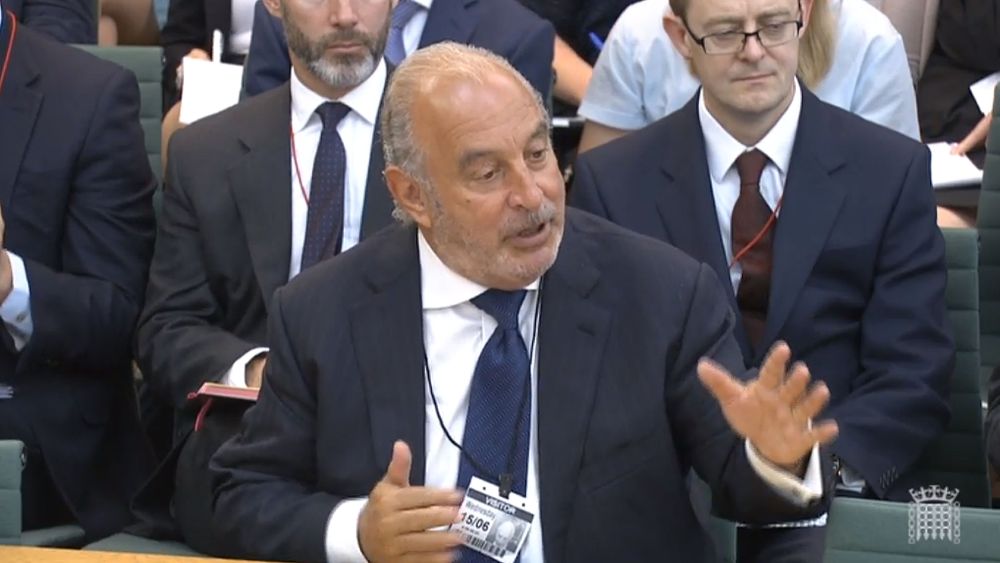
LONDON — During a much-anticipated grilling in Parliament on Wednesday, Sir Philip Green apologized publicly for the BHS fiasco, admitted that he sold the ailing retailer to the wrong person, and stressed — multiple times — that he was working to fill the BHS pension gap.
“Nothing is more sad than how this has ended,” said Green, who sold the BHS business last year for 1 pound, or $1.50, to a consortium led by a twice-bankrupt former race car driver.
BHS, which has 164 stores across the U.K., collapsed in April and is now being wound down by administrators with up to 11,000 jobs lost. It was the U.K.’s biggest retail failure since the Woolworths chain shut in 2008.
Related Articles
“I spent 15 years — a third of my professional career — at BHS and, if anything, I had too strong an emotional tie to it. I apologize to all of the BHS people and hope to find a sensible solution” to the pension fund, Green told a joint parliamentary committee at Portcullis House in Westminster.
You May Also Like
The committee is co-chaired by Labour MPs Frank Field of the House of Commons Work and Pensions Committee and Iain Wright of the Business, Innovation and Skills Committee.
Wednesday marked the first time Green has spoken at length and in public about the failure of BHS, the mass-market general merchandise retailer he purchased in 2000. He also answered questions about the BHS pension fund gap, which swelled to 571 million pounds, or $822 million, under his watch.
The Monte Carlo-based billionaire, a born-and-bred Londoner who also owns Topshop’s parent Arcadia Group, kept his cool while answering questions. But he took some pleasure in needling the parliamentarians on the committee.
Dressed in a dark suit, white shirt and deep purple tie, his glasses planted halfway down his nose, Green interrupted his testimony to tell one member of the committee: “Would you mind not staring at me like that all the time? It’s making me uncomfortable.”
He told another member to “put your glasses back on, you look better.” He offered a puzzled response to one MP’s query, asking: “Are we in the same room?” and told another: “I don’t like the way you’re asking me the question.”
During the grilling, he told the Conservative MP Richard Fuller: “Richard, you’ll get your moment — relax.”
At one point Wright, who chaired the second part of the six-hour session, told Green it was clear he had a dominant personality “but you’re surprisingly thin-skinned when responding to polite questions.”
Green was also self-critical — and said he didn’t want to park blame for the failure of the business or the pension fund problem — with anyone inside or outside his retail empire.
With regard to the fund, which fell into deficit the first time in 2005, Green admitted he had minimal contact with the fund’s trustees over the years and was confident they, and the various outside advisers he paid, were making sure it ran smoothly. Indeed, it was only in 2012 that Green began talking about plugging the gap — but the plan, devised with help from Deloitte, did not come to fruition.
“There have been stupid, idiotic mistakes made, poor communication on both sides, and very, very, very few conversations with the pension fund trustees,” Green admitted.
He said “unfortunately, no one brought the pension issue to my table” until it was too late. “I am happy to be accountable, but clearly someone was asleep at the wheel,” he said.
Green also admitted that he took his eye off BHS after buying Arcadia in 2002. “My time got split, and it’s not easy to find great people to run businesses,” he said.
Not surprisingly, Arcadia proved a seductive business, due chiefly to the pulsing, trend-setting Topshop chain. Green did splashy capsule collections with Kate Moss and Kendall and Kylie Jenner. Earlier in April — weeks before BHS’s collapse — he unveiled Ivy Park, an ath-leisure joint venture with Beyoncé.
Via Topshop Unique, the retail tycoon also tapped into emerging London talent via collaborations with brands such as J.W. Anderson, Marques’Almeida and Meadham Kirchhoff.
As Green was managing the glamorous Topshop business, he also was grappling with the BHS property portfolio, which proved challenging.
“There were some very poor property deals done — 30- to 40-year leases — and structurally the business was not in good shape. The stores were going to be very, very expensive to modernize, and the economics in the marketplace were not right for doing so,” he said.
Over the years, Green said Arcadia invested 800 million pounds, or $1.13 billion, in BHS and he admitted that by 2014 it was time to think about moving on.
Green also suggested that — with hindsight — he would never have taken out 423 million pounds, or $600 million, in dividends in the years immediately following his purchase of the then-profitable BHS, had he known the trajectory the company would take in an increasingly difficult retail environment.
“We let it run too long, and had put a lot of money into it already, and it was time to move on.” He told one MP, “If retail was easy, everyone would be doing it. In this business, you get good years and bad years.”
MPs later cross-examined Green about the man he did eventually sell the business to, Dominic Chappell, a bankrupt with zero experience in retail. As reported last week, the committee’s investigation turned nasty, with Chappell accusing Green of nixing an 11th-hour rescue deal by Sports Direct owner Mike Ashley. During their testimony that same day, former BHS executives accused Chappell of being a fantasist and a thief who tried to steal money from the business shortly before it filed for administration in April.
“Unfortunately we found the wrong guy. I am sorry we did the deal and I would not do it again,” said Green, adding that Chappell seemed a legitimate buyer, with prestigious accountancy and legal teams working for him.
Green argued that Chappell and his advisers were “fully aware of the pension liability” in response to a series of questions suggesting that Green sought to conceal the pension hole from prospective buyers.
He said he also did everything to find a buyer for the business — rather than file for Chapter 11-style protection. “I didn’t want to go through a pre-pack process, and I believe if the business plan had been followed, BHS would not have gone out of business.”
Green added that if he wanted to be ruthless, he would have simply filed for Chapter 11 himself. “I tried not to let that happen, but maybe I should have put it through the ‘process’ and resurrected it.”
With regard to the pension gap, Green has come under mounting pressure from parliamentarians and industry peers to solve the problem. On Wednesday he told MPs that he is actively working on it.
“I have never run away from looking into solutions to the pension fund. I am prepared to sort this out, and find a solution for the 20,000 BHS pensioners. The problem is resolvable, and I am here to sort it out. There does seem to be a light at the end of the tunnel,” he said.
The pension is now in the hands of the Pension Protection Fund, an industry-backed safety net. Pensioners will get a fraction of the money that they would have from a properly funded BHS. It remains unclear how gravely impacted the PPF will be if it is indeed forced to foot the whole BHS pension bill.
MPs have already heard from a variety of people in their investigation, including Ian Grabiner, chief executive officer of Arcadia; Paul Budge, Arcadia’s finance director; Gillian Hague, Arcadia’s financial controller, and Chris Harris, the retailer’s property director.
The point of these parliamentary investigations, which are open to the public and available to watch online, is to hold individuals accountable for their actions and to gather evidence that lawmakers believe is in the public interest. After wrapping up their investigation, parliamentarians will file a full report that lawmakers can use as points of debate and which other individuals and organizations — such as HMRC, the U.K. tax office — can study.
One member of the committee, speaking on background to WWD, said there was no basis for any eventual criminal proceedings in the BHS case.
The joint parliamentary investigation is one of five probes into the sale and management of BHS by bodies including the pensions regulator and the U.K.’s Serious Fraud Office, the government body that investigates and prosecutes serious and complex fraud, bribery and corruption. The latter is in its very early stages.
While Green believes BHS could have been saved under new owners, it would have taken an Olympian effort. Burdened by large-scale brick-and-mortar stores in an increasingly omnichannel world, and under pressure from cut-price competitors such as Primark, BHS needed strong leadership, robust funding and a host of new strategies. Following its collapse into administration, the team at the retail consultancy Retail Remedy said “as nostalgic as any of us might feel towards the brand, BHS needed customers that were shopping elsewhere. BHS lost relevance and the consequences are now apparent.”