
Has China peaked as a textile and apparel manufacturing giant?
Industry buyers and sellers within China fear for the future of the business, saying that profit margins have all but disappeared. They said it has become clear that central government policy is not likely to change in favor of promoting more textile and apparel manufacturing.
“Current economic policy is focused around high-end production and high-tech goods, offering incentives to companies that engage in these businesses,” said Li Fuyang, a textiles industry analyst. “There is little attention paid to lower-end manufacturing like basic clothing and textiles without added value.”
Related Articles
With rising costs for personnel and raw materials across China, and pressure to keep costs low for buyers, factories have been shutting down in quick succession across the Pearl River Delta and other manufacturing zones. There has been a reinvigorated effort to push factories into the poorer, less developed Chinese interior and western regions. Though some factories have moved, experts say the higher cost of transporting finished goods from China’s landlocked interior basically negates what amounts to only 5 to 7 percent savings in overall production costs.
You May Also Like
“The industry might die in 10 years if there’s no good policy coming up from government,” said Shi Jiajun of the Shanghai office of Li & Fung, the Hong Kong-based global trading company.
Rick Helfenbein, president of Luen Thai USA, said that while he believes China will maintain its position as the number-one apparel supplier to the U.S., his company has changed its sourcing strategy and “redirected some of its business out of China” to other countries.
“If you look at it from our perspective as a direct manufacturer, we’re seeing changes and have been restructuring our portfolio, but we haven’t decreased our China production,” Helfenbein said. “We have increased our alternatives [sourcing countries] for our customers that want alternatives.”
When it comes to the steady trickle away from China as the world’s textile and apparel manufacturing center, the Asian country’s loss appears to be everybody’s gain. Industry experts say the production business that is leaving China is ending up in a large number of other countries and regions, from Vietnam to the Western Hemisphere.
China’s impressive infrastructure and logistics platform continue to make it a key destination for most major buyers, but it has lost apparel import market share in the U.S. in the last 12 months, falling to 40.8 percent for the year ending July 31 from 41.9 percent in the year-earlier period, according to the Commerce Department’s Office of Textiles & Apparel. In July, combined shipments fell 7.6 percent to 2.4 billion square meter equivalents, as apparel imports fell 3.2 percent to 1 billion SME and textile imports declined 10.5 percent to 1.3 billion SME.
“That is an astronomical number,” Julia Hughes, president of the U.S. Association of Importers of Textiles & Apparel, said of the import share decline. “It could represent a substantial increase for other countries,” such as Vietnam, Bangladesh and Indonesia. “There are definitely shifts away from China.”
Luen Thai is sourcing more in the Philippines, where it has had a presence for more than two decades, as well as Indonesia, Helfenbein said.
“The Philippines is an excellent environment to work in,” he said. “The peso is stable and worker-retention rate is high, around 90 percent, which is a big deal for us, because we use skilled labor. We are also going into Indonesia and expanding there. Everybody should have backup plans. Costs will continue to rise in China. The cost of labor will continue to go up, but what you have in China that you don’t have elsewhere is enormous flexibility and skill level.”

The Western Hemisphere is also benefiting from sourcing shifts out of China and Asia, as companies try to offset the rising labor and raw materials costs by making apparel closer to home. While China lost apparel import share, other countries have gained share in the past 12 months. (See box.)
Combined apparel and textile shipments from Vietnam rose 6.6 percent to 267 million SME in July compared with a year earlier, as apparel imports increased 0.9 percent to 167 million SME and textile shipments were up 17.7 percent to 100 million SME. Still, China’s overall apparel and textile import volume to the U.S. dwarfs that of Vietnam, the second-largest supplier. For the year ending July 31, China’s combined import volume was 25.8 billion SME, while Vietnam’s was 3.1 billion SME.
Kevin Burke, president and chief executive officer of the American Apparel & Footwear Association, said he sees some business coming back to the Western Hemisphere, especially the countries involved with the Central American Free Trade Agreement — the Dominican Republic, El Salvador, Honduras, Guatemala, Costa Rica and Nicaragua — to take advantage of the duty free imports to the U.S.
“It’s taken awhile,” since the pact was enacted in 2005, said Burke. “It’s a vital area of the world to produce product. Companies are trying to shorten the supply chain and reduce time in the supply chain. If you have the choice of making a garment in Central America and making it in China and being able to get the same price, with 11 days less on the water, plus distribution time on the West Coast, you might want to look at that as a viable alternative.”
Burke noted that the region is known for producing basic merchandise, with companies such as VF Corp., Hanesbrands, Levi Strauss & Co. and other denim firms doing significant sourcing in the region, as well as a renewed interest in Mexico, which has enjoyed duty free import status since passage of the North American Free Trade Agreement in 1994.
There’s also been revived interest is making goods in the U.S., particularly high-quality knits. So far the desire hasn’t translated into a real movement, but there are bits of data, such as 1,100 more apparel workers hired in August, and much anecdotal evidence of at least a fractional rebound in domestic textile and apparel manufacturing. Established domestic knitters such as Fessler USA, Buhler Quality Yarns and Huntingdon Yarn Mill Inc. have reported increased orders and interest in future business from retailers and brands.
Michael Lakritz, product development and merchandise manager for Los Angeles-based Laguna Fabrics, and president of its Enviro fabrics division, said, “There are more retailers and brands looking for U.S. consumption because they feel they can’t produce overseas effectively anymore.”
Lakritz said as a domestic converter of basic and novelty knits, Laguna has the ability “to turn relatively fast, which plays into what’s happening right now in the market.”
“We can turn from lab dips and approvals in three to four weeks compared to six, eight, 10 weeks overseas,” he said “Pricing has always been an issue. But retailers are helping us with domestic business because they’re placing orders so close to the season. We do a lot of private label for stores such as Nordstrom to Forever 21. Nordstrom is placing more business onshore with private label manufacturers, and I think that’s going to continue. They’re in the fashion business. If you wait 12 weeks for the cycle, you’re missing the trends.”
Laguna specializes in developing novelty and innovative fabrics for the contemporary market. The company knits and finishes all of its fabrics locally, ranging from large program orders to single fabric lots. Laguna specializes in Lenzing branded fibers, including various blends of Modal, Tencel and Promodal, as well as bamboo, hemp, organic cotton, rayon viscose, Lurex and wool blends.
“Since we’re one of the largest converters onshore for novelty knits, our business has been up,” he said.
As for the revival of U.S. manufacturing overall, Lakritz said, “There’s no question it’s coming. The biggest problem right now is that even if manufacturers are willing to pay the price, they’re finding it difficult to find the needle, the cut-and-sew factories. There’s just not enough production capability. We’re talking about a 1.5 to 3 percent production shift back to the U.S., which may not seem like a lot, but after all these years, it’s significant. The desire is there, the orders are there, but the production is not, but it will come. For now, those brands looking to bring production closer to home are going to places like Guatemala, Honduras and even Mexico.”
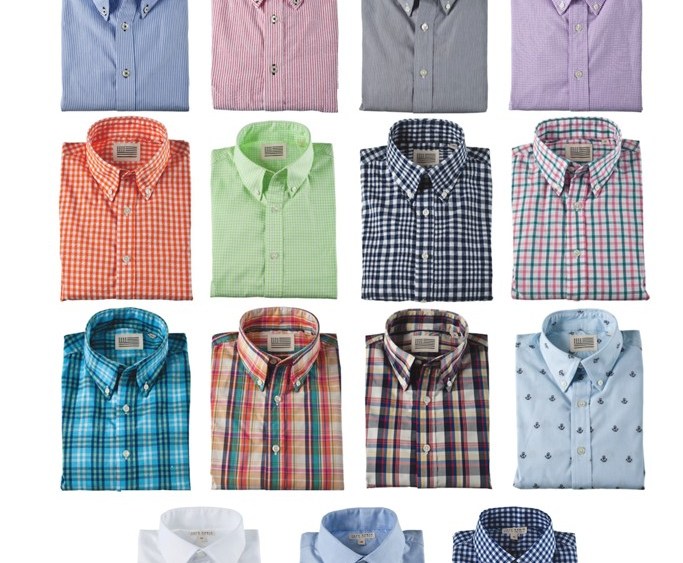
Jon Terbell, president of Jack Robie, a direct merchant of better men’s shirts sold exclusively on its Web site, jackrobie.com, chose to produce its line only in the U.S. when the company launched in June 2010.
“The decision to manufacture in the U.S. was about quality, and not produce halfway around the world, with time zones and language barriers and a host of other problems that come with it,” Terbell said. “We decided to pay a little more and be able to have better quality control, better relationships with our manufacturer, and provide our customer with the best product possible.”
Terbell said since Jack Robie is a direct merchant, “we’re able to produce in the States and still offer competitive prices.” The line is made in a factory in Carlstadt, N.J., using mostly Japanese, Italian and Turkish fabrics. The company’s offices are on Lafayette Street and Astor Place in Manhattan’s NoHo neighborhood.
“We go to the factory personally every week or two to talk directly to the manufacturer,” Terbell said. “He has the best technology, the best Gerber sewing machines. We’re able to get the exact shirt we want and not compromise on anything.”