
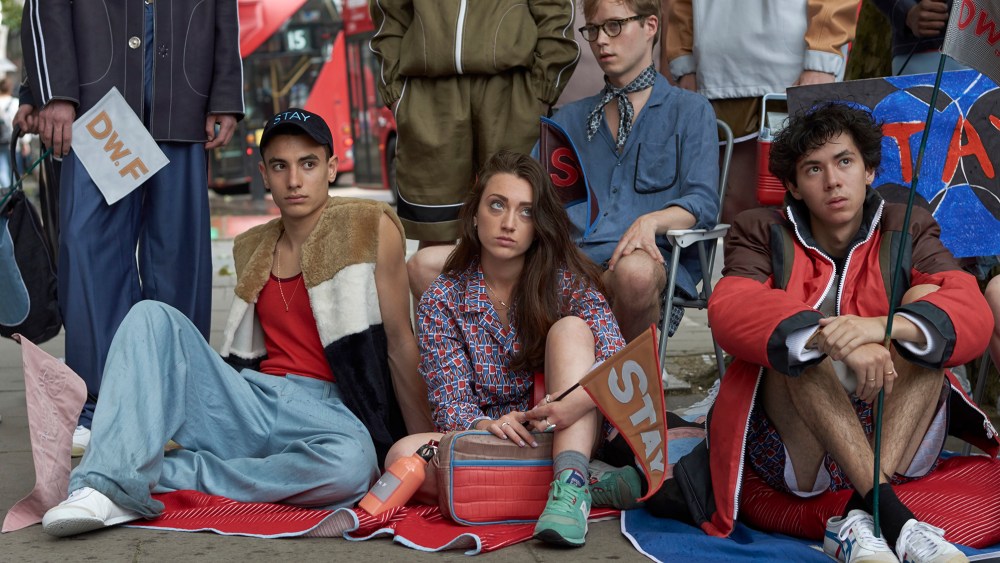
LONDON — Stay!
That is, by and large, the opinion of the British fashion and retail worlds as the U.K. heads to a historic referendum Thursday on whether to remain part of the 28-nation European Union, or to go it alone.
Weekend polls showed both sides in a virtual tie, with the “Remain” camp slightly in the lead following the murder of the British MP Jo Cox last week. Since Prime Minister David Cameron revealed the referendum date in February, the debate has not only split Britain’s Conservative party but also cut across family, gender, class, age and socioeconomic lines.
The perception that “Remain” would be the more likely outcome gave a boost to global stock markets, which have been pressured lately, in part due to uncertainty surrounding the U.K. The Europe Stoxx 600 index jumped a robust 3.7 percent on Monday, and the UK FTSE added 3 percent, to close at 6,204. The German DAX gained 3.4 percent, to end the day at 9,962, and the French CAC also increased by 3 percent, to close at 4,340.
Related Articles
In addition to the rally in Europe, oil gained almost 2.5 percent and came close to $50 a barrel, and U.S. Stocks rode the push higher. The S&P 500 came within 40 points of its all-time high before pulling back and closing at 2,083, an increase of 12 points. The Dow Jones Industrial average climbed by as much as 250 points before trimming gains and ending the day ahead 129 points, at 17,804. The Nasdaq tacked on 36 points, to close at 4,837.
You May Also Like
Generally falling into the “Remain” camp, the fashion industry sees itself firmly as part of a great international community and relishes London as a capital of finance, tech, creativity and innovation. It also views the country as a beacon of generosity, open-mindedness and progressiveness — all arguments Cameron has been making for reasons to stay.
Earlier this year, 198 business leaders — including Burberry’s chief creative and chief executive officer, Christopher Bailey; Kurt Geiger chairman Neil Clifford, and Jacqueline Gold, head of the high-street lingerie chain Ann Summers — signed a letter stating they wanted to remain part of Europe.
Last month, more than 280 British creatives signed another letter voicing their support for the Remain camp. They included designers Vivienne Westwood, Patrick Grant, Bella Freud, Katharine Hamnett, Hussein Chalayan and Daniel Fletcher. British Vogue editor Alexandra Shulman has also been vocal in her support of Britain staying put.
Last week, the Anglo-Dutch giant Unilever, parent of personal-care brands such as Dove, Vaseline and Pond’s, urged its employees to vote to remain. Unilever said it owes much of its success over the past 25 years to the creation of a single European market of 500 million consumers “and — importantly — to the collective weight of the European Union in helping to open up markets and drive standards in other parts of the world, including in such important areas as the environment and social protection.”
Many fashion and retail figures polled by WWD will vote to remain, but admit they are doing so with a heavy heart. They love the idea, the romance of Britain breaking free from Brussels and standing apart from the European pack, but their wallets, business interests — and common sense — are telling them to stay. They argue there are just too many unknowns.
Some are still undecided. “My family is disagreeing totally, and I’m on the fence. I understand both sides of the argument,” admitted Neil Barrett, the British designer who divides his time between Italy and the U.K., and who has studios in both countries. “Living abroad, I can appreciate how useful it would be to stay in, because of the ease of cross-border movement and trade.”
He said if Britain votes to leave, he realizes that some of his team — he works with people of 20 different nationalities — will be stuck in huge customs lines, and that he’ll have to factor in extra shipping times, new tariffs and pricing.
“Whatever happens, everyone will adapt to what is the greater good, and so will I,” said Barrett, adding that coping with different countries’ price lists and import taxes is already a fact of life for fashion designers.
The publicly quoted Mulberry, which has an English chairman, a French ceo and a Spanish creative director, does not comment publicly on fiscal matters and would not be drawn on the Brexit debate.
Its chairman Godfrey Davis told WWD: “It’s a democratic process, and we haven’t tried to influence our employees’ votes or anything like that. At the end of the day, it will be what it will be, and we think we’re well-placed to succeed, whatever the outcome.”
Brexit has become such a divisive issue that organizations such as the British Fashion Council, the British Retail Consortium, the U.K. Fashion and Textile Association and University College: London are, like Mulberry, not taking a public stand.
Although the BFC eventually voiced its views on Scottish independence in 2014 — pushing for the country to remain part of the U.K. — this time it has not weighed in. “It’s such a complex issue with multiple aspects. One opinion might not represent all of our stakeholders,” said a spokesman.
That, however, didn’t stop the BFC from releasing a poll last week of U.K. designer businesses’ hopes ahead of the vote. The BFC said nearly 500 designers opened the e-survey, with 290 responding. Some 90 percent of those who responded stated their preference to remain, while 4.3 percent voted to leave. Meanwhile, 2.4 percent were undecided and 2.8 percent said that they would not vote.
Last week, during London Collections: Men, designers took the opportunity to express their views on the issue. Patrick Grant of E. Tautz and Sibling’s Cozette McCreery and Sid Bryan all took their bows in T-shirts with the capital letters: “IN.”
Fletcher staged a flash protest outside the official show venue at 180 Strand, rounding up friends, family and models who held signs and blankets with slogans such as “Stay” and “Better Together.”
“What I think scares me most of all is moving out of the free-trade zone,” Grant told WWD. “It seems to me that most politicians on the ‘Leave’ side seem not to know the difference between free trade and tariff free, which is seriously worrying. Free trade means doing business with Sweden or Germany or Spain in just the same way as we do business in Edinburgh or Manchester. Hassle free, cost free, delay free. And free is good for business.”
He said his fear is that whatever future tariffs are agreed, a stand-alone Britain would be forced into a world of “cross-border customs; costly, complicated paperwork; interruptions, and delays. And cost is bad for business. Especially small ones like mine.”
After the Sibling show, McCreery said she feels “so strongly about being European. We work with European factories and consider ourselves citizens of the world. Britain needs to be a lot more inclusive, and we need to get on with each other.”
The retailer and entrepreneur Simon Burstein, whose family helped build international designer businesses in London via their specialty store Browns, and who has recently opened another shop called The Place London, said Britain needs to remain.
“Of course there is a lot of bureaucracy in Brussels, but we have to remain united in our core values. We don’t necessarily have to agree on everything. We need to stay in, get things moving, be at the table — not away from it — and fight,” he said.
Burstein pointed to his daughters, who are half French. “They can work anywhere in Europe, and that is what the younger generation should be able to aspire to. We need to do this for them.”
Although University of the Arts London is not taking a public stand, Professor Frances Corner, pro vice-chancellor at UAL and head of the London College of Fashion, said much is at stake.
“Almost 75 percent of British exports of clothing, hats and footwear go to countries across the EU and its single market of 500 million consumers,” she said. “This is worth a staggering 5 billion pounds [or $7.18 billion at current exchange] to our economy, and free trading also means that fashion businesses in the U.K. benefit from less bureaucracy whilst receiving better deals on tariffs and regulation.
“Fashion, and its intrinsic relationship to our economy, social impact, creative education and sense of identity, is vital to Britain. Central to our success is the ability to keep pace and stay competitive, and I personally believe that our membership to the European Union underpins that,” she added.
While the British Retail Consortium, a lobbying body, has not taken a public position, it acknowledged in a paper published in March that life would be tough on retailers if Britain were to leave. The body also pointed out that while the EU is famous for its endless flow of directives, laws, procedures and red tape, so is Britain.
The BRC said leaving the EU but remaining in the Single Market — or the European Free Trade Area — would also mean the U.K. would be subject to EU legislation “without any formal role in deciding it.” It said EU laws would still apply to product regulation and information requirements, in industries such as food and beauty.
The lobby pointed to potentially big problems for U.K.-based e-commerce companies, which would be subject to increased customs controls, adding to delivery times and costs, if the “Leave” campaign were to win.
In its paper, the BRC also appealed to the EU to fight harder for itself: “International trade is becoming increasingly important for the U.K. The EU needs to demonstrate that it can deliver trade-liberalizing agreements with our main international trading partners that would be at least the same as, if not better than, agreements that the U.K. could strike on its own.”
That said, there have been some high-profile figures in the worlds of business, finance and the arts who are in the “Leave” camp, including the billionaire businessman Lord Anthony Bamford, whose wife is Carole Bamford of Daylesford Organic; James Dyson, the billionaire inventor and British vacuum-cleaner supremo, and “Downton Abbey” creator Julian Fellowes. “It’s democracy versus autocracy,” he’s said of the Brexit debate.
In a recent letter to his employees, Bamford, whose family-owned company JCB is one of the world’s largest manufacturers and exporters of heavy machinery, wrote: “Do I wish to remain in an EU of diminishing economic importance as it moves towards ever-closer union? Or do I want us to pull out of the EU, reclaim our sovereignty and regain control of how we trade with Europe and the world? After [so many] years in the EU, I am voting to leave.”
In an opinion piece published in The Evening Standard earlier this month, the City investor Axel von Schubert argued that the U.K. would save billions by not having to support EU regulations, and claimed that 95 percent of U.K. firms do not even export to the EU. He said the costs of membership exceed the benefits of the Single Market.
He added the whole EU construct is flawed. “Forcing 28 culturally diverse countries under one umbrella, out of which the majority is technically bankrupt, is economic suicide. If the U.K. stays in the EU, all will seem stable for now, but not in the long term. A strong pound will make exports to the EU expensive with a declining euro.”
Broadly speaking, young urban dwellers and businesses — especially e-commerce ones and those that trade internationally — are in favor of remaining part of the European Union, while older voters, angry with EU legislation, fees, court rulings (and ever more integration to come) want out.
Numerous elements involving the economy, politics and simple moral beliefs are involved in both the “Stay” and “Leave” arguments — including immigration, national sovereignty, regulation, trade and currency. There has also been scaremongering — and guilt trips — aimed at voters on both sides.
The debate has been a bitter one, although both camps put their differences aside last week following the murder of Cox by a far-right fanatic. Both sides suspended campaigning to pay tribute to Cox, who was adamant that Britain remain part of the EU.
When the campaigning resumed on Sunday night, both sides switched back into high gear, with Cameron stressing that the vote will be irreversible.
He told the British public on Sunday that if the U.K. decides to leave, “that’s it. We are walking out the door, we are quitting, we are giving up on this organization. I do not think Britain, at the end, is a quitter.” It is widely expected that Cameron will be forced to stand down as prime minister if Britons vote to leave.
The exit camp, meanwhile, accuses those lobbying to remain of “peddling phony forecasts and scare stories to…frighten the electorate into voting ‘Remain.’ ” They argue that Britain is strong enough to negotiate favorable trade deals, and that the EU overall is becoming less important as a trading partner. Unshackled by Brussels, they argue, Britain can flourish.
They also talk about the inevitability of a pan-EU army, and of being forced — eventually — to abandon the pound in favor of the euro. They believe paying 350 million euros, or $275 million, a week in EU charges is wasteful, and argue the money could be spent on Britain’s National Health Service.
One of the biggest concerns is high levels of immigration, from Eastern Europe in particular. In 2015, net migration to Britain was the highest on record.
Britain is the EU’s second-biggest economy, after Germany, and accounts for nearly 18 percent of the region’s GDP, yet those who want to leave see Germany and its chancellor, Angela Merkel, as the region’s power brokers.
But even as the “Leave” camp argues for economic sovereignty from the EU, a host of major organizations — including the Bank of England, the World Bank and the International Monetary Fund — warn that exiting would result in irrevocable damage.
They’ve warned of a threat to security due to a lack of cooperation with EU partners, slower economic growth, recession, erosion of Britons’ household incomes, frozen credit markets, withering foreign investment and the nation’s loss of recognition as the world’s bridge into greater Europe.
There is also the wider risk that if Britain leaves, other countries will follow, leaving Germany to finance the poorer countries in the bloc, and exposing the region to future threats from Russia. On Monday, the German news magazine Der Spiegel dedicated its latest edition to the Brexit debate, with a cover that reads “Please don’t go!” According to the BBC, 79 percent of Germans want Britain to remain in the EU.
Stock markets have been rattled, although the weekend polls showing the “Remain” camp had a tiny lead resulted in European markets rising on Monday. The pound also has seesawed against major currencies: Since February, it’s down 8 percent against the euro, although it’s risen 7 percent against the dollar.
No one doubts that short-term risks remain. Under the current Treaty of Europe, it would take a minimum of two years for Britain to disentangle itself from the EU, and it would have to start negotiating new trade deals immediately, although it could lower its own tariffs and duties at once. Others have argued it could take decades for Britain to fully disengage.