Stepping into the spotlight on Wall Street can be expensive.
Levi Strauss & Co. said its second-quarter net income fell 63 percent, primarily due to $29 million in costs associated with its initial public offering in March.
The denim maker’s earnings tallied $28.2 million, or 7 cents a diluted share, down from $74.9 million, or 19 cents, a year earlier. Adjusted net income fell to $69 million from $83 million, with $10 million of that decline tied to smaller gains in foreign currency derivatives.
While Levi’s bottom line was weighed down by those items, sales continue to grow. Revenues for the quarter ended May 26 rose 5.4 percent to $1.31 billion, which translated into a 9 percent gain in constant currencies.
Related Articles
Under Chip Bergh, who has been chief executive officer since 2011, Levi’s has been expanding beyond its core, growing overseas, through retail and in women’s and tops.
You May Also Like
While the company’s sales in the Americas rose 3 percent to $670 million, sales in Europe perked up 9 percent to $398 million and Asia gained 6 percent to $222 million.
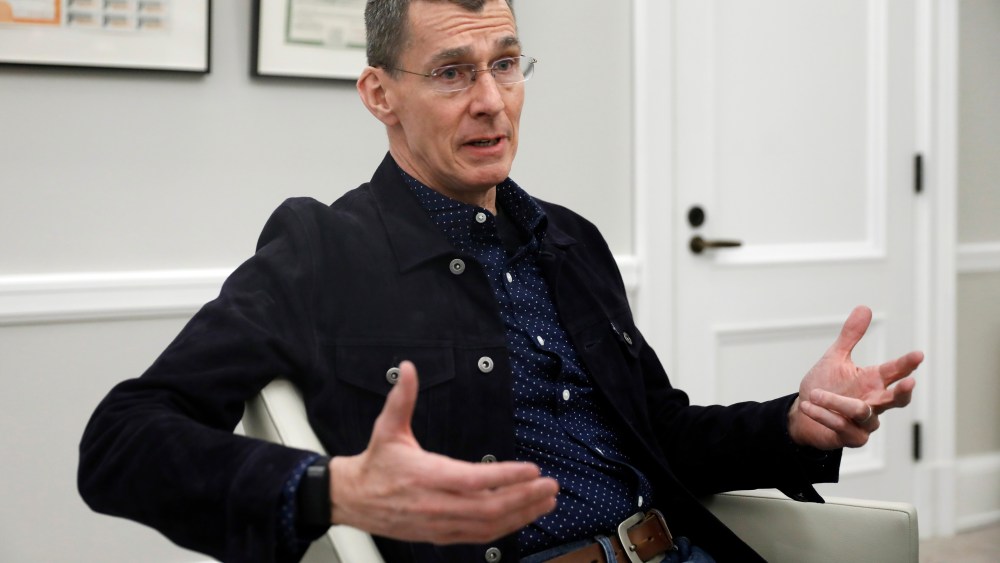
“Everybody’s got this doom-and-gloom view of the economy globally,” said Bergh in an interview with WWD. “The business results that we’re seeing would suggest that on a global basis, the consumer is at a pretty good place.”
The U.S. business is being pressured mostly through wholesale accounts, where sales fell 2 percent.
“It’s been a challenging environment for the big department stores,” he said, noting the industry was still contending with bankruptcies and store closures. “Our own stores are doing OK; it’s really more of a channel dynamic. The consumer has multiple options in terms of where they want to go shop. You have to give them a reason to come to your stores, an experience.”
On a conference call with analysts, Bergh added that Levi’s was working to strengthen the wholesale operation by expanding it, adding more premium business and trying new approaches.
“But it’s going to continue to be challenging…customers close doors from the bottom of their lists going up and they’re starting to cut into the bigger stores that represent bigger business for us,” the ceo said. “And I guess what I would say is, the good news is we are all over this. You know, we don’t have our head in the sand.
“We have been testing your concession model with Macy’s, for example, in six stores,” he said. “That looks very, very promising [for the] potential to expand that. We’ve been testing Levi’s in Target that looks promising, the potential to expand that. These can all help offset softness from some of the more challenged wholesale customers.”
But Bergh, in the interview, pointed to the company’s breadth, as it operates in 110 markets, and noted, “When a big country like the U.S. has a tough quarter, other markets are able to step up and more than offset that.”
While there have been some concerns in the industry that U.S. brands are starting to feel pinched by the heated rhetoric around the trade war with China, the ceo said Levi’s hasn’t seen that and is in the process of building in the country.
For Levi’s, the IPO did not bring major changes. The firm already had public debt and reported its results quarterly. But it is getting more immediate and public feedback from investors.
For instance, shares of Levi’s fell 7 percent to $22.04 as investors digested the second-quarter earnings decline in the aftermarket release.
That’s still well above the stock’s IPO price of $17 and just a bit below where it was at the end of its first day of trading.
Bergh said he’s still looking at the long term.
“The IPO is not the finish line, it’s the starting line,” he said, noting Levi’s was becoming a better company through the process. “We have to be more disciplined and more rigorous.”
And the brand has to stay tuned in to shoppers.
“To keep the brand at the center of culture, it’s about remaining consumer-obsessed and really staying focused on the consumer on a global basis, really understanding where the consumer is going,” Bergh said.
For now, that means going back to Coachella.
“We generated 9 billion impressions coming out of Coachella, it was a 50 percent increase over last year,” he said. “Most of it was unpaid impressions — and we’re not even an official sponsor of Coachella.”
“The Levi’s 501 short was the uniform at Coachella again this year; the 501 short business was up 50 percent in the second quarter,” he said.
