
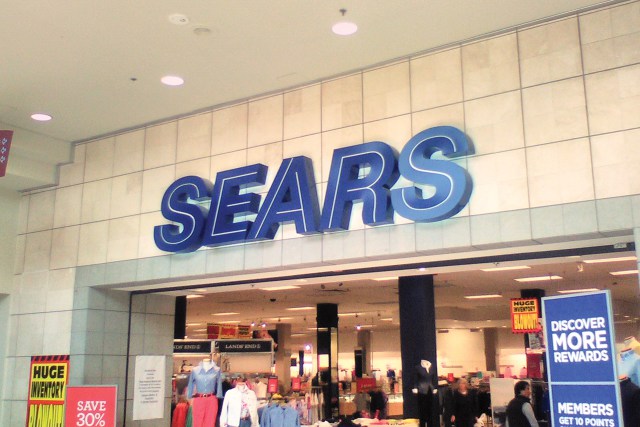
Sears Holdings Corp. has found another way to kick the can down the road, but buying itself more time to attempt to turn around operations in the short-term is probably not enough to reverse the company’s long-term decline, credit analysts said.
While improved liquidity is a positive, the conclusion among credit analysts is that the retailer’s challenges — growing the top line, having the right product — and $4.6 billion of funded debt — remain.
Sears on Friday said it has a new plan to cut both costs and its pension obligations. Chairman Edward S. Lampert said the new restructuring program would target $1 billion in annualized cost savings. The plan includes simplification of Sears’ organizational structure; implementation of an integrated model to drive efficiencies in pricing, sourcing, supply chain and inventory management; optimization of the product assortment, and active management of its real estate portfolio.
Related Articles
In addition to the recent financial transactions to optimize its capital structure, Lampert said the restructuring initiative “will reduce our overall cash funding requirements.”
You May Also Like
Although there wasn’t anything substantively new that hadn’t already been disclosed earlier this year, it was enough to have investors send Sears shares up 25.6 percent to close at $6.96 in Nasdaq trading on Friday. The quick run up in the share price earlier in the day — it was up 44.4 percent in pre-market trading — and given that Lampert and Fairholme Capital own a substantial number of Sears shares suggest that a short squeeze might have been at work.
Christina Boni, vice president and senior analyst at credit ratings agency Moody’s Investors Service, said, “Asset monetization is giving the company more runway to deal with operational issues [but] the topline of the business remains extremely challenged.”
She explained in a telephone interview that while it wasn’t the first time Sears has addressed its cost structure, it is the first time that Sears has addressed it in such an “aggressive manner” to right-size its infrastructure. What she hasn’t seen is any material data to support improvement and stabilization of the business at the topline. Given the secular issues facing the retail sector, the need to have products that a consumer wants and a way for product differentiation from competitors remains key for Sears. Boni said Sears’ apparel categories “continue to be challenged.”
Boni believes it might be difficult for Sears to regain lost foot traffic: “The comps [for the fourth quarter] are a negative double-digits. There’s a big difference between comps down in the single digits to down double digits.” She also said the reduction in asset base accelerates the timeline required to stem annual operating losses, which have been in excess of $1.5 billion.
In a research note she issued late Friday, Boni noted that Sears has $4.6 billion of funded debt, as well as unfunded pension and post-retirement obligations of about $2 billion.
Monica Aggarwal, credit analyst at Fitch Ratings, said, “Sears’ turnaround plan doesn’t provide a lot of new news [and] it doesn’t change the trajectory of the company in any significant way. Sears will still have to raise a significant sum of money to fund operations, likely in the $1.5 to $2 billion range annually over the next two years. EBITDA is projected to remain materially negative, similar to the negative $800 million range in 2015 and 2016, as comparable-store sales remain in the negative midsingle to high-single digits.”
An analyst at a financial services firm that does credit checks for non-factored accounts wasn’t impressed by the latest initiative by Sears: “There’s a lot of duplicate Kmart and Sears operations stuff that should have been addressed 10 years ago, but there’s really nothing here where you can say Sears is finally heading in the right direction,” said the analyst, who requested anonymity.
Another analyst at a competing credit-checking firm, also for non-factored clients, saw the news as a positive, although not because he thinks Sears has solved its problems. While he doesn’t believe that Sears will realize profits anytime soon, he believes that it might be time to start approving smaller orders again for Sears now that the company has bought itself another six months to a year’s worth of time. “The benefit of going in now would mean our clients don’t miss the opportunity to sell merchandise,” he said.
A spokesman for Sears, disagreeing with the analysts’ conclusions, said, “They couldn’t be more wrong.”
The Sears spokesman explained that the new initiatives would ensure that the company becomes a more agile retailer. “We believe these actions will enable us to focus our investments to drive our strategic transformation and the evolution of our Shop Your Way ecosystem through value-enhancing partnerships, compelling offerings and a seamless online and in-store shopping experience for our members. In the process, we will optimize the product assortment at Sears and Kmart stores, using data analytics to better align with preferences of our best members focusing on profitable, high-return best categories,” the spokesman said.