
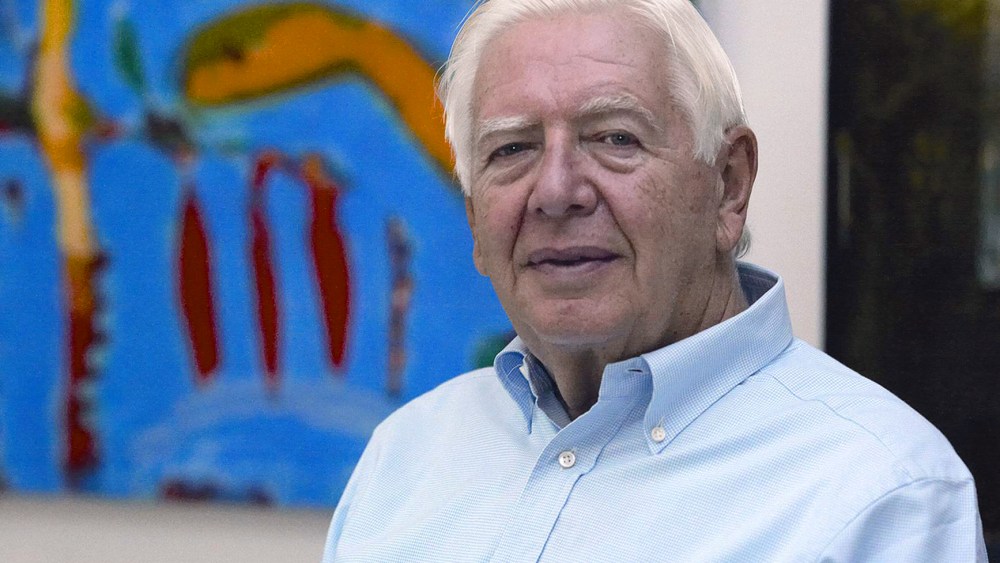
NEW YORK — With Tuesday’s opening of the Pentland Centre for Sustainability at Lancaster University in the U.K., Pentland Group chairman Stephen Rubin hopes to get more companies involved with environmental sustainability, ethical supply chains and other socially responsible business practices.
Rubin spoke of that initiative — as well as his take on the global economic outlook, the potential impact of the migrant crisis in the European Union and his role in turning the footwear company his parents started in Liverpool 83 years ago with a 500 pound, or $765 at current exchange, loan into a $3 billion global juggernaut — during an interview last week at the Regency Hotel here. The Pentland Group and its leader are committed to the United Nations Global Compact’s Ten Principles, which highlight how businesses can tackle environmental issues.
Related Articles
He pointed out that in 2013, Earth Overshoot Day — the date when humans exhaust nature’s budget for the year — happened in mid-August, its earliest point to date. “As the world’s population is going up to nine billion [by 2050], we’ll be doubling the need for all resources. What if in the future no one buys shoes but rents them like they do with ski boots? What if we’re taxed on virgin raw materials we consume? These are some of the ideas that we are putting out there,” he said.
You May Also Like
Referring to the speech he planned to deliver at the Pentland Institute opening, Rubin said, “If the world were a village of 100 people, five would control 32 percent of the world’s wealth, 80 would live in substandard housing, 48 would live on less than $2 day and included in that would be 20 who live on less than $1 day.”
With 19,000 employees worldwide and products sold in 200-plus countries, the Pentland Group’s brand management division has 13 athletic, outdoor and fashion brands under its umbrella, including Speedo, Lacoste, Berghaus, Hunter Boots, Boxfresh and Ted Baker footwear. The conglomerate’s retail division consists of JD Sports fashion, in which it has a 58 percent stake.
“Very simplistically, we try to show that you can do business…everything we do as a family business is that we’re looking to the long-term. There’s no such thing as a fast buck,” he said. “It’s a question of long-term partnerships and development as with a family. Everything we look at we say, ‘Right, will that be good for the grandchildren?’ that sort of thing.”
Trained as a lawyer, Rubin joined the family business in 1959, taking on the chairman’s role after his father died in 1969. Rubin’s reputation as an astute businessman was solidified in 1981 when Pentland acquired a 55 percent stake in the-then struggling Reebok for $77,500 — and a decade later sold off its shares for $770 million. Along the way, Pentland saw its share price more than triple and the company at one time came within a hair’s breadth of bidding for Adidas.
Rubin’s dedication to his own family, as well as the thousands of others that he indirectly provides for by employing via Pentland’s pursuits, is not taken lightly. (Three of his four children are connected to the company, with his son Andrew serving as chief executive officer.) “We worked out that it was about 500,000 [indirectly employed by the group]. It’s one of the reasons it gives you a sense of responsibility. You don’t abuse it,” he said.
In the wake of the 2008 financial fallout, Pentland continued to invest in technology and fashion businesses, and its marketing budget grew as well. “We’re trying to take funds raised from the traditional brand side and the retail side, and invest them in a diversity of other areas. So we’ve invested in a number of Palo Alto [companies] and various other things of that nature,” he said.
With stakes in Heidi Klein swimwear and Boston-based running apparel label Tracksmith, Rubin said, “We have always had a rep of being management friendly. We’ve never done a hostile act. Most of the people we’re in business with seek us out and ask, ‘Will you invest in us and can we work together?'”
Having first set up a Hong Kong office in 1964, Rubin cited changes since as Asia’s increasing standard of living, Korea’s shift from a footwear exporter to a “great importer,” and “a lot of problems in China with regard to labor.”
“In my lifetime, the whole place has turned around,” he said. “One of the first countries we bought cheap shoes from was Japan, and cheap shoes from Japan today is a joke. Again, the whole thing has evolved.
“What has happened is the social legislation, particularly in a lot of countries in a large part of Europe, has really helped cheap manufacturing countries and developing countries. When you look at the limitations on the 30-hour working week, national insurance, high taxation and social security of every description….It’s very difficult to see how [you can] give people what you want to give them, and let people enjoy life. I’m a great believer in [British philosopher and social reformer] Jeremy Bentham whose belief was, so if people are to enjoy life, we want to give them the things that they want to enjoy life, so it becomes evermore difficult to compete when roughly a third of the cost of a shoe on average is labor.”
Interestingly, Rubin could see “the possibility of certain manufacturing almost coming back to America because U.S. benefits are so much less than the European ones. I’m not too technical on the Pacific Rim situation with this whole new agreement that’s been signed excluding China, that’s going to affect China to an extent,” he said of the Trans-Pacific Partnership trade agreement between the U.S. and 11 other countries.
Asked if there is reason for alarm, Rubin said, “I don’t think so. What was China’s GDP — [nearly] 7 percent last quarter? People always need to sell newspapers and be alarmists but I would have thought their progress continued.”
He added, “There’s an awful lot of apparel coming from other countries. Bangladesh is pretty humongous, isn’t it? The thing is, as the world becomes more observant of CSR — Corporate Social Responsibility — and more particularly human rights, then people look a lot further into their supply chains. And we all know there have been problems in China.”
The way Rubin sees it, the burgeoning ath-leisure category is a matter of necessity for the new players. “People are dressing down much more,” he said. “They have to [jump in]. Otherwise, they wouldn’t sell anything. The question is whether secondary brands are really brands at all. What does it take to be a brand today? If you take Nike or Adidas, the money they spend on advertising or marketing, it’s humongous. For anybody to actually break in is exceptionally difficult. I think the brand is as exceptional as the product.”
Referring to the 500,000 migrants who have crossed into Europe this year, Rubin is uncertain about the long-term potential economic impact on the EU. “When you turn the television on, and night after night after night, with winter closing in, some of the scenes that you’re seeing are just so tragic. Genuinely, I haven’t got a clue. I think we’ve got a very, very major problem on our hands. Couple that with a big economic problem, and you’re going to find a big continuous surgery,” he said. “A lot of these are not wealthy countries — Croatia, Slovenia, Montenegro. They’re nice countries and compact, but whether they can take the strain is a different thing altogether.”