LONDON — Burberry is making gains in China, opening another carbon neutral store in the region, and watching full-price sales rise in the double-digits worldwide. But that clearly wasn’t enough for investors, and the share price plummeted 9 percent to 17.92 pounds on Thursday morning, shortly after the first half results were released.
Burberry‘s shares recovered some ground, and then flatlined for most of the day, closing down 5.6 percent at 18.69 pounds on the London Stock Exchange. Burberry also underperformed the FTSE 100, which closed up 0.6 percent at 7,384.18.
Investors could have been concerned about the company’s upcoming change of guard. Versace’s Jonathan Akeroyd will take over as chief executive officer in April from Marco Gobbetti, who set out an ambitious five-year plan to cement Burberry’s place in the luxury space and achieve high-single-digit revenue growth, and “meaningful” operating margin expansion.
Related Articles
Gobbetti is leaving at the end of this year, and while there is no indication that Akeroyd will go off-piste, and reset the plan — Burberry chair Gerry Murphy said as much during the analyst presentation — doubts linger.
You May Also Like
“When discussing the strategy of upcoming CEO Jonathan Akeroyd, we note that the chairman didn’t get drawn into confirming that there wouldn’t be a reset at the brand, which to us remains a risk,” Carole Madjo of Barclays wrote in a note following the presentation.

Luca Solca of Bernstein noted the decline in the share price, and wrote that Burberry management’s commentary during the call “brought nothing particularly new or encouraging” that might have shored it up.
Another reason for the share price decline could well be lingering worries about China, and specifically the wobble that Burberry witnessed in August when sales declined due to a fresh set of COVID-19 restrictions in the region.
On top of that, questions remain about Chinese President Xi Jinping’s call for China to achieve “common prosperity” — and how that might impact luxury spending.
Julie Brown, Burberry’s chief operating and chief financial officer, tried to put both concerns to rest, saying the common prosperity program would be good for luxury business as more Chinese would have money to spend. She added that the company had seen no adverse impact from the program so far.
She was also frank about Burberry’s August performance, noting that the decline in China dragged down the brand’s overall growth in the half.
In the six months to Sept. 25, Burberry said retail store sales were up 37 percent compared with 2020, and 1 percent compared with 2019.
However, that 1 percent gain was made in the first three months of the half. Sales in the second three months were flat due mainly Chinese shoppers staying away from stores in August.
Burberry said COVID-19-related travel restrictions in the APAC region were “especially impactful” in China, “reducing footfall materially, leading to an adverse effect on revenues,” although the company saw a good recovery in September.
Overall, mainland China saw growth of 30 percent compared with the first six months of 2019. Brown seemed confident that Burberry was back on track in China, although she admitted that no one can predict when new COVID-19 restrictions might appear again, and disrupt travel and shopping.
Testament to its confidence in the Chinese market, Burberry on Thursday opened a new, carbon neutral store at Plaza 66 in Shanghai, part of a longstanding commitment to reduce its environmental impact.
In line with Burberry’s ambition to become Climate Positive by 2040, the Plaza 66 store is also undergoing LEED (Leadership in Energy and Environmental Design) certification process.
Burberry said it’s on track to procure all of its electricity from renewable sources by 2022 and will have a carbon neutral footprint across all of its operations globally by next year.
The share price decline on Thursday didn’t reflect the sales uptick in the first half, which was in line with consensus, or EBIT, which at 196 million pounds, beat the consensus figure of 181 million pounds.
In the first six months, revenue was up 38 percent to 1.2 billion pounds, while operating profit more than doubled to 207 million pounds. Profit after tax, meanwhile, tripled to 145 million pounds at reported exchange rates.
Retail full-price sales grew 18 percent, driving margin expansion and free cash generation — and proving that Burberry can still flourish without discounting or marking down its merchandise.
The company said that digital has also been performing well, with full-price sales almost doubling compared with 2019. The interim dividend has been reinstated at 11.6 pence, 3 percent ahead of fiscal 2019-20, levels while the company has recommenced its share buyback plan.
Murphy said Burberry is maintaining its medium-term guidance for high-single-digit top-line growth (as laid out by Gobbetti in 2017), while the company has also maintained its sales and profit guidance for the 2021-22 fiscal year.
Burberry also mentioned that wholesale sales will be “ahead of” pre-pandemic levels in the second half of the current fiscal year, while there are currently no plans to raise prices despite inflationary costs.
Brown said Burberry has been seeing its transportation costs rise, “but we’re working very hard to offset the headwinds from inflation.” She said there are currently no plans to raise prices again after the price hike last May.
In the first half, some regions performed better than others: Burberry said the Americas, mainland China and South Korea all delivered strong double-digit growth compared with 2019, while other regions remained under pressure from reduced tourist levels.
Leather goods saw double-digit growth in full-price comparable sales compared with 2019, with outerwear “strengthening” in the period. The company said the new store format is also attracting a higher-spending customer.
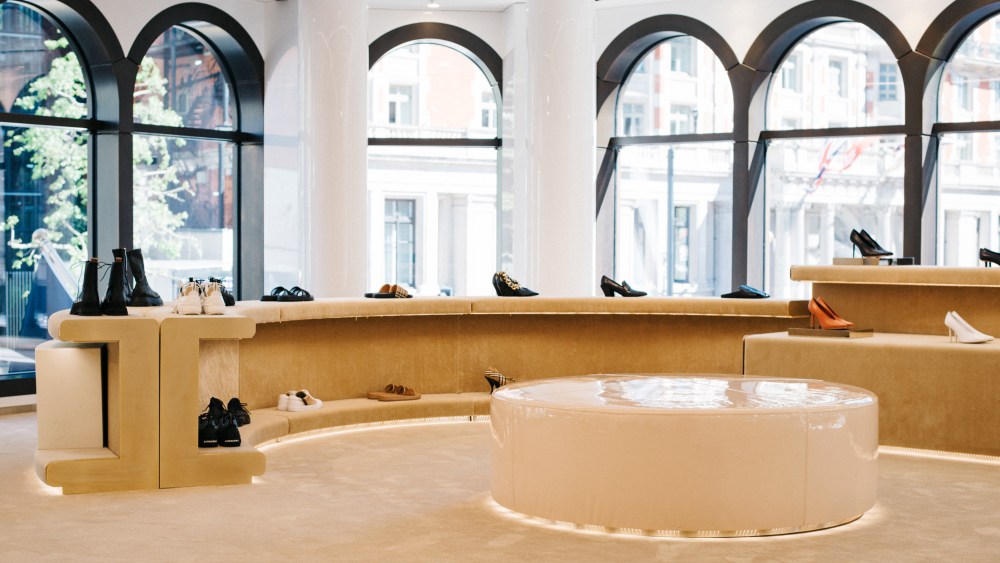
Burberry said it now has 15 stores in the new format, which made its debut over the summer at 1 Sloane Street in London. Some 50 new concept stores are set to roll out globally by the end of the current fiscal year, and the company said it plans to accelerate its investment in the store estate this year.
Brown said the new stores are attracting “a higher level of expenditure,” which was one of the aims of the design. Gobbetti came up with the store concept along with Burberry’s chief creative officer Riccardo Tisci and the eminent Italian architect Vincenzo De Cotiis.
The Sloane Street store is located between Harrods and Harvey Nichols, and it’s part of a new development by The Knightsbridge Estate. It spans 9,225 square feet over three floors and looks different from Burberry stores of the past.
It’s bright and spare with lots of tall, arched windows; a network of slim metal rails on the floors and ceilings, some of them configured in an abstract check pattern. There are black-and-white checkerboard floors, and lots of mirrors reflecting the light pouring in from the street.
“I didn’t want this to be a fleeting moment,” Gobbetti said in an interview earlier this year. “This is a brand with an incredible heritage, based on items, products, icons — not trends. The store had to be fresh, modern, relevant but it also had to have a timeless attitude.”