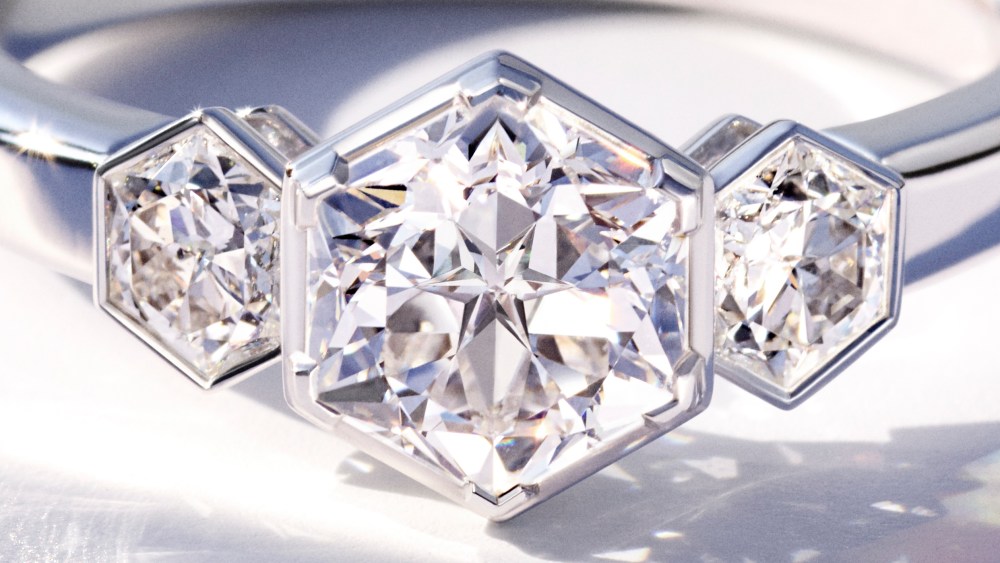
PARIS — “If we come back to the essence of jewelry, it’s a question of metal and stone,” said Chaumet’s chief executive officer Jean-Marc Mansvelt at a presentation showcasing new developments in the Bee My Love line.
Chief among those is the all-new Taille Impératrice diamond cut, boasting a hexagonal shape with 88 facets and a 48-degree angle for light dispersion — rather than the standard 35-degree used in the brilliant cut — that the jewelry house spent more than three years developing.
Its creation was inspired by the symbolism of the number eight, which figures an infinity sign when flipped on its side and is the shape of a dance used by bees to communicate the direction, distance and density of nutrients they find.
Related Articles
Available from 0.23 carats to 3 carats for the best effect, the ideal sizes to maximize the cut’s effect for a diamond “much more striking than a brilliant-cut one of similar dimension and equal quality,” according to Mansvelt. The new cut was deployed to great effect on a 1-carat solitaire flanked with two smaller diamonds, and on a Y-shaped necklace finished with a 1.5-carat stone.
You May Also Like
But it also made for judicious accents on stackable bangles and flexible pieces that built on the idea of a beehive with hexagons seemingly growing onto the skin, designs that will no doubt continue to attract a steady stream of the younger clientele Bee My Love has been capturing since its launch in 2016.

Also fluttering in the neighborhood were the butterflies and dragonflies imagined by sculptor and jewelry designer Harumi Klossowska de Rola, daughter of the late painter Balthus and artist Setsuko Klossowska de Rola, for Chanel-owned goldsmithing specialist Goossens. For this third chapter, she designed nine pieces around these delicate insects, including a diadem where leaves and fluttering wings blended together in a trompe-l’oeil effect.
If more visible jewels were needed to crown an outfit, they could be as graphic as the ovals inlaid with mother-of-pearl and connected with diamonds of a barrette designed by emerging label Viltier, or the many headpieces found in the second Messika by Kate Moss collection, which was shown in a runway format — an unusual choice for a jewelry house.
But seeing these jewels in motion slotted right into the mood of the collaboration between founder Valérie Messika and Moss. “While working with Valérie, I felt like I was in a fashion house. The excitement, the frenzy, the craziness. She thinks of jewelry as fashion,” the supermodel said in an email exchange, adding that coming back to Paris felt like the industry was back and booming.
Models including Cindy Bruna, Isabeli Fontana and Soo Joo Park took to the runway, clad in Alexandre Vauthier designs and adorned with eclectic designs inspired by Moss’ personal taste and collection of jewels, be they acquisitions to celebrate milestones or gifts. “I like the idea of reinterpreting different themes across cultural references and inspirations found in jewels with my own tastes,” Moss said, naming colored stones — malachite, turquoise and onyx, in particular — as the starting point of this collection articulated into sets.
Cue Color Play and its pointed ovals that made a form-fitting black dress look like Black Panther’s heroic getup; the asymmetric strands of diamonds of the Twisted Wave design worn as a contemporary tiara, or a long necklace from the Liberated Spirit range, its Art Deco pompom swinging jauntily with every step.
The familiar proportions of the Chanel No.5 bottle were the first thing that struck in the high jewelry collection celebrating the iconic scent’s centenary, but many items nodded to the idea that perfume is no static object. Patrice Leguéreau, director of the house’s fine jewelry creation studio, gave life to the perfume within and even coming out of the bottle in exuberant displays.
That took a variety of forms, from the silhouette of a bottle dripping downward into a shower of glittering diamond, tourmaline and morganite drops of the No.5 Cascade, to the sillage given life as a 350-carat radiant array of imperial topaze that took the whole décolletage with the Golden Sillage necklace.
As for the witty Golden Stopper earrings and their asymmetric spray of perfume arcing away from one ear, they were a nod to the perfume but also the excitement of someone opening a bottle of No.5 with gusto — an expansive and expensive gesture of personal luxury.
Equally liquid was the new Serpenti Viper, presented by Bulgari at its Parisian flagship unveiled this summer and designed by Peter Marino. Just like its namesake, the new variation shed much of its animalistic connotations to become a geometric motif that curls around the arm or around the neck. Most precious of all is the Infinite Compositions high jewelry set where the scales become a sinusoidal design featuring hinged sections to better wind against the neck or a wrist.
A stroke of divine inspiration was the starting point of this second chapter of fine jewelry brand Tabayer. Founder Nigora Tokhtabayeva was looking for a symbol to replace the eye, which she used in her 2017 launch but had found to be divisive. Looking for another symbol of protection, she discovered a knot of reeds, symbol of Mesopotamian goddess Inanna, and turned them into a graphic loop. Scattered with diamonds or left plain, rings and bracelets figuring a knot’s curl have a contemporary mien that belies their antique inspiration.
A bicycle chain and the idea that the only way forward was to “keep on grinding” in the face of difficulties — a pandemic, economic downturns, you name it — were the starting point of Nadine Ghosn’s newest fine jewelry collection, titled “Lifecycle.” Here, the playfulness of her previous collections was replaced by some serious mechanical chops. Not only are the rose gold necklace and bracelets manufactured exactly like their functional inspirations, but diamond-studded versions use the “micro setting” technique so that each stone is facing upwards from its gold surface, for maximum bling.
Motion also influenced the label Statement, which added punky yet playful spinner rings adorned with pyramidal studs to its lineup. “I wanted to translate the idea that you can put yourself in motion without abandoning your fundamentals,” said founder Amélie Huynh of this addition to a fine jewelry line she envisions as armor for one’s identity.
This was a deeply personal collection for Danish jeweler Sophie Bille Brahe, who drew inspiration from the rose garden her late father used to tend. She updated brand signatures like drop earrings or necklaces featuring graduating diamonds with floral motifs adding a fresh, feminine touch. Elsewhere, Bille Brahe felt the need for some extra glamour and got more confident with adding larger diamonds on rings and on the bottoms of her popular “Fontaine” earrings for extra volume — and high impact.
Designing the pieces of the Robert Mapplethorpe jewelry tribute collection, to be further extended in 2022, was likewise a deeply emotional experience for Gaia Repossi. “It was very emotional because I never collaborated with someone who is no longer there,” she said, explaining she’d spent three whole days just exploring the bric-a-brac in a toolbox where the late photographer stored the found objects he used in his jewelry. Among those repurposed elements were the mechanical parts that inspired the Mechanic ring, a technical construction with hinges that allows the ring to move and makes the finger the central axis of a design that looks a little like a motor.
Chiara Capitani and Romy Blanga have poured humor and much-needed optimism into the spring 2022 collection of their brand Eéra, which saw childlike star and smiley face motifs being transformed into precious fine jewelry pieces, by adding diamonds and gold. The gold was painted matte purple or bright blue, in line with the duo’s ongoing flair for bright color and “manipulating how gold is perceived.” Elsewhere, the duo added diamond and neon-hued stud earrings; stacked hoops, and colorful chokers that offered a fresh take on classic tennis styles.
Sunlight on water can be a moment suspended in time. For Romain Testuz and Yuliy Schwartzburg, founders of Swiss fine jewelry brand The Rayy, it was instead the start of eight years of mathematical research that sees a metal surface transformed into a jewel that projects an image or message when hit with direct light. In Facets, their architectural offering made of responsibly sourced 18-karat gold and lab-grown diamonds, it’s the faces imagined by Spanish visual Blanca Miro Skoudi that wink in and out of sight.