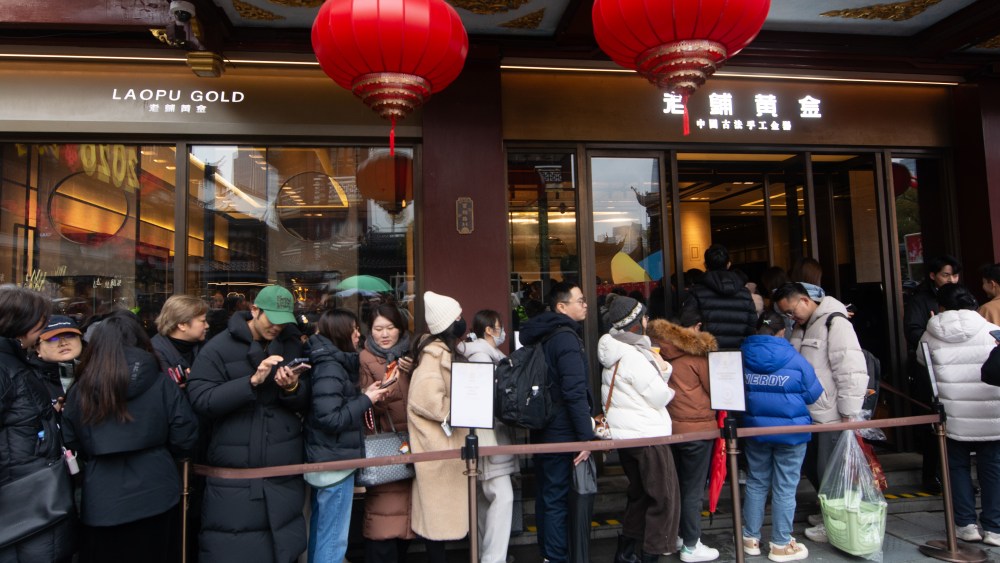
LONDON — The success of Laopu Gold in 2025, with full-year revenues exceeding 27.3 billion renminbi, or $3.95 billion, has inspired a growing list of Chinese jewelers to compete in a relatively new category known as Gufajin, or ancient-method gold.
According to Ting Zhou, founder of luxury research and consulting firm Yaok Institute, in addition to selling products with distinctive cultural designs made using a mix of traditional Chinese techniques, what sets this arena apart from China‘s traditional gold jewelry giants, such as Chow Tai Fook and Lao Feng Xiang, is that these players build their brands using the playbook of a luxury house and open stores at key locations to drive brand awareness and growth.
Related Articles
Laopu Gold’s founder and chairman Xu Gaoming has reportedly stated publicly that his brand’s competitors are global luxury groups, not Chinese chain jewelers. The company’s pricing policy, raising prices two to three times per year, independently of gold price fluctuations, reinforces the message that the value here is the brand and the craft, not the commodity.
You May Also Like
Zhou noticed that Laopu Gold’s success has been widely imitated. To wit, China’s top-performing luxury mall Nanjing Deji Plaza alone hosts no fewer than five ancient gold brands.
According to local media reports, at least 19 of the 32 shopping malls where Laopu Gold operates in mainland China, which also include mega luxury hubs like China World Mall in Beijing, IFC Shanghai, Hangzhou Tower and Shenzhen Bay MixC, have simultaneously brought in competing Gufajin brands.

Notable players in the bourgeoning Gufajin field also include the Shenzhen-based Jemper, which has placed nine of its 12 existing or forthcoming stores in malls already hosting Laopu; Lamchiu, a Lanzhou-based brand that has built its identity around craftsmanship and original design; Baowangfu, a label hailing from Qingdao, equipped with an intangible cultural heritage craftsman training base, and the Kering-backed Borland, founded by Xu Zewei, whose family has been in the made-to-order jewelry business since the 1980s.
Still, per Zhou’s observation, most of Laopu Gold’s would-be rivals have yet to meaningfully differentiate. “There are slight variations in product style. Jemper leans into innovative design, Borland emphasizes intangible cultural heritage, and Lamchiu focuses on couture-level customization, but none of these differences are significant,” she said.
In the long run, Zhou projects that the market can sustain more than 10 gold jewelry retail brands and 20-plus ancient-gold-themed brands looking to achieve genuine luxury status. But it will take more than being a strong follower to become a believable competitor to Laopu.
On the other hand, Zhou believes Laopu’s competitive threat to global players may be overblown.
“Laopu Gold has claimed an approximately 80 percent customer overlap with Hermès, but our research puts the figure closer to 40 percent,” she said.
Fundamentally, Zhao sees that the consumption motivations of branded jewelry buyers and Chinese gold jewelry buyers remain substantively different.
“Chinese gold jewelry brands are still fundamentally selling gold,” she argued. “The store-of-value and wealth-appreciation attributes of gold remain the foundation and core reason these brands have been able to grow. They do not yet possess the brand power and premium-pricing capability of true luxury brands.”
The ultimate question for Laopu Gold, and, by extension, for the Gufajin category, as Zhao puts it, is whether Chinese consumers will truly accept a gold jewelry brand on purely luxury terms — as items where brand mythology and cultural prestige outweigh melt value.
Zhou remains cautiously optimistic about the future of Gufajin.
“The rise of ancient gold is indeed helping to shift gold’s identity from investment asset toward jewelry and consumer good, but this will be a long and gradual process. Chinese consumers’ deeply rooted perception of gold as a store of value cannot be easily overridden in the short term,” she added.