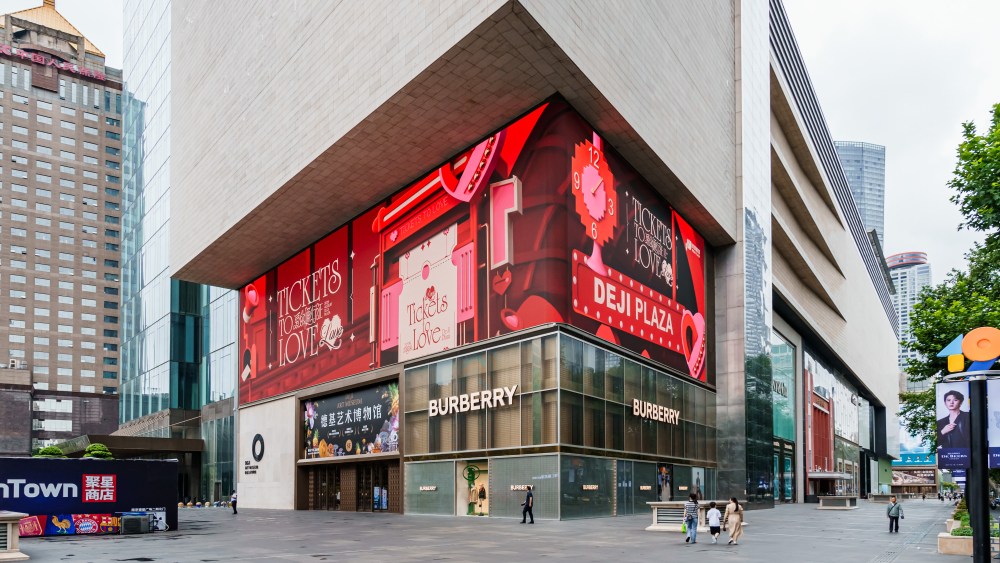
To gaze into the future of China’s evolving luxury retail dynamic, look no further than Deji Plaza, a regional luxury shopping mall in the affluent capital of Nanjing.
The mall, part of the Nanjing-based real estate company Deji Group, was founded in 2006 by Wu Tiejun, an enigmatic local businessman. By 2018, it surpassed 10 billion renminbi, or $1.39 billion in sales, and became the highest-grossing retail project in Eastern China.
By 2024, sales more than doubled to 24.5 billion renminbi, or $3.4 billion, dethroning longtime champion SKP.
Related Articles
With a steadfast focus on luxury retail — Deji remains the only Nanjing mall to have Hermès, Chanel, Louis Vuitton and Dior under one roof — the local retailer has become a top luxury destination in the region, covering an expanse of the so-called “high speed rail three-hour shopping zone” that reaches as far as Anhui and Zhejiang provinces, as well as Shanghai.
You May Also Like
Despite new developments over the past five years, most notably IFC and MixC, Nanjing’s retail landscape remains “extremely fragmented,” according to a recent city report by real estate consultancy Savills.
“Unlike the dynamic in other lower-tiered cities, such as Chengdu, Hangzhou, or Xi’an, Deji remains a rarity,” said Chester Zhang of Savills. “There’s virtually no competition for Deji in the region because it really strives to understand its customer base — in terms of service, in terms of cuisine preferences.”
Zhang also highlighted the importance of Anhui clientele, given the province’s close historical ties with Nanjing. According to Deji, 75 percent of its shoppers come from outside the city.
For Deji, staying ahead of the curve meant reimagining some of the basic tenets of retail real estate.
“The 1.0 era of retail was all about competing for tenants. The 2.0 era is about operations, now we are working toward 3.0, the era of content, because consumers are maturing as well,” said Ai Lin, vice president of Deji Group.
In practice, that meant attracting the most exciting brands matched with the most exclusive product offerings.
In late August, La Beauté Louis Vuitton will open its first China store at Deji, right next to its ultra-busy subway entrance, which receives an average daily footfall of 300,000 people.
In June, MAC Cosmetics unveiled a “musical spaceship” retail concept on the same floor. Fueling the gold investment craze, Chinese gold jewelry brand Jemper will open its first Eastern China store at Deji.
Last year, the mall made adjustments to around 100 storefronts, some of which were used to make room to facilitate the ultimate Deji experience, including a lush food court and expand its opulent bathroom designs that began in 2023.
As imaginative and even more functional than Maurizio Cattelan’s golden toilet, each of Deji’s viral bathrooms — or “worry-free zones” — spans 500 square meters and costs more than 10 million renminbi, or $1.4 million, to create, based on internet lore.
Designed by the Shanghai-based architectural firm X+Living, bathroom themes range from calligraphy, and classical music to Chinese Zen and cyberpunk. So far, Self-Portrait and MAC Cosmetics have hosted splashy pop-ups inside the bathrooms.

Ai quickly dismissed assumptions around Asian luxury malls’ obsession with equally luxurious bathrooms, calling it a Japanese invention, and instead positioned Deji’s bathrooms as an integral part of its “humanistic” retail approach.
“The restroom is a reflection of retail acumen. Why do people always focus on restrooms when discussing Deji? It’s because restrooms have high usage rates; they’re also public spaces that require careful planning by retail operators,” Ai said.
She explained that the ideas sprang from a need for male shoppers to relax while waiting for their partners. It was also a direct response to China’s nationwide “toilet revolution,” launched in 2015 to improve sanitary conditions at tourist attractions.
“If they have to wait, why not carve out a space for them to wait in peace?” Ai said. “We later added a mother and baby room to support single parents,” she added.
Since turning into tourist hot spots, these lavish bathrooms helped drive Deji’s daily foot traffic to a record 335,000 during the Labor Day Golden Week in May.
Running in parallel with its sociable bathrooms is Deji’s increased focus on art, which fuels its high-end appeal.
When the luxury destination decided to open 24 hours in December, its museum branch followed suit by extending opening hours to midnight.
“We want our consumers to enjoy art at ease, and art ought to be an integral part of a kind of leisurely lifestyle people aspire to,” Ai said. “Even if you’ve got your work goals, many of life’s responsibilities to take care of, you still need to leave some time for yourself. So we figured if we stay open till midnight, people will be able to really take their time to take in art.”
A 9,000-square-meter cultural landmark on the eighth floor of Deji Plaza Phase Two, Deji Art Museum opened in 2017 and has become a rarity in China.
The museum, which started as a private art space and earned institutional prestige three years ago when it came under the oversight of the National Cultural Heritage Administration, has distinguished itself from predecessors like K11 and Beijing’s Parkview Green Fangcaodi with its robust and wide-ranging collection, which began with Jinling artifacts, Chinese antiquities, and expanded quickly to Chinese contemporary art, floral art and artworks related to the color black.
Its most recent exhibition, titled “Nothing Still About Still Lifes — Three Centuries of Floral Compositions,” brings together the museum’s decade-long collection of floral-themed artworks — including nearly 100 Chinese and Western masters such as Claude Monet, Zhao Wuji and Jeff Koons — and is curated by the acclaimed curator Joachim Pissarro.
The museum’s permanent exhibition, “An Era In Jinling,” offers a gamified experience of pedestrian life during the Song Dynasty, while a Beeple exhibition, constantly refreshed with new works, ensures Deji’s art offerings have as much dynamism as its shop floors.
Done right, exhibitions can translate directly to revenues for the museum. Including ticket sales, commercial collaborations and gift shop sales. Sales reached 50 million renminbi, or $6.9 million, in 2024, and it plans to nearly double its sales to 99 million renminbi, or $13.9 million, this year.
With its attention-grabbing approach to retail and art, Deji now counts 60 percent of shoppers from outside Jiangsu province. Three quarters of the people who visit the museum come from out of town.
Ai declined to reveal the shopping mall’s overall sales goal for 2025, saying, “We are not the kind to set a fixed target just for the sake of it, then pop the Champagne at year-end.” Instead, the focus remains on innovating experiences.
Deji’s own bathroom evolution will expand to 15 locations once it completes its retail upgrades for Phases 2 and 3 of the shopping mall, the latter currently being excavated for artifacts before construction can begin. Its latest bathroom doubles as a gallery displaying early works by Beeple — after purchasing the American self-taught artist’s digital art piece “S.2122” for $9 million in 2023, Deji opened his first solo exhibition in its eighth-floor art museum.
It also expanded its bathroom aesthetics to a pocket of its phase 2 retail space, pairing up-and-coming lifestyle brands with futuristic corridors and iconic artworks from the likes of Hajime Sorayama and Ichwan Noor.
At the nearby Hexi district, a planned second central business district, Deji will open a spinoff retail project that caters to Gen Z shoppers, which is slated to open later this year.
Building an experience around nighttime retail, Deji is continuing to explore AI-powered security, humanless shopping and even interactive robotic trash cans — all bringing a taste of smart retail innovation to the mall.
“Deji’s 24.5 billion renminbi in sales was not driven solely by a small clutch of VIP shoppers — it’s also built on everyday purchases: a cup of coffee here, a pair of shoes there. We advocate for being a comprehensive luxury mall with an expansive range of offerings,” Ai explained.
“Of course, we are intentional about adding popular segments, including high jewelry, luxury cosmetics and premium fragrances. It’s about bringing the best products to consumers, so that when people think of Deji, they think of the best brands and a top-tier retail experience — but a top-tier experience isn’t just about luxury alone,” Ai said.
”Deji is a retail space full of life, full of stories, which brings in tremendous traffic and attention. The question is whether the brands have the ability to convert that traffic — to effectively engage and utilize it. If they can do that well, they can generate stronger sales performance at Deji,” said Ai, posing a challenge luxury executives can’t afford to ignore.