
NEW YORK — It’s a fine time for fine jewelry.
Year-over-year jewelry sales in the U.S. have been up for 20 months in a row, according to Sarah Quinlan, senior vice president and group head of Market Insights for MasterCard Advisors — a trend that has seen jewelry outpace the perennial engines of the fashion world: Handbags, women’s apparel and footwear. Quinlan attributes the extended period of increased jewelry purchases to a shift in post-recession spending. “The consumer is back and they are spending differently than they were prior to the recession,” she said. “Prior to the recession, we bought one of everything on a continual basis. Now what you see is really a value for money purchase.”
Related Articles
Jewelers are certainly reaping the benefits of the newly returned urge to spend. According to MasterCard’s post-holiday SpendingPulse report, released on Dec. 26, retail sales during the Black Friday to Christmas Eve period increased 5.5 percent in 2014. The report also noted that, based on initial analysis, “the jewelry and women’s apparel sectors performed stronger than other categories.”
You May Also Like
In November, Tiffany & Co. reported that third-quarter sales in the Americas were up 10 percent, to $459 million. Revenues at LVMH Moët Hennessy Louis Vuitton’s watches and jewelry division — which includes Tag Heuer, Zenith, Hublot, Chaumet, Bulgari, De Beers and Fred — jumped to 706 million euros, or $842.2 million at current exchange, in the third quarter from 607 million, or $724.1 million, in the first three months of the year.
“In the last 24 months, we saw a significant interest for our jewelry pieces,” said Caroline Scheufele, copresident and creative director of Chopard. “We are noticing a growing set of affluent young clients investing in fine jewelry and starting their collections.”
The drive toward jewelry, noted Quinlan, is part of the post-recession want for experiences over things. “This was such a difficult recession in the sense that there was personal wealth lost,” she said. “What’s happened is people have changed their behavior, and what they value much more is their friends and family. We see this in how they spend, and they are spending on experiences. We see travel and restaurants up. Those are experiences, but what else creates a memory? Jewelry. You remember when you were given the piece of jewelry or when they were bought. It’s a personal thing.”
Laura Gurski, partner and global head of retail practice at A.T. Kearney, agreed. “It’s been five years since we entered the recession, and if you look at it, toys, apparel and even electronics have been heavily discounted and those are items that, despite the economy, people still found somewhat affordable,” she said. “Fine jewelry tends to be something that people will purchase when they feel comfortable. For many, it’s an investment.”
Alain Bernard, chief executive officer of Americas at Van Cleef & Arpels, said the brand was “more than satisfied with what is happening for us in the market,” at the moment, adding, “Our clients are looking for value and something that can stand the test of time. Our pieces are eternal and can be passed on through generations.”
Quinlan noted that customers want the experience of purchasing jewelry to be more than just another transaction, adding that 84.2 percent of all jewelry is sold at independent jewelers with an average price point around $2,600. “It’s a combination of having a unique item and a unique experience for that item,” she said. “The consumer is very direct. The key thing to understand is that she knows exactly what she’s looking for. Time is the most precious thing to her.”
Added Gurski, “Independent retailers need to play up the local experience, the fact that their assortment is tailored to the area, and the overall in-store experience so that people feel more comfortable and confident.”
Joanne Teichman, founder of Ylang 23 in Dallas, cited a 35 to 40 percent growth in sales year-over-year, for the latter half of 2014. The Dallas store carries brands such as Andrea Fohrman, Jemma Wynne, Jennifer Meyer, Monique Péan and Cathy Waterman, and after 28 years in the Galleria Dallas, opened its own, standalone space — nearly double its previous size at 1,950 square feet — in February. “It’s been a big year for us,” Teichman said. “We moved out of the mall and into a shopping center.”
California-based boutique Broken English also expanded its retail footprint this year, opening a location in New York in August. “We do sell jewelry online, but the bulk of our sales are definitely in-store,” said founder Laura Freedman. “For the most part with fine jewelry, if customers can try it on, they want to try it on. If you are spending anywhere from $500 and up, you want to see the thing before you buy it.”
Last year also saw the opening of several independent designers’ own stores, including Irene Neuwirth in Los Angeles and Aurélie Bidermann and Jennifer Fisher in New York. “I have a really strong brand awareness now that I didn’t have for many years and worked really hard to build,” Neuwirth said. “I wasn’t going to [open a store] until we had the built-in clientele.”
All three designers stressed the importance of creating a personal experience for each customer. “People are excited to finally come in and be able to touch and feel the jewelry, where before it was more of a showroom setting and very corporate,” Fisher said. “It really is a one-on-one feel. Everyone who comes in is surprised at how intimate it is. When you’re buying fine jewelry, you don’t want somebody looking over your shoulder.”
Added Bidermann, “When people come to the store, they have the full experience. We make customers comfortable and give them the inside story on each piece or give suggestions on how to wear them. It allows me to have a direct relationship with the customer.”
Quinlan noted that now, more than ever, women are purchasing fine jewelry for themselves. “Women are working and represent more than 50 percent of the workforce,” she said. Teichman noted that 90 percent of her clientele are women self-purchasing, with an age range of 30 to 60 years old. “There are so many professional women who are in their state of life where they can afford to buy what they like,” she said. Alexis Bittar, who launched fine jewelry in October 2013, describes his fine customer as “about 45 years old and definitely brand conscious…she’s the type of woman who will wear Proenza [Schouler].” Fine jewelry now accounts for about 22 percent of all in-store purchases at Alexis Bittar stores and roughly 20 percent of overall sales.
“Women know exactly what they want,” added Bernard.
And just what is that? “Diamonds are carrying the day, and not just for bridal jewelry,” Ghurski said. “Some of the investment pieces that people are making are in traditional stones and bigger ticket stones.”
Said Scheufele, “American ladies like to buy significant pieces with big stones. They like being unique with prestigious pieces.” “Unique” certainly is the buzzword for many customers, causing a surge in one-of-a-kind and personalized pieces. “With the way that retail is now, and with everything so accessible, it’s a sea of sameness, in a way,” said Neuwirth, whose colorful gemstone pieces are predominantly one-of-a-kind. “People are more attracted to things that are unusual and other people won’t have.”
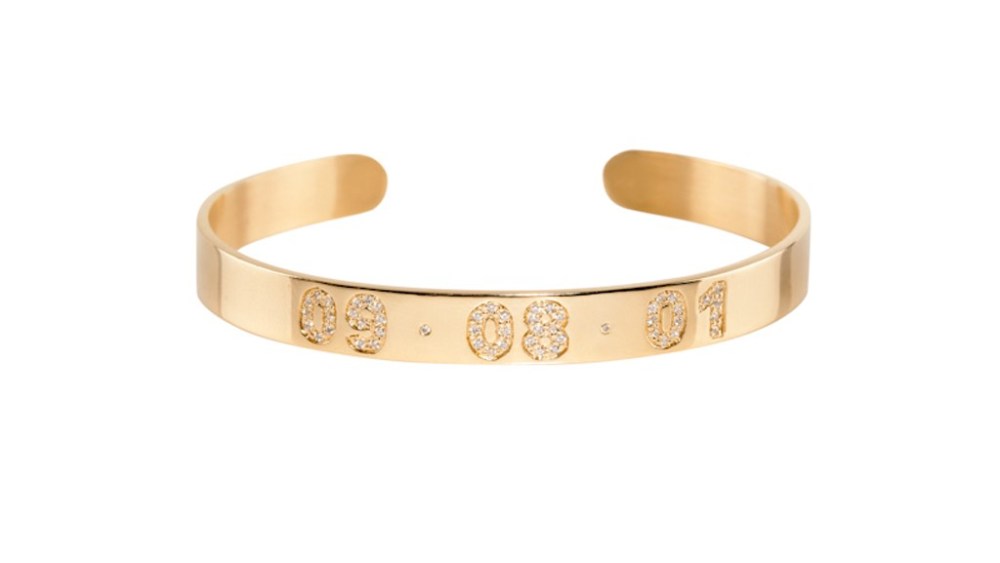
Among the popular and personalized styles: Fisher’s 14-karat gold cuff with customized dates engraved in white diamonds ($5,000), Bidermann’s interchangeable charm bracelets (charms start at $3,415) and Jennifer Meyer’s engraved nameplate necklaces, a popular piece at Ylang 23, where Teichman sells “usually at least one a day” of the style (prices start at $1,150).
But while consumers may be looking for the unique, they increasingly want it to be wearable rather than simply collectible. One fine jeweler, who requested anonymity, recounted how last month a customer who regularly spends $100,000 annually with the firm came in for her yearly spree. While her husband kept pushing pieces that cost six figures, she instead opted for several pieces in the $10,000 range, explaining she wanted things she could wear every day rather than a single piece that would spend most of its life locked in her safe.
Looking to this year, Quinlan expects fine jewelry sales to continue at its current level, as consumer spending continues to stabilize, and both retailers and designers do their part to provide customers with a worthwhile and engaging retail experience. “They have to reach out to the consumer, create the experience, make them aware of what they have to offer, and continue to evolve their collection,” she said.