
The Swarovski family is all about sharing its values with the wider community, whether it’s setting up its Swarovski Foundation to facilitate charitable giving or throwing open the doors to Crystal Worlds, its revamped museum-meets-theme park in Wattens, Austria, which is set to open in April.
To reinvent Crystal Worlds, which first opened in 1995, Swarovski has spent around 34 million euros doubling the size of the attraction to about 19 acres, which Markus Langes-Swarovski said would take the destination’s Chambers of Wonder concept — previously limited to immersive crystal installations inside the attraction — into Wattens’ Alpine landscape, so “the sun hits crystal and it begins to sparkle.”
Related Articles
The site will boast five new Chambers of Wonder, designed by artists including Lee Bul from South Korea and Studio Job, a Belgian and Dutch design duo. Bul has created “Into Lattice Sun,” which Swarovski described as “a universe of crystal and mirrors,” while Studio Job’s design is called “Studio Job Wunderkammer,” and is fashioned to evoke “thousands upon thousands of short stories in the shape of movement, music [and] reflections,” the firm said.
You May Also Like
In addition, designer Tord Boontje is designing one of the chambers, and a highlight of the installation will be “Silent Light,” the tree that Boontje created with Alexander McQueen for London’s Victoria and Albert museum in 2003, which is made up of 150,000 angular crystals.
Despite the conceptual nature of the projects, Langes-Swarovski aims for the new Crystal Worlds to have a “democratic approach,” appealing to all ages.
“Because of the crystal, you don’t need to explain the value,” he said, referring to its sparkling nature. “With Swarovski, it comes naturally, [a child would] already appreciate it because of the properties of crystal.”
He expects that the revamped Crystal Worlds will see around 800,000 visitors a year, up from the most recent count of 750,000 visitors — the largest group of whom come from China — who have made the location Austria’s second most-popular tourist attraction.
Indeed, such is Crystal Worlds’ popularity with overseas visitors, Langes-Swarovski said taking the concept to other locations is a topic that the family “often discuss.” He said following the Wattens reopening, the firm will plan to think about that move in “a very active manner.”
But thinking about community experience isn’t all about fun, nor is it a new concept for Swarovski — it’s woven into the firm’s DNA. Nadja Swarovski describes her great-great-grandfather Daniel Swarovski as “a philanthropist who did so much for his employees.”
When Swarovski set up the business in Wattens in 1895, in tandem with the growth of the crystal manufacturing, he set out on an altruistic path of providing water-powered electricity for the community, along with repairing bridges, opening a primary school and a medical center, and setting up a restaurant for current and former employees near its headquarters.
The latter grew from the tradition of Daniel’s wife, Marie, who personally made lunch for all the employees, with a restaurant being set up as she struggled to cook for the growing ranks of staff.
Indeed, in Daniel’s memoir, he wrote that “a precondition for your long-term success is that you endeavor to think not only of yourselves, but also of your fellow human beings. Those who adhere to this condition will certainly be blessed with success.”
And now, his great-great-grandchildren are continuing and building on that belief. In 2013, the family launched the Swarovski Foundation as part of the firm’s commitment to charitable giving, relating both the community and the spheres of the environment, health, arts and culture. With its launch in Venice, the Swarovski Foundation announced the funding of the restoration of the statue of San Giorgio in the city, which sits atop the Basilica di San Giorgio Maggiore.
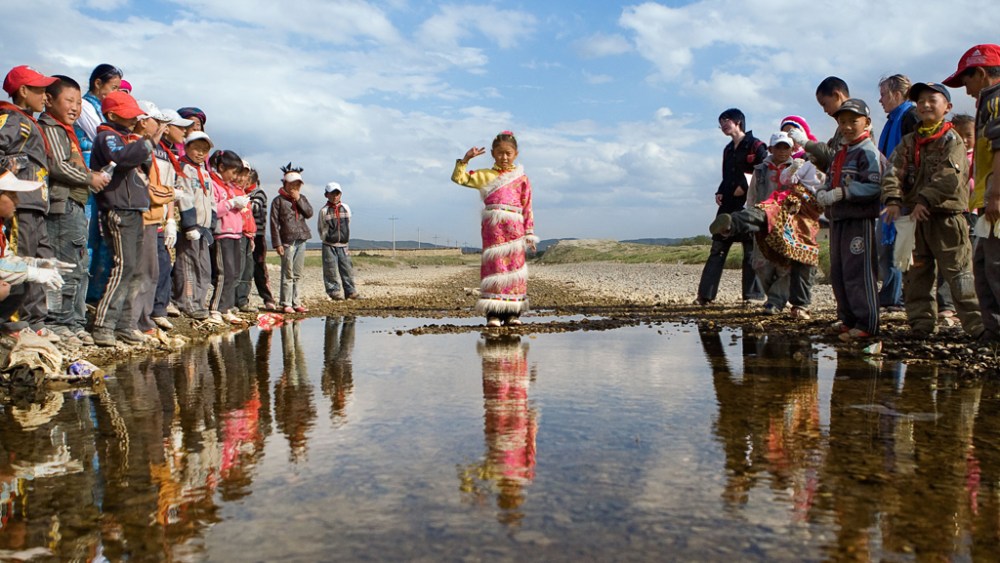
There are also ventures such as the Swarovski Waterschool, which is part of Swarovski’s corporate responsibility strategy, and aims to spread the message of sustainable water use, taking its cues from how important hydroelectricity was in setting up the original Swarovski factory.
The venture has been active in Austria, India, China, Uganda and Brazil. Projects include helping to restore the ecological integrity of the Yangtze river in China, and providing clean water and developing sustainable water supplies in Uganda.
“With all the things that we are doing…sometimes we feel we are doing the job that the government should be doing,” said Nadja Swarovski of the foundation’s work.
Other notable activities that are part of the foundation’s work include supporting Nest, a charity that helps artisans to build sustainable business and aims to alleviate poverty, empower women and promote peace. The Swarovski Foundation funded Nest’s Varanasi Project in India, supporting Nest in bringing sustainable resources such as clean water, healthcare, education and ways to empower women to Varanasi’s weaving community.
The foundation also supports Women for Women International, a non-profit humanitarian organization that helps marginalized women in countries affected by war and conflict. Nadja Swarovski acts as one of the organization’s ambassadors, saying she sees the company as having a “fundamental responsibility to actively engage with and promote women’s rights,” particularly in light of its large female workforce and predominantly female customer base.