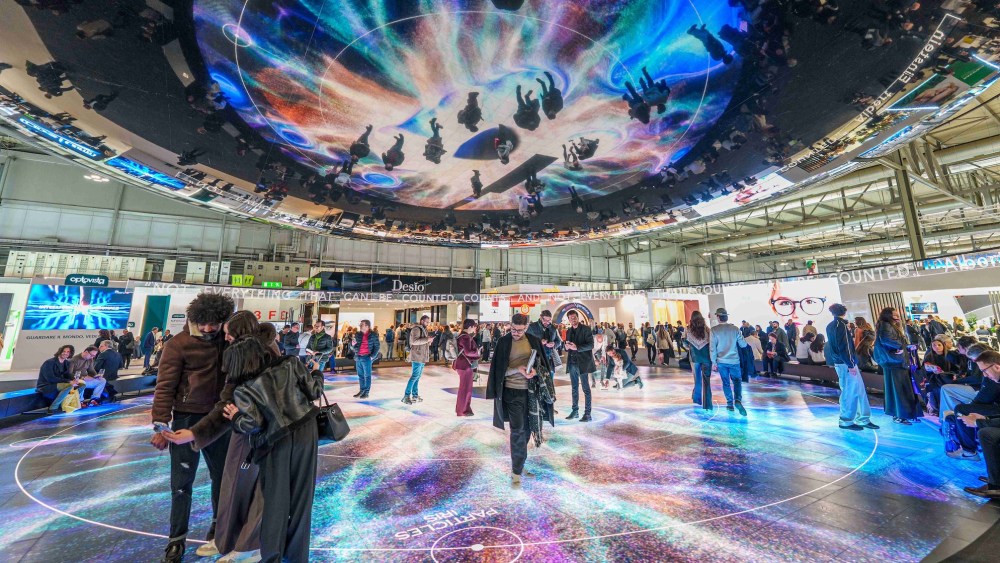
MILAN — Against an uncertain outlook for the fashion industry at large, eyewear has emerged as a resilient segment, better positioned to weather macroeconomic headwinds, including tariffs, weaker U.S. exports and geopolitical instability that has dented consumer confidence.
The three-day eyewear trade show Mido, pushed back by a week to avoid overlaps with the Milano Cortina 2026 Winter Olympics, closed here Feb. 2 attracting 42,000 visitors from more than 160 countries, in line with 2025 figures.
Related Articles
Over the long weekend, the fairgrounds buzzed with industry operators discovering the spring 2026 collections of more than 1,200 exhibiting brands.
You May Also Like
Lightweight metal frames, retro-looking sunglasses popular with Gen Z, pastel hues and performance-intended eyewear dominated the collections, while smart eyewear technologies popped up here and there, signaling the category’s growing appeal.
2026 Industry Outlook
According to preliminary figures provided by Italian eyewear association Anfao, the industry is expected to log sales of 5.64 billion euros in 2025, flat year-over-year.
Exports decreased 3.9 percent to just over 5 billion euros, weighed down by poor U.S. exports, which plummeted 33.3 percent in 2025 amid tariffs introduced in the second half of the year, Anfao said.
This was partially offset by growth in Europe, where exports rose 8.1 percent; China, up 20.6 percent year-on-year, and Mexico, which increased 10.7 percent.
“Among the main ongoing complexities is the progressive depreciation of the dollar, within a complex and volatile global context, particularly influenced by the instability created by tariffs,” said Safilo Group’s chief executive officer Angelo Trocchia.
As reported, the publicly listed eyewear firm reported a 1 percent decline in preliminary 2025 sales to 983.4 million euros. At constant exchange, sales were up 1.8 percent. Earnings before interest, taxes, depreciation and amortization margins improved to 10.8 percent, up 280 basis points versus 2024, driven by price adjustments in North America, sourcing shifts outside China and favorable price-mix dynamics, Trocchia said.

“For 2026, amid the ongoing challenges and complexities of the geopolitical and macroeconomic environment, which will continue to influence top-line growth opportunities, the group remains focused on its strategic drivers to develop the business both organically and through selective acquisitions,” the CEO told WWD.
“For 2026, we’re being cautious. Early signs at the start of this year are looking good,” said Barbara De Rigo, chief marketing officer of De Rigo, pointing to a solid 2025 performance despite uncertainty linked to U.S. President Donald Trump’s tariffs.
This year’s Mido marked the first edition since VSP Vision, parent of Marchon Eyewear, completed its acquisition of Marcolin, creating a new eyewear powerhouse seen fueling the polarization of the sector. In the nine months ended Sept. 30, Marcolin posted net sales of 416.6 million euros, up 2.1 percent compared with a year earlier.
As reported, Nicola Zotta was appointed president of eyewear and managing director of both companies, tasked with steering their integration and chart the next phase of growth.
Independent players dealt with uncertainty with resilience, too.
House of Modo — the eyewear group comprising the Modo, Eco, Italia Independent and EyeFly brands — logged a 10 percent increase in 2025 sales.
“We gained new market share despite a challenging environment, especially for independent players,” said Giovanni Lo Faro, Modo’s CEO, international. “There is growing interest for indie companies with a clear DNA and history versus [fashion] brand extensions in eyewear…and we’re well positioned to acquire more market shares in 2026,” he predicted.
The company was less exposed to U.S. tariffs thanks to its Stateside operations. “The U.S. has remained the strongest and most vibrant and energetic market for us,” Lo Faro said.
For the Swiss Akn Group, 2025 was transformational with the acquisition of Switzerland-based eyewear brand Götti and premium lens company Eyetech, alongside the termination of the Valentino license, handed over to Kering Eyewear, and the exit of creative director Olivier Rousteing from Balmain, for which the company holds the eyewear license. The brightest spot was the house brand Akoni, which posted an 18 percent sales growth, said founder and CEO Rosario Toscano.
“The U.S. market did not expand due to price increases linked to tariffs on our Made in Japan products,” Toscano said, citing also higher raw materials costs in light of the weaker yen. Still, he forecast a 30 percent sales increase for Akoni in 2026, driven by the recent expansion of its footprints in China, Hong Kong and Taiwan and a potential U.S. rebound. He is plotting a retail debut for Akoni in 2027.
At group level, he forecast a 25 percent increase in 2026 revenues, which will be driven mainly by geographic expansion.
Optimism for 2026 was echoed by Cedric Moreau, CEO of Barton Perreira, under the umbrella of the LVMH Moët Hennessy Louis Vuitton-owned Thélios. “We’re developing global markets, restructuring our procurement department for better forecasts, analytics and service levels. We’re focused on service excellence, improving delivery times and increasing stock availability,” he said.
The Berlin-based eyewear brand Mykita reported single-digit growth across all regions and channels last year, including Asian markets, the leading U.S. market, as well as Germany, Italy, France and South Korea. “It was a dynamic year, confirming we’re on the right path,” said founder Moritz Krueger.
Ditto for the Brazilian brand Lapima, founded by Gisela and Gustavo Assis, which reported 40 percent growth in European orders for 2025 and is now focused on increasing its market share in Japan, where it debuted last April.
Italian brand L.G.R. helmed by Luca Gnecchi Ruscone, logged a 20 percent revenue jump last year and is set to open its first Middle Eastern flagship in Abu Dhabi’s Saadiyat Grove Mall next April. The brand is seeing strong growth in the U.S. — its top online market, driving more than 30 percent of digital sales.
Overall, Anfao described 2026 as a year of “gradual rebalancing,” forecasting sequential improvements in the U.S., consolidation in Europe, and stronger momentum from Asia and the Middle East.
Hopes on the European Union trade deal with Mercosur — the South American bloc that includes Argentina, Brazil, Paraguay and Uruguay — were tempered after the European Parliament voted to delay the deal’s ratification, referring the pact to the European Court of Justice to examine whether it is compatible with the bloc’s existing treaties.
“We’ve already been growing steadily in the region….There is a lot of appetite for brands with a European flair and the right positioning,” Lo Faro said.
Toscano stressed that Akn Group’s strategy is consumer-led rather than market-driven, aimed at recruiting the wealthy pack shopping for eyewear that can retail for more than $1,000.
“Geographies are defiant…our strategy will always tap into our target customers rather than a country,” he said.
De Rigo expressed her optimism for the Mercosur deal to eventually materialize, while highlighting the growing importance of India, among the emerging markets.
Are House Brands the Next Big Thing?
Eyewear companies are increasingly investing in their house brands, which offer greater creative and innovation freedom and stronger margins.
EssilorLuxottica has been zeroing in on its Meta tie-ups for the proprietary RayBan and Oakley labels, as well as Nuance Audio, a convergence of eyewear and hearing aid devices, for example.
“Our portfolio has long been, and continues to be, one of the group’s core strengths. EssilorLuxottica benefits from an unparalleled ecosystem of more than 150 globally recognized brands…[which] allow the group to serve consumers across mid-range to premium segments, while maintaining strong resilience and balance across geographies and categories,” said Matteo Battiston, global design and market research director at EssilorLuxottica.
“While protecting and strengthening brand equity remains a top priority, supported by sustained investments to combat counterfeiting and parallel markets across the portfolio, EssilorLuxottica continues to selectively explore new licensing deals, partnerships and growth opportunities that align with its strategic pillars, innovation roadmap and long-term value creation,” he offered.
Meanwhile, Safilo singled out the David Beckham eyewear line, for which it hosted a party in Milan attended by the namesake soccer champ ahead of Mido, as well as the Carrera brand as top contributors to growth in 2025 and going forward.
“From a portfolio perspective, growth [in 2026] will be driven by a well-balanced mix between proprietary and licensed brands, with proprietary brands representing around 50 percent of the portfolio. This allows us to strengthen margins and brand equity through our house brands, while continuing to leverage the visibility, desirability and market reach of licensed brands. This balance gives us flexibility and resilience across geographies and customer types,” Trocchia said.
“I don’t believe in pursing licensing deals for the sake of it,” Toscano said. “I believe that the licensing model in eyewear has become a tad outdated. One needs to bring added value to the brands it collaborates with. I think Hermès would be a great fit for us because we’re able to create products aligned with the French brand’s ethos and standards,” he said, teasing potential new opportunities ahead.
Cracking Smart Eyewear
Driven by a strong marketing push and enhanced user experience, smart eyewear seems to be gaining traction.
Arguably the company that has set the strongest standards in the category, EssilorLuxottica “is entering a profound transformation, moving beyond product-focused innovation toward experiences that carry meaning and lasting relevance….Eyewear is evolving into an intelligent, context-aware companion, anticipating needs, delivering timely support and enhancing everyday life in a natural way,” according to Battiston.
“Artificial intelligence is playing a central role in making eyewear increasingly adapt to individual behaviors and environments. At the same time, design is becoming even more central. As technology fades into the background, true differentiation will come from desirability….In this sense, wearables are evolving into cultural objects, widely desired, not merely gadgets,” he said.
To this end, consumers are waiting for the global rollout of the Meta Ray-Ban Display model, which integrates a display in the right lens to show wearers incoming messages, previews of photos to capture, video calls and visual AI information. They are currently available in the U.S. only.
Other players are tailgating on the leading position held by the eyewear juggernaut.
Forecasting the increased appeal and development of digitally enabled products, Trocchia touted the Carrera Amazon smart glasses, introduced to the U.S. market in 2023.
“Safilo is very interested in the topic and is studying the evolution of the sector. Our priority is to find solutions that can meet the real needs of consumers. We are working on it, and we will take action at the correct time to fulfill the market needs,” the Safilo CEO said.
House of Modo debuted EyeFly at Mido, a new brand integrating open-ear audio, built-in microphones supporting calls and voice interactions, hand-free connectivity and touch-sensitive temples to enable one-tap controls.
“Reception has been great, with a good number of orders placed over the past three days,” Lo Faro said. “Interest proved to be not only theoretical but factual,” he said.
The viral Henry Jullien brand — part of the Italian group iVision Tech that shot to fame after French President Emmanuel Macron wore its sunglasses at the Davos World Economic Forum last January — introduced the fast-charging HJ Tech smart eyewear line, which features open-ear audio, Bluetooth connectivity and interactive controls.
Embracing a different technological route, the New York-based Chamelo brought its mind-blowing tint-adjusting lenses and open-ear audio frames to the fair.
A new model called Lion City and crafted from premium acetate boasts the company’s RX-ready, patented HVL technology which allows the wearer to change the color of the lenses, cycling through four nuances by tapping the right temple. It is combined with open-ear connectivity controlled via the left temple.
The Frames for Spring 2026
The spring 2026 collections highlighted that eyewear players are paying attention to TikTok’s numerous trends, from the retro-looking aesthetics and pastel-hued frames beloved by Gen Z to gorpcore trickling down to everyday attire.
The vintage look was ubiquitous, from Persol’s acetate Pilot shades and Isabel Marant’s tiny oval Havana or ivory white frames to Web’s 20th anniversary models in acetate with a metal torchon embedded in the bridge, and Max & Co.’s wraparound styles. The Haider Ackermann-designed Tom Ford slim shields had a retrofuturistic spin, while at Lapima, the narrow oval frames Penny, a nod to skateboarding, mingled with Coco, an ultra-feminine cat-eye style inspired by surfboards and their swallowtail shape, presented in matching frame and lens colors.
To be sure, eyewear featuring tonal lenses and frames emerged as a strong trend, seen also at Italia Independent in the Elegia slightly cat-eyed model in a red-to-pink gradient with the signature logo embossed in contrasting light blue around the hinges, and in Longchamp’s Aviator style in olive green with matching lenses.
Color reigned supreme, from Akoni’s Mars-inspired, orange-y red lenses for the fifth anniversary brushed gold model Eris, inspired by vintage silver lighters, artisanal timepieces and fountain pens, to Marc Jacobs’ oversize butterfly sunglasses with light orange lenses or in Mykita’s Lite Powder collection crafted from circular stainless steel, an innovative powder coating that enhanced the standout neon pink frames.
At Barton Perreira, minimal aviator styles in lightweight and light-colored titanium came with gradient pink lenses, while L.G.R. introduced a new generation of mineral glass polarized lenses developed with Barberini, enriched with Terre Rare, or rare earth minerals, including neodymium, praseodymium and erbium, which filter light wavelengths to boost color separation, depth and contrast while maintaining transparency.
Come next spring, shields and masks will no longer be confined to weekend getaways in the great outdoors. Numerous urban iterations on the performance models were on display at the fair.
These included the Carrera Eyedra semi-rimless style and Canada Goose’s Summit wraparound acetate model equipped with Sideris lenses for enhanced vision, as well as Scuderia Ferrari’s sports-appropriate, superlight shield shades and Akoni’s Altitude Series, a capsule of three models in colored clear acetate mounting performance Eyetech lenses.
Expanding its collaboration with Zac Efron, who fronts the brand’s last ad campaign, Police by De Rigo Vision introduced an rPET mask boasting and the registered IRID electronic lenses that adapt to changing light in 0.09 seconds — 100 times faster than conventional photochromic lenses, according to the company.