Efforts to implement effective ESG practices — including achieving Scope 3 emissions — seem to have reached an inflection point for the fashion industry. Spurred on by the effect of climate on weather and the environment, policymakers are demanding action, and now.
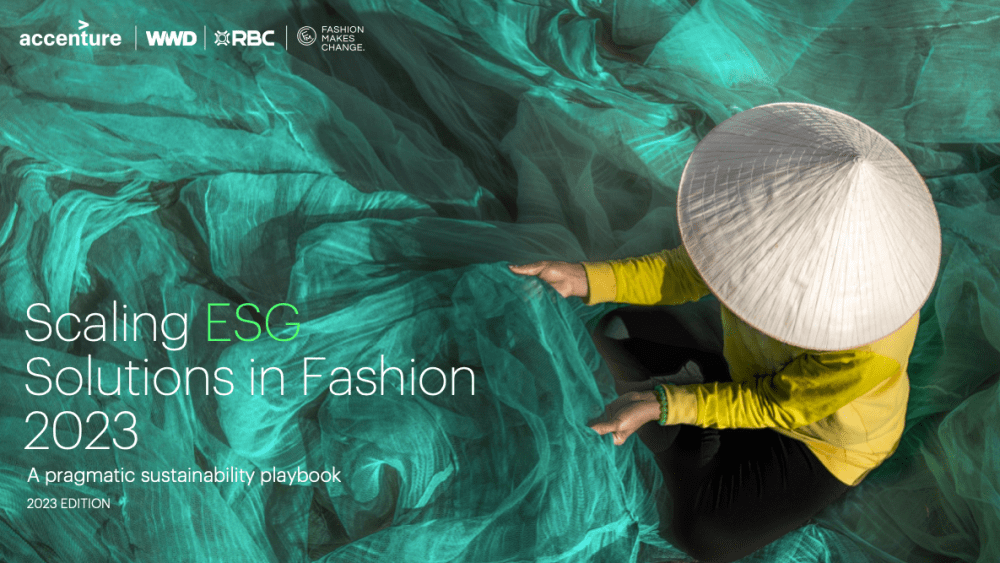
To help retailers and brands accelerate their initiatives, Accenture’s follow-up to last year’s ESG report is a playbook of actionable steps. “Scaling ESG Solutions in Fashion 2023: A pragmatic sustainability playbook,” is 70 pages and was created via a partnership between Accenture, the Fordham Responsible Business Center and Fashion Makes Change. WWD got a preview of the report, which will be presented at WWD’s Sustainability Summit later this month.
Related Articles
[To get a copy of the Accenture report, CLICK HERE.]
You May Also Like
In the report, the authors acknowledged that reaching ESG goals has been difficult and fraught with setbacks. And even as the goalposts have moved, the work remains challenging. Still, recent ESG coalitions are making progress and are having a positive impact, the report said, adding that the latest Fashion Industry Charter for Climate Action Progress Report from the UNFCCC “revealed that 44 percent of active signatories have set public climate targets to remain below 1.5°C of global warming — up from 23 percent in 2020.”

The report’s authors said to guide and accelerate progress further, the 2023 ESG playbook contains “a call for continued collective action — for companies both advanced and new to the ESG journey — on 12 priority areas for transformation.”
The areas focus on carbon, circularity, plastics, labor rights and customer engagement, among others. Each area presented includes current initiatives, practices and technologies that can be leveraged and adopted right now by retailers and brands. Moreover, the playbook spans the entire value chain from forecasting, sourcing and material creation to product design, procurement and merchandising. It even explores marketing and distribution.
But there’s another dimension of the report that examines issues outside of worker rights: human rights. “Beyond climate, fashion’s ability to accelerate cultural change also provides a unique opportunity to move the needle on gender disparity, poverty and race discrimination,” the report stated. “By forging new practices, brands are becoming responsible stewards not only of their businesses but of society.”
Another key aspect of the 12 priority areas is the education of the consumer, which the marketing teams of fashion retailers and brands can take on. Recommended goals and action steps include using existing third-party verifiers “to ensure high-quality product certification and verification — gaining consumer trust and avoiding greenwashing.” The report urges brands and retailers to adopt digital labeling solutions to effectively communicate product sustainability while implementing “an industry-wide data sharing framework to collect and share data, driving alignment toward product-level sustainability claims.”
Interested in learning more? Join us for the WWD Sustainability Forum: Scaling ESG Solutions, which is presented by Accenture. The virtual event takes place June 20 at 11 a.m. EST and will also be available on-demand. CLICK HERE for more information.