PARIS — Energy sobriety. The phrase may have been coined by French president Emmanuel Macron as part of his plan to reduce national power consumption, but like any good trend, LVMH Moët Hennessy Louis Vuitton is taking it global.
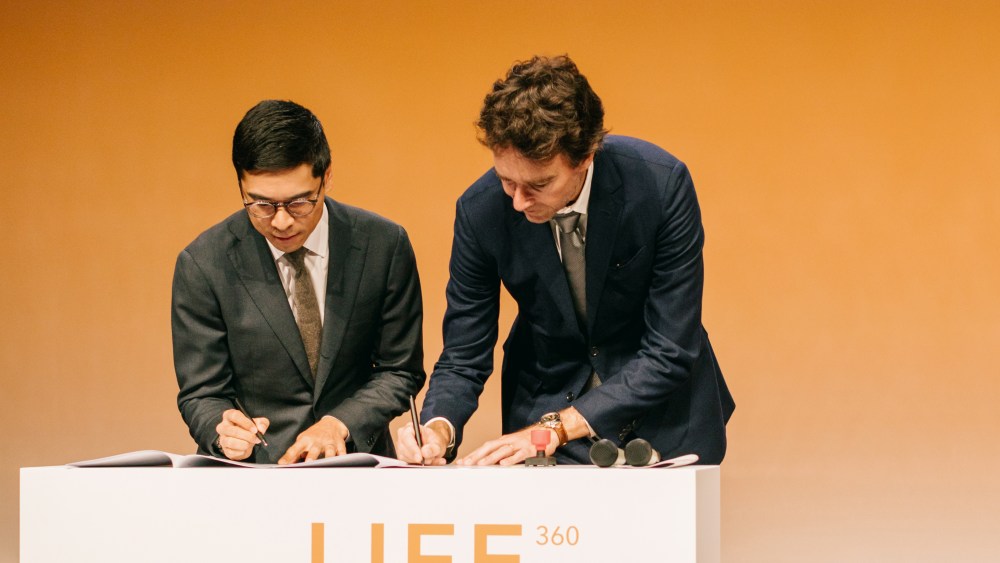
The world’s largest luxury group is partnering with Hong Kong-based real estate developer Hang Lung Properties to reduce their energy consumption. LVMH head of image and environment Antoine Arnault and Hang Lung vice chair Adriel Chan took part in a splashy signing ceremony Tuesday, with the groups committing to a three-year partnership.
Related Articles
Hang Lung Properties will cut its energy consumption by 18 percent by 2025 across its 100 shopping malls, in part by turning off shops’ lights outside of business hours, while LVMH committed to measuring and tracking energy consumption at its stores and sourcing 70 percent of its materials within 300 miles. This follows LVMH’s overall energy reduction plan, which aims to cut consumption 10 percent worldwide by October 2023, which was announced Sept. 15.
You May Also Like
“As far as sustainable development is concerned, I think we are pioneers – as far as philosophy is concerned, and as far as mindset is concerned,” said Arnault of his efforts to overhaul the group.
“As virtual spaces continue to flourish, we strongly believe that physical experience must retain its importance, because it constitutes one of life’s enjoyable pleasures…[and] the excellence of our stores extends to their environmental excellence,” he said. Arnault noted that they do not always have direct control of their properties and thus are not able to ensure those shopping center units adhere to LVMH’s environmental standards. “Ambitious environmental objectives must therefore be shared by both partners or there is a risk that these goals will not be achieved.”
Arnault praised Hang Lung for working collaboratively: “A landlord that shares our environmental ambitions as well as our belief that partnerships are a powerful driver for positive change,” he said. LVMH has 97 stores in mainland China through Hang Lung Properties.
“This partnership will make a positive impact in real estate and retail globally,” said Chan, noting that China aims for carbon neutrality in 2060, while the group aims for 2050. “This brings me to one of my favorite aspects of sustainability, the fact that it is a positive sum game, in what often feels like a zero-sum world. We’re setting an important example for the entire real estate sector. And we hope that it will inspire many more collaborations with our other tenants, and for LVMH with their other real estate partners.”
Arnault noted that they are now seeking out similar agreements with property groups in the U.S. and Europe.

The signing was part of LVMH’s “Life 360 in Stores” conference, which awarded some of the group’s maisons including Hublot, Berluti, Fendi and Loewe, as well as multibrand retailers Sephora, DFS and Le Bon Marché, for innovations.
LVMH environment development director Hélène Valade discussed the company’s commitment to reducing its energy use. “We have been in a context of very high tension on the energy market, in particular on the electricity and power market and we have tried to act proactively to present a plan for energy sobriety,” she said. “We do things which are more profound in terms of energy efficiency, because we are talking about issues which are complex, sophisticated in a city.”
Éléonore de Boysson, president of DFS in Europe and the Middle East, said the group’s Paris department store La Samaritaine has reduced its energy consumption significantly. While they don’t have hard numbers just yet, it could be up to 40 percent, she estimated. De Boysson noted the historical building installed all LED lighting during its renovation, and that DFS recently launched an internal education campaign for employees. “It was easier because we have a very young team, and all the young people have a very high awareness of these issues, so it was quite easy to mobilize them,” she said.
The reductions are also helping the bottom line and making the financial argument for environmental programs, said Valade. “We can also talk about the economic challenge, because the power and electricity invoices are going down, and this supports the environmental transition that we need.”
Stores are reporting bimonthly numbers on energy use so the group can accurately set targets and monitor reductions, group deputy director of environment Alexandre Capelli told WWD. The plan has been implemented across France, and will be applied across Europe on Nov. 1. It will roll out to the rest of the world in the first quarter of 2023 in order for the group to reach its targets by the end of the year.
The conference also served as a small preview of an upcoming retail, real estate and climate forum that will be cohosted by LVMH and Hang Lung to discuss further ways property developers can reduce their energy use.
Valade said the conference is the first of its kind and aimed at “cocreating” solutions. “It is also the first time with LVMH and the Hang Lung team to define the duty of each one to ameliorate the environmental management of boutiques, in a collaborative partnership,” she told WWD. “The precise measures are not yet defined, but we thought it would be more effective to sit down with LVMH teams and operational teams to discuss and decide formats to make our work, construction, mobilization and valuation more efficient.”
“We are highly anticipating it,” she added.
That conference will take place Nov. 24 and 25 simultaneously in Paris, Hong Kong and Shanghai.