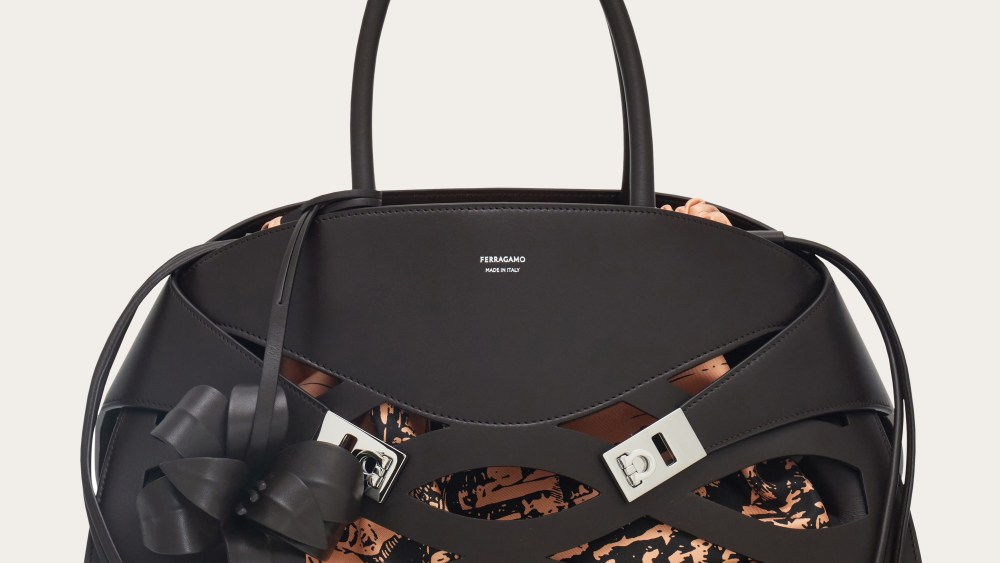
MILAN — “Sustainability pertains to Ferragamo inherently, it was born sustainable out of necessity,” said James Ferragamo.
In his role as chief product officer, he recalled how his grandfather Salvatore started employing cork, straw or fishing lines for his shoe designs due to the shortage of leather and metals caused by World War II. “This sparked creativity, the limitations were actually a source of inspiration,” contended Ferragamo during an interview at the brand’s Milan headquarters on Wednesday, globally recognized as Earth Day.
Related Articles
Indeed, flanked by Davide Triacca, sustainability director, Ferragamo underscored that innovation and prioritizing natural and bio-based materials continue to be the company’s North Star.
You May Also Like
“We are testing two materials that we hope to have in production soon; one is a yarn made from castor oil, without the use of any chemical derived from petrol, and it has the look and feel of nylon, and can be used for both accessories and ready-to-wear,” said Ferragamo.
The other is a yarn made with regenerated scraps of leftover leather, which, woven with Italian biologic and organic cotton, creates a fabric that is both “beautiful and resistant,” he said.
Over the years, Ferragamo has explored different natural materials, for example launching in 2017 a capsule collection made with the patented Orange Fiber, then the first fabric in the world made with citrus fruits, for a twill that looked and felt like silk.
Triacca proudly said that Ferragamo has been included for the first time in the S&P Global Sustainability Yearbook 2026, which recognizes the company as a top sustainability performer in the luxury sector, and among the top 15 percent of companies in the textiles, apparel and luxury goods industries.
Also, he pointed out that, as part of the CDP (Carbon Disclosure Project) on climate change, Ferragamo in 2026 achieved an “A” score, positioning it among the top 4 percent of global performers, “out of the 22,000 companies they evaluate. It’s easy to tout sustainability, but we have the numbers to substantiate it,” he said, praising James Ferragamo’s “vision, solid and well-structured governance that he set up, and the activations that have been propulsive.”
The Ferragamo heir, son of former chairman Ferruccio, said the first priority is “mainly the most obvious, net zero emissions as a measurable commitment by 2050.”

Since 2023, the company has reduced its total emissions by over 19 percent and, last year, its directly operated sites ran on 100 percent renewable energy, through GOs (Guarantees of Origin). Also, in 2025, over 80 percent of Ferragamo’s key raw materials were certified according to internationally recognized sustainability standards, more than 90 percent of packaging was made from paper or cotton, and 97 percent of suppliers were based in Italy, with half of its manufacturers in Tuscany.
The company employs 3,300 people globally, of which 650 are in Florence, and counted 350 stores at the end of 2025.
Another significant step the company has taken is the investment in protecting four species of native cows in Tuscany that risk extinction. “We are working with the Tuscan region and the Florence University offering incentives to the farmers to keep them alive,” said Ferragamo. This is part of the goal to use hides closer to home.
Asked about leather, which can be seen as controversial speaking about sustainability, Triacca said that “leather is 3.5 percent of the financial value of a cow. Sure, we all eat too much meat but the hide that is not reused would only become waste. We like to say that the alternative to leather is better leather, and we aim to reduce its impact by working with suppliers.”
Ferragamo guarantees that 98 percent of the tanneries it works with are certified.
The executive waved away the idea that sustainability is costly. “It gives value. We are in the business of luxury and the parameters we work with help to develop products for customers that are durable and will have lesser impact on the environment.”
Triacca said that “customers expect this from a luxury company, and we must respect the highest standards. The biggest mistake we avoid is to place the cost of sustainability on the customers.”
The Ferragamo company, which will report its first-quarter sales on May 14, is in the midst of a turnaround, with a focus on its core footwear and leather goods categories, a strategy confirmed by James Ferragamo.
On Monday, Ferragamo Finanziaria SpA, the holding company of the Ferragamo family and the controlling shareholder of Salvatore Ferragamo SpA, appointed Fabrizio Freda as special strategic adviser.
Asked to comment on this move, James Ferragamo said that Freda “will help the family to make decisions and ensure a deeper engagement with the controlled company compared to the past. He can advise on strategic direction and positioning and this engagement will contribute to an exchange of opinions, which is always helpful.”
He confirmed the Ferragamo family’s commitment to the fashion group in the long term, dispelling rumors about a divestment, with a smile defining it a “subcutaneous” engagement. He also gave no indication as to the timing of the arrival of a chief executive officer, saying the search is ongoing.
Since the exit of Marco Gobbetti as CEO of Salvatore Ferragamo last March, executive chairman Leonardo Ferragamo has been spearheading the strategy of the company with a transitional chairman advisory committee. It comprises James Ferragamo; the company’s former chief financial officer Ernesto Greco, and former CEO Michele Norsa, who has taken on the role of special chairman adviser.
Freda retired from his role of president and CEO of The Estée Lauder Companies in December 2024, having joined the group in 2009. Previously, he held roles of increasing responsibility for about 20 years at Procter & Gamble.