“We are very busy in the White House today working on Trade Deals,” Truthed President Donald Trump on Wednesday afternoon.
A flurry of trade announcements, from 25-percent tariffs on India and a complete kibosh of the de minimis trade exemption, effective next month, spilled out of 1600 Pennsylvania Ave.
With the Aug. 1 tariff deadline less than two days away, Trump broadcasted on social media that he had “spoken to the Leaders of many Countries, all of whom want to make the United States ‘extremely happy.’”
Related Stories
India may yet be among them, despite the president’s tariff announcement earlier in the day. The country’s status may not be solidified, with Trump saying in a press conference that the administration is still negotiating with Indian trade officials.
One sticking point appears to be its membership in the BRICS Alliance, the trade bloc also comprised of Brazil, Russia, China, South Africa, Iran, Saudi Arabia, Egypt, Ethiopia, the United Arab Emirates and Indonesia. The president referred to the collective as “a group of countries that are anti the United States,” adding that the group aims to weaken the U.S. dollar, as BRICS has floated the idea of creating its own unified currency.
Trump also, again, underscored the “tremendous deficit” in trade with India, but indicated a willingness on the part of the country’s government to lower trade barriers with the U.S. in order to remediate the issue. “They have one of the highest tariffs in the world. Now they’re willing to cut it very substantially. But we’ll see what happens,” he added, saying that a resolution will be reached by the end of the week.
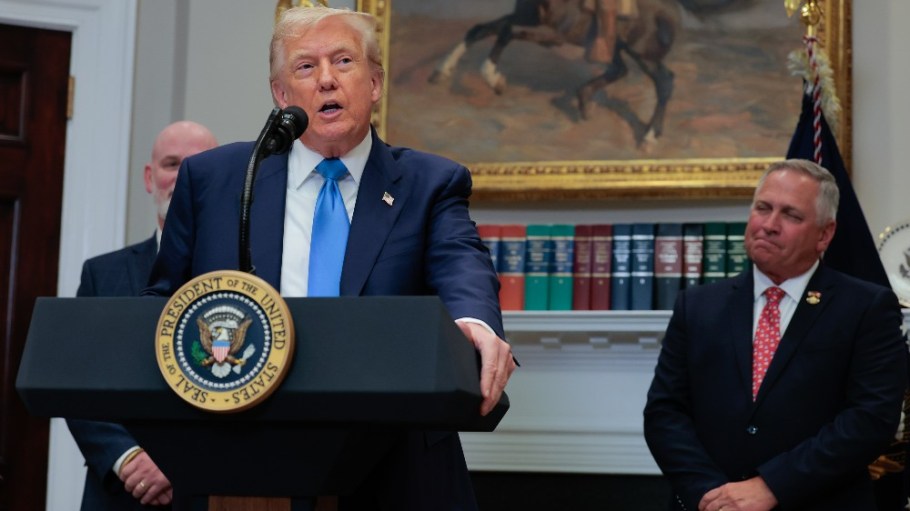
“August 1 is very big day for this country, because money is going to pour into the United States like we’ve never seen before,” Trump told reporters at the White House.
India was far from the only country attempting to bend Trump’s ear, the president wrote on Truth Social, saying he’d soon be meeting with a South Korean delegation eager to knock down the threatened 25-percent duties to a more manageable rate via an undisclosed “offer” to the U.S. “I will be interested in hearing what that offer is,” Trump wrote.
He also announced the conclusion of a deal with Pakistan, wherein the country will work with the U.S. on developing oil reserves.
“Likewise, other Countries are making offers for a Tariff reduction. All of this will help reduce our Trade Deficit in a very major way,” he added.
While speculation abounds regarding the future of many of the country’s trade relationships, the question of how the president plans to handle Brazil after threatening the country with sky-high 50-percent tariffs earlier this month has been answered, albeit disappointingly for the South American nation.
An executive order signed by Trump and released by the White House Wednesday afternoon said that Brazil will ultimately face 40-percent duties on goods imported into the U.S.—a small consolation barely worthy of the word, considering it faces the highest duty rate of any country or trade bloc announced in recent weeks, significantly higher than the 10 percent promised by the president on “Liberation Day” four months ago.
The president cited Brazil’s indictment of its former president and Trump ally Jair Bolsonaro, along with a recent ruling that U.S.-headquartered social media platforms should be held accountable for certain user content, as reasons for the import tax boost. Notably, while Trump has targeted many trade partners for trade imbalances, the U.S. exports more to the country than it purchases from it. Last year, U.S. exports to the country totaled $49.7 billion, while imports from Brazil amounted to $42.3 billion—a surplus of $7.4 billion for the U.S.
Most global trade officials are clamoring for deals before Friday, but the trade truce between the U.S. and its foremost economic rival will persist for two more weeks.
The president’s stance on China appears to be softening, as he told reporters Wednesday that the negotiations are “moving along well.” Trump did not indicate whether he intends to extend the current bilateral tariff pause, which expires Aug. 12, though many (including his own cabinet members, who met with Chinese officials in Stockholm this week) have speculated that another three-month truce might be brokered.
“I think it’s going to work out very well. We’re right in step,” he told reporters. “I think we’re going to have a very fair deal with China.”