The handful of American small businesses behind the case against President Donald Trump’s tariffs are urging the Supreme Court to uphold the rulings of two lower courts, which deemed the duties illegal, when the case is heard next month.
This week, toy company Learning Resources and its co-complainants, along with V.O.S. Selections and its fellow petitioners, submitted briefs to the high court reasserting the reasons that Trump’s steep and sweeping tariffs, levied under the International Economic Emergency Powers Act (IEEPA), are illegal and detrimental to businesses and consumers in the United States, amounting to “an over $3 trillion tax increase on Americans over the next decade.”
Related Stories
Recent studies show that companies stand to pay least $1.2 trillion more in 2025 in tariff-driven expenses than they anticipated before the duties, and shoppers will eventually absorb 55 percent of tariff costs.
By asserting tariff authority under IEEPA, “the President with the stroke of a pen increased the Nation’s effective tariff rate tenfold to the highest it has been since at least World War II,” counsel for Learning Resources and other petitioners, like fellow toy firm Hand2Mind, wrote.
“In the months since, he has raised and lowered, paused and resumed, and threatened and unthreatened tariffs at will, for a grab bag of reasons,” the brief said. “IEEPA does not give the President such vast unilateral power.”
The complainants argued that in fact, IEEPA doesn’t give the president power to impose taxes or tariffs at all, and it hasn’t been used to do so during any of the 69 times it’s been invoked since it was established in 1977. Trump’s actions are an attempt to rewrite U.S. trade laws and reshape the country’s economy, they argued, noting that the authors of the Constitution understood taxation to be a “potent power” with the ability to harm those being taxed while filling “the sovereign’s coffers.”
Instead, that power rests exclusively with Congress, the brief said. “This Court should not lightly assume that Congress abdicated its core taxing power to permit the President to tax Americans with virtually no limits,” lawyers for Learning Resources wrote. “This Court should hold the IEEPA tariffs unlawful, and finally put an end to the unprecedented and unrelenting tax burden on Americans.”
The second group of companies, led by wine importer and distributor V.O.S. Selections, also filed a brief opposing both Trump’s liberal use of tariffs and the mutability of the administration’s decisions.
“Here, the government contends that the President may impose tariffs on the American people whenever he wants, at any rate he wants, for any countries and products he wants, for as long as he wants—simply by declaring longstanding U.S. trade deficits a national ‘emergency’ and an ‘unusual and extraordinary threat,’ declarations the government tells us are unreviewable,” the plaintiffs wrote. “The President can even change his mind tomorrow and back again the day after that. That is a breathtaking assertion of power, and one would expect to see an unequivocal grant of authority from Congress to support it—if the Constitution permits it at all.”
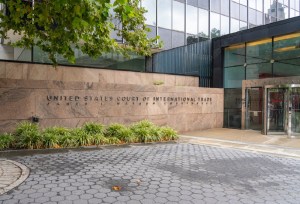
Last month, the Supreme Court agreed to hear the administration’s appeal of its tariff regime, which was declared unlawful by a New York-based Court of International Trade (CIT) this spring. The administration appealed that decision to a Washington, D.C.-based United States Court of Appeals for the Federal Circuit, which sharply scrutinized the administration’s use of IEEPA as a justification for the tariffs, and narrowly upheld the CIT’s decision.
The administration wasted little time in appealing the appeals court’s decision, imploring the Supreme Court to hear the case quickly and deliver a final ruling. The high court agreed to do so in early September, setting the date for oral arguments to begin on Nov. 5.
In recent weeks, Trump and his surrogates have sought to convey confidence that the tariffs will remain in place. But the administration has also been pushing forward with gusto on solidifying trade agreements with countries across the globe, as well as rolling out dozens of exemptions on imported products that aren’t produced stateside.
Meanwhile, the president is leaning on other mechanisms outside of his favored trade law, IEEPA, to levy tariffs on a number of imports. Most recently, Trump utilized Section 232 of the Trade Expansion Act of 1962 (which allows the Commander in Chief to take action against certain imports if the Secretary of Commerce deems them a threat to national security) to impose 25 percent tariffs on trucks and truck parts, along with 10 percent tariffs on buses, which will take effect Nov. 1.
Trump said last week that he intends to watch the Supreme Court proceedings.