In the release of the annual Trade Policy Agenda and report on the past year, United States Trade Representative Ambassador Jamieson Greer said he aims to “double down on the America First Trade Policy in 2026 to capitalize on the wins from 2025 and keep momentum going for domestic producers and the U.S. economy.”
The Trump administration is slated to continue pushing its trade policy with an eye toward further driving down the pervasive trade imbalances that it used to justify its wide-ranging tariff strategy, the USTR lead wrote in a 280-page annual report.
Related Stories
Since President Donald Trump began implementing his policy in April 2025, the trade deficit in goods has fallen on a year-over-year basis every month through December 2025, the report said. China, historically the largest driver of the country’s overall trade deficit in goods, has relinquished its status in that regard. “In other words, in one short year, the United States has substantially diversified its import sources and reduced its import dependency on China,” Greer wrote.
The report asserts that the U.S. has seen a 6.2 percent increase in goods and services exports since the Agreement on Reciprocal Trade program was launched, amounting to $3.4 trillion in outgoing trade. That figure includes a 9.9 percent rise in the export of capital goods like aircrafts, computers and semiconductors worth $63.9 billion. The agency said that “domestic production has started to scale,” citing January data showing that U.S. manufacturing expanded for the first time in two years.
Greer said the U.S. is still “behind the curve for the domestic production necessary for its broader economic and national security, especially in strategic sectors,” however. “In 2024, the United States recorded a goods trade deficit of approximately $1.2 trillion—the largest globally in human history—reflecting not temporary imbalances but a structural failure of the global trading system to deliver fairness and reciprocity to American workers, farmers, ranchers, and businesses.” The figure represented a 40 percent increase in the goods trade deficit from just five years prior.
What has happened to the U.S. with regard to international trade is not about comparative advantage, as the country boasts workers, innovators, natural resources and capital—”and yet, despite these advantages, it has to bring from abroad so much of what it needs to thrive, to survive,” the report said.
While certain items, like cocoa and bananas, aren’t produced stateside, “what about cars, cookies, clothes, and computer chips? Tools, titanium, and tanks?” Greer queried. “There is no inherent reason why U.S. production cannot satisfy more of U.S. consumption of goods like these.”
In order to address these challenges, Greer proposed several trade strategies.
Further the Agreement on Reciprocal Trade program
Since Trump announced his reciprocal tariff program on April 2, 2025, “dozens of trading partners stepped forward to signal their willingness to negotiate reciprocal trade agreements to address U.S. concerns. And so, the ART program was born,” Greer wrote.
Over the course of the past 10 months, USTR has signed ARTs with Argentina, Bangladesh, Cambodia, El Salvador, Guatemala, Indonesia, Malaysia, and Taiwan and announced framework deals with Ecuador, the European Union, India, Japan, North Macedonia, South Korea, Switzerland and Liechtenstein, Thailand, and Vietnam. Each agreement requires a trading partner to significantly lower its tariffs and non-tariff barriers to U.S. exports, while the U.S. maintains a tariff on that partner. “This will help achieve balance by increasing exports of U.S. agricultural and industrial goods while reducing import dependencies,” the report said.
“The ART program has produced new broad-ranging commitments on market access, labor and environmental standards, and national and economic security, all while retaining the tariffs needed for our reindustrialization,” it added. The administration will continue to negotiate agreements that feature lower (or zero) tariffs on U.S. exports and better terms for American exporters. While “the tools for implementing and maintaining tariffs in connection with the ARTs are subject to judicial review, and may change when appropriate, we expect to continue to work with our partners to implement these deals,” the report said.
Step up enforcement actions for U.S. trade laws
Beyond the pursuit of new deals, USTR said it aims to make “robust” efforts to enforce all trade agreements and trade laws this year by closely monitoring the implementation of existing ARTs and pursuing other measures to support customs enforcement with an eye toward duty evasion.
“Additionally, USTR will continue robust efforts to combat unreasonable and discriminatory measures that burden or restrict U.S. commerce through existing Section 301 actions,” the report said. The agency plans to assess the appropriateness of initiating new Section 301 investigations to address trade concerns and perceived abuses, and it will continue ongoing Section 301 actions, including the investigation into China’s compliance with the Phase One Agreement that began in Trump’s first term, the investigation into Nicaragua’s labor practices, and the investigations into China’s shipbuilding and semiconductor practices.
Review of the U.S.-Mexico-Canada Agreement
The USMCA review, due to take place in July, will include bilateral negotiations with both Mexico and Canada and trilateral engagement “where appropriate” to address “challenges in our relationships.” The USTR report said the government will work to resolve issues that arise during the review and will only recommend that the USMCA be renewed if those challenges are resolved.
Some such hurdles include a surge in foreign direct investment from companies not based in any of the three member countries, including non-market economies within the region and abroad, as well as a need to strengthen rules of origin across a number of sectors to include measures against transshipment and offshoring.
Since the USMCA entered into force during Trump’s first term, trade deficits with both countries have increased. USTR accused Mexico of adopting preferential measures that benefit its domestic sectors and not adequately enforcing labor laws, and accused Canada of failing to meet its USMCA dairy market access commitments and maintaining discriminatory and restrictive digital measures that hurt U.S. firms.
Achieve reciprocity and balance in China trade
The report said the administration “will seek to work with China so that both sides can better manage their bilateral trade with the aim of promoting economic benefits for producers and consumers in each country.” It said that “the U.S.-China economic relationship can be improved for fairness, balance, and predictability.”
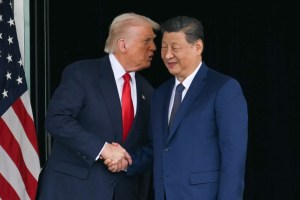
To achieve that goal, the U.S. will continue to work with China to build upon the deal reached between Trump and President Xi Jinping in October, as it represents the first step toward achieving a comprehensive deal. The U.S. will then closely monitor China’s compliance with the agreement.
President Trump is slated to visit Beijing and meet with Xi at the end of March or early April.
Promote U.S. interests on international stage
Through “various plurilateral and multilateral economic engagements,” the U.S. can advance its goals for a new trading system based in balance and reciprocity, Greer wrote.
This year, the U.S. will take part in the Group of Seven (G7), Group of Twenty (G20), and the Organization for Economic Cooperation and Development (OECD) to address economic imbalances, industrial overcapacity, forced labor and other problems plaguing the international trading system. At the World Trade Organization, the U.S. plans to push to reduce barriers to U.S. trade.