Nations across the globe are pressing “pause” on trade deals with the United States in light of the latest developments surrounding President Donald Trump’s tariff strategy.
The president reacted quickly to the Supreme Court’s ruling against his International Emergency Economic Powers Act (IEEPA) tariffs on Friday by imposing 10 percent universal baseline duties—a figure that was augmented to 15 percent over the weekend.
The move thrust in-progress and nearly finalized trade deals with America’s most prominent partners into a state of upheaval.
Related Stories
India, for example, will not send a delegation of trade officials to Washington, D.C. this week as planned to hash out the remaining details of an agreement jointly announced by Prime Minister Narendra Modi and Trump on Feb. 2. The deal would have drawn down punishing 50 percent duties on Indian imports (raised by 25 percent in August 2025 due to the country’s purchasing of Russian oil) to just 18 percent.
The scheduled three-day talks between India and U.S. trade officials have been deferred as India’s government takes a beat to “study the implications” of the Supreme Court ruling and Trump’s ensuing actions, an Indian commerce ministry official told the BBC.
The nations still have plenty still to hash out before signing on the dotted line. As a part of the agreement, India committed to purchase $500 billion in American energy, technology, coal and agricultural products while lowering trade barriers like tariffs on American-grown options, much to the chagrin of the 700 million farmers and tradespeople that make up those industries. Protests erupted across India following the deal’s announcement.
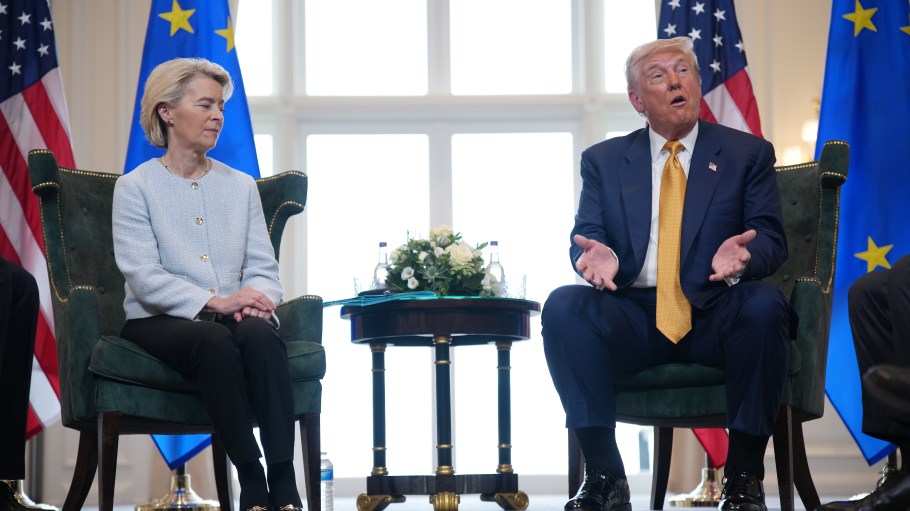
Meanwhile, the future of the European Union-U.S. trade deal, sealed with a handshake between Trump and European Commission President Ursula von der Leyen at the U.S. president’s golf course in Turnberry, Scotland last July, is also in flux, leaving the 27-member bloc consternated and questioning.
“A deal is a deal. As the United States’ largest trading partner, the EU expects the U.S. to honour its commitments set out in the Joint Statement—just as the EU stands by its commitments,” the European Commission wrote in a statement.
The EU-U.S. trade deal drew mixed reactions from heads of state when it was announced, as it imposes 15 percent tariffs across a wide range of European products and consumer goods destined for the U.S. market. In return, Europe agreed to lower its own tariffs on U.S. products to zero, to purchase $750 billion in energy from American sources and to invest $600 billion into the U.S. economy. However lopsided (as some European heads of state suggested), the hard-won agreement was preferable to the 30 percent tariff rate Trump previously threatened.
The European Commission is now requesting “full clarity” on the steps the U.S. intends to take following the Supreme Court’s decision before moving forward with the deal, which must be finalized by the European Parliament.
“The current situation is not conducive to delivering ‘fair, balanced, and mutually beneficial’ transatlantic trade and investment, as agreed to by both sides,” the Commission said.
EU trade officials have been in touch over the weekend with U.S. counterparts like U.S. Trade Representative Ambassador Jamieson Greer and Commerce Secretary Howard Lutnick. Greer appeared on CBS News on Sunday seemingly to deliver reassurances to trading partners regarding the status of the prospective deals: “We’re going to stand by them. We expect our partners to stand by them.”
The message wasn’t conveyed with enough force or specificity to convince some leaders.
Chair of the European Parliament’s committee on International Trade, Bernd Lange, said the developments of the weekend amounted to “[p]ure tariff chaos from the US administration.”
“No one can make sense of it anymore—only open questions and growing uncertainty for the EU and other US trading partners,” he wrote on X. “Terms of Turnberry Agreement and legal basis on which it was built have changed. Do new tariffs based on Section 122 not constitute a breach of the deal? Regardless, no one knows whether the US will adhere to it—or even be able to,” he added.
Lange and other members of the European Parliament’s trade committee plan to hold an emergency meeting on Monday afternoon to discuss next steps.
EU Trade Commissioner Maroš Šefčovič rallied his G7 counterparts for a virtual meetup, too, writing on X afterwards, “Stability, predictability are top of mind for our businesses—I restated that full respect for the [EU-U.S.] deal is paramount. Staying in touch with my counterparts to secure reassurances.”
At 10 Downing St. in London, questions abound about how the U.S.-United Kingdom trade deal established last spring will proceed and whether retaliatory measures are in order.
Prime Minister Keir Starmer’s official spokesman said Monday that the majority of the agreement—which included a reduction in U.S. tariffs on British cars, aluminum, steel, beef and aerospace products, and a lowering of UK tariffs on American beef and ethanol—will remain in place, though the situation is “evolving.”
“Our approach to the US has always been pragmatic. We continue to have productive conversations with them and those discussions are happening at all levels, but nothing is off the table at this stage,” the spokesperson said, indicating that reciprocal tariffs from the UK could be in order.
However, “Industry doesn’t want to see a trade war where both sides keep escalating the situation, and that’s why our focus is on constructive engagement with our US counterparts to retain the UK’s competitive advantage,” the spokesperson added.
Most UK products face tariffs of 10 percent, the lowest baseline rate available from the U.S. But that could change with Trump’s Saturday announcement, which imposes 15 percent tariffs on all trading partners. The British Chambers of Commerce said that could spell an added 5 percent tariff on a large number of UK exports that aren’t covered by the trade deal.
Breaking with some of its neighbors’ shows of force or defiance, Switzerland, which struck a preliminary bilateral trade pact with the U.S. late last year, is scrambling to ratify the agreement as confusion around global trade relationships swirls.
The deal significantly lowered duties on Swiss goods imported into the American market from 39 percent to 15 percent. The Swiss Economy Ministry, eager to solidify those terms, said it’s sticking fast to the mandate.
“The primary objective of the ongoing negotiations has from the outset been a legally binding agreement that would provide Swiss companies with the greatest possible legal certainty,” the ministry said.