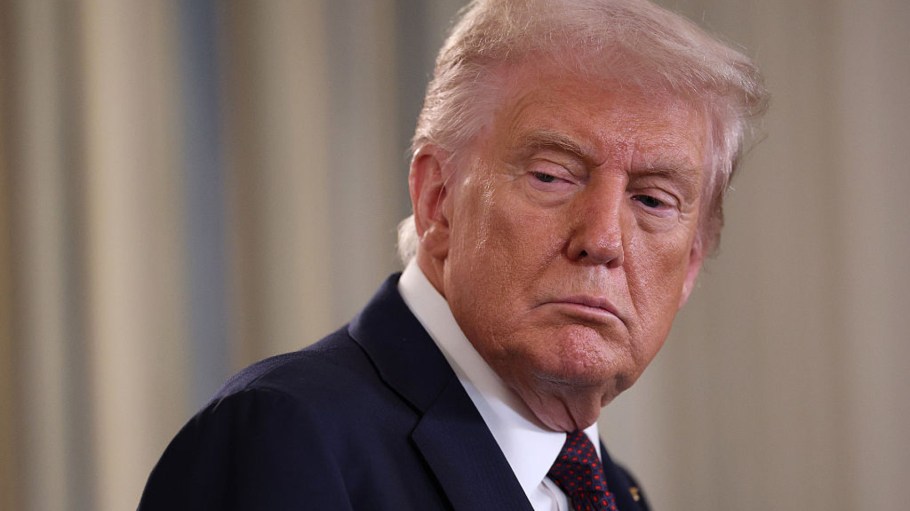
President Donald Trump isn’t taking the Supreme Court’s Friday decision to strike down his International Emergency Economic Powers Act (IEEPA) tariffs—which have blanketed over 90 United States trading partners in double-digit duties since last year—lying down.
Following an announcement that he would implement an across-the-board 10 percent tariff on trading partners using Section 122 of the 1974 Trade Act starting Feb. 24, the Commander in Chief upped the stakes on Saturday, resetting the duty rate to 15 percent. Section 122 allows the president to impose tariffs of up to 15 percent for 150 days in order to address balance-of-payments issues.
Related Stories
The decision was made “Based on a thorough, detailed, and complete review of the ridiculous, poorly written, and extraordinarily anti-American decision on Tariffs issued yesterday, after MANY months of contemplation, by the United States Supreme Court,” an irate Trump Truthed over the weekend.
Accusing nations across the globe of ripping off the U.S. “without retribution” for decades, Trump said, “During the next short number of months, the Trump Administration will determine and issue the new and legally permissible Tariffs, which will continue our extraordinarily successful process of Making America Great Again – GREATER THAN EVER BEFORE!!!”
U.S. Trade Representative Ambassador Jamieson Greer added color to the president’s plan over the weekend, seeking to reassure about 20 nations (including the United Kingdom, the European Union and Japan) that have brokered bilateral trade deals with the U.S. over the course of recent months. “We want them to understand these deals are going to be good deals,” the official told CBS News on Sunday. “We’re going to stand by them. We expect our partners to stand by them.”
Greer also released a statement underscoring the administration’s commitment to its trade policy and its intention to move forward with imposing tariffs on non-free-trade-agreement countries through other means.
“For many months, the Trump Administration has cautioned foreign trading partners and the business community that if the Supreme Court were to limit the President’s authority to impose tariffs under IEEPA, alternative tools would be implemented to address many of the issues at the heart of the President’s reciprocal tariff program,” Greer said.
In addition to leveraging Section 122, the USTR will, “in short order,” initiate several investigations under Section 301 of the Trade Act of 1974—the same rule Trump used to hit China with wide-ranging punitive duties worth $380 billion during his first term. Those tariffs, some of which still cover fashion products with duties up to 25 percent, remain in place.
Section 301 empowers the USTR to embark upon investigations into trading partners that it believes have deployed “unjustifiable, unreasonable, discriminatory, and burdensome acts, policies, and practices” against the U.S. The investigation into China was launched in 2018 under allegations of intellectual property theft and unfair trade practices that led to a massive trade imbalance.
“We expect these investigations to cover most major trading partners and to address areas of concern such as industrial excess capacity, forced labor, pharmaceutical pricing practices, discrimination against U.S. technology companies and digital goods and services, digital services taxes, ocean pollution, and practices related to the trade in seafood, rice, and other products,” Greer said of the current plan.
However, the Section 301 investigation process is far more cumbersome and labor-intensive than the president has become accustomed to since he began imposing tariffs using IEEPA in the early days of his second term. Investigations can vary widely in their duration, typically ranging between 6-18 months.
“We intend to conduct these investigations on an accelerated timeframe, in keeping with the Section 301 statute’s substantive and procedural requirements,” Greer said. Ongoing Section 301 investigations, including those involving China and Brazil, will move forward. The USTR Ambassador also clarified that tariffs levied under Section Section 232 of the Trade Expansion Act of 1962, which mostly impact steel, aluminum and automobiles, will remain in place.
Stock futures took a dive Monday morning following Trump’s upward revision of his new, stop-gap tariff policy.
Dow Jones Industrial Average futures, along with the Nasdaq 100 and the S&P 500, all fell 0.3 percent after closing higher on Friday following the Supreme Court’s ruling against the IEEPA duties.
ING economists on Sunday wrote that they “remain nervous” about further potential consumer goods price increases and inflation. Rising import prices and the latest core goods Consumer Price Index reading of 1.1 percent year-over-year show that “corporate America is bearing the bulk of the burden from tariff costs,” they added.
The financial experts also echoed the concerns of many American importers regarding tariff refunds, which the both the administration and the Supreme Court suggested could be a bureaucratic headache and a “mess” to unravel.
“While the ruling left open the possibility of refunds on roughly $130 [billion] in tariffs collected under the International Emergency Economic Powers Act (IEEPA), it did not offer guidance on how that would be achieved,” ING economists wrote.
More than 1,000 protest cases have been filed with the Court of International Trade, which first ruled against the Trump IEEPA tariffs last May, in order to secure access to refunds—a process that some trade lawyers estimate could take between one to two years.
“The Administration has warned that it would fight, running the risk of years of litigation,” ING added.