President Donald Trump’s “Liberation Day” has arrived. But with new “reciprocal” duties announced against the country’s most prominent trade partners, it’s likely that many Americans will find themselves feeling more shackled by growing financial burdens than emancipated from participation in the global economy.
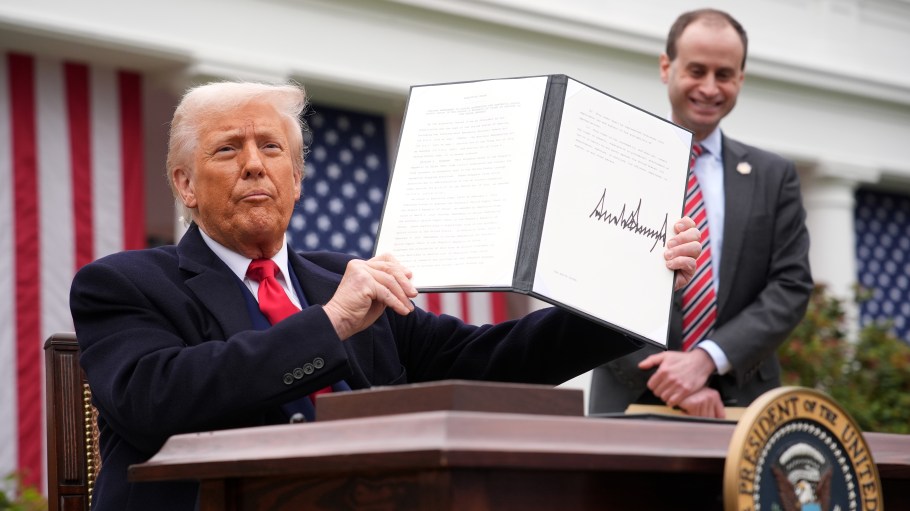
At a televised ceremony from the White House Rose Garden, the president listed a litany of perceived abuses perpetuated by other nations against America’s domestic industry and economy, and elucidated a plan that includes a 10-percent universal baseline tariff and proportionately heightened duties on goods from across the globe.
Related Stories
“For decades, our country has been looted, pillaged, raped and plundered by nations near and far, both friend and foe alike,” he said. “American steel workers, auto workers, farmers and skilled craftsmen… They really suffered gravely. They watched in anguish as foreign leaders have stolen our jobs. Foreign cheaters have ransacked our factories, and foreign scavengers have torn apart our once beautiful American dream.”
The president signed an executive order establishing new duty rates equivalent to half or less of the average tariff value charged by about 60 countries. The calculation of the new duty rates also accounted for the impacts of “non-monetary barriers and other forms of cheating,” Trump said.
The changes include 34-percent tariffs on China-made goods, 20-percent duties on products from the European Union, 46-percent duties on Vietnam, 32-percent tariffs on Taiwan, 24-percent tariffs on Japan, 26-percent duties on India, 25-percent duties on South Korea, 36-percent tariffs on Thailand, 49-percent duties on Cambodia, 37-percent duties on Bangladesh and 32-percent duties on Indonesia. China, Vietnam and Bangladesh alone account for 49 percent of U.S. apparel imports.
Trump also signed a second executive order ending the de minimis trade exception, which allows shipments worth $800 or less to enter the country duty-free—a cornerstone of the business models employed by Asia-based e-commerce titans like Shein and Temu. The trade “loophole” will close on May 2.
“Chronic trade deficits are no longer merely an economic problem. They’re a national emergency that threatens our security and our very way of life,” Trump said, indicating that the changes will go into effect on Thursday.
While Canada and Mexico were not mentioned during Wednesday’s address, the White House indicated afterward that the existing International Emergency Economic Powers Act (IEEPA) executive order announced by Trump in February, which charges both countries a 25-percent duty on goods not compliant with the U.S.-Mexico-Canada Agreement (USMCA), will continue.
Trump threatened in recent weeks to blanket all imports from both countries with new duties (whether or not they were covered by the free-trade agreement), much to the consternation of Mexican and Canadian leaders. But the White House announcement indicated that USMCA-compliant goods, like textiles and apparel, will continue to see a 0-percent duty rate.
The president may have been swayed by behind-the-scenes negotiations with heads of state; Mexican President Claudia Sheinbaum announced early Wednesday that the nation would not engage in a tit-for-tat trade war with the U.S.
Europe: ‘We have a strong plan to retaliate’
With Trump’s announcement taking place well after business hours across the Atlantic, European Commission president Ursula von der Leyen made her sentiments—and the trade bloc’s agenda—known preemptively.
“Our immediate response to tariffs is unity and determination. I have already been in contact with our heads and state of state and government on the next steps…and we will assess tomorrow the announcements very carefully to calibrate our response,” she said Tuesday.
While the EU is willing to work with the White House to further solidify the “nearly balanced” scales of goods and services trade, the Commission president reiterated that Europe “has not started this confrontation.”
“We do not necessarily want to retaliate, but if it is necessary, we have a strong plan to retaliate,” she said, noting that “firm countermeasures” will be taken against U.S. duties. The EU will also continue to work to diversify trade with other partners and “double down on our single market” by removing remaining trade barriers between European nations.
“Of course, there are severe issues in the world of trade, without any question over capacities. We know about the imbalances. We see unfair subsidies, denial of market access or the IP theft,” she added. “And I hear Americans when they say that some others have taken advantage of the rules. I agree. We also suffer from it, so let’s work on it. But tariffs across the board, make things work worse, not better.”
Fashion industry advocates weigh in
Industry trade groups in Washington responded quickly to Trump’s Rose Garden announcements—and many bemoaned the impacts the new tariff structure will have on U.S. retail.
National Retail Federation (NRF) executive vice president of government relations David French said the heightened duties would contribute to “more anxiety and uncertainty for American businesses and consumers.”
“While leaders in Washington may not care about higher prices, hardworking American families do,” he added. “Voters do not see tariffs as helping vulnerable communities including blue-collar workers, rural communities, families with young children, low-income households, the elderly and farmers. Tariffs are a tax paid by the U.S. importer that will be passed along to the end consumer. Tariffs will not be paid by foreign countries or suppliers.”
Beyond this, “the immediate implementation of these tariffs is a massive undertaking and requires both advance notice and substantial preparation by the millions of U.S. businesses that will be directly impacted,” he said.
The U.S. Fashion Industry Association (USFIA) said it was “deeply disappointed” by the administration’s decision to impose new duties on imports, saying it would “particularly affect American fashion brands and retailers.”
According to the group, some of the countries targeted with “worst offender” tariffs are major suppliers for American importers and also important customers for U.S.-made exports.
“The fashion industry depends on global supply chains more than perhaps any other sector of manufactured goods. For instance, a bale of cotton might be grown in Texas, shipped to Europe to be spun into yarn, sent to Korea for fabric production, then to Vietnam for garment assembly, and finally to the U.S. for retail sale—back in Texas,” the group said, illustrating the global reach of the fashion supply chain.
“Americans cannot afford another round of price increases,” added Retail Industry Leaders Association (RILA) senior executive vice president of public affairs Michael Hanson.
The new duties on household goods like clothing will raise costs across the board, he said. “The President’s plan is not a targeted attempt to protect American innovation or national security but will hit every family’s budget.”
Urging the White House to “reconsider its course,” Hanson said, “These newly announced tariffs—and the expected retaliatory tariffs on American businesses—risk destabilizing the U.S. economy, undermining the goals of bolstering domestic manufacturing and growth.”
Footwear Distributors and Retailers of America (FDRA) president and CEO Matt Priest agreed, warning that “If the administration moves forward without a clear, measured process, we risk another wave of ‘shrinkflation’—where Americans pay more but get less.”
The group’s senior vice president, Andy Polk, added that previous duty hikes, including the 1890 McKinley Tariff and the Smoot-Hawley Tariff of the 1930s, resulted in increased prices, trade retaliation, and economic downturns.
“Regardless of the era, the consequences of high tariffs and retaliations remain largely the same,” he said. “When costs rise, consumers lose. History tells us that these policies don’t just impact businesses—they hit American families at the checkout line.”
Some duty rates for children’s shoes top 90 percent, he added, noting that footwear has always been among the most heavily tariffed consumer goods. “President McKinley later regretted his high-tariff policies, and history may repeat itself,” he added.
“To be clear, tariffs are taxes borne by the American companies that import the goods and the hardworking American families that buy those goods. Before today’s so-called ‘Liberation Day,’ the average tariff on clothes, shoes, and accessories, necessities every American must buy, was already more than five times higher than on other U.S. imports,” said Steve Lamar, president and CEO of the American Apparel and Footwear Association (AAFA).
“True liberation would have involved eliminating this high tariff burden and relieving U.S. consumers of its regressive and misogynistic effects, rather than layering on more costs that fuel inflation,” he added. “While we welcome President Trump’s focus on reducing foreign trade barriers, we need to reduce America’s high trade barriers as well and do so in a predictable manner that enables long-term investment and supply chain decisions.”
Companies that have already been in a “wait-and-see” mode for the past two months are now facing more uncertainty due to the president’s announcement, according to Lamar.
“While the President touts ‘America First’ policies, this tariff plan overlooks its destructive impact it will have on the U.S. manufacturers in our industry. These American companies depend on foreign inputs which have no, or very few, American substitutes,” he said. “Tariffs will significantly increase the cost of manufacturing in the U.S., and, when paired with the retaliatory tariffs that will surely come, will undermine U.S. export opportunities as well.”
American manufacturers’ hopes hinge on further action
Alliance for American Manufacturing president Scott Paul said he believes Wednesday’s trade action prioritizes domestic producers and workers, representing “a necessary step in the right direction.”
“The United States maintains one of the world’s most open markets, but the trade practices of countries like China—and even some of our allies—have damaged communities throughout the country, shutting down factories and eliminating family-supporting jobs,” he added. “After decades of policies geared toward offshoring, there will be an adjustment period as businesses restructure their supply chains to adapt to the tariffs, but America can no longer avoid facing the trade imbalances that have plagued us for more than two decades.”
However, Trump’s sweeping referendum on foreign trade partners must be met with federal help for U.S. manufacturers aiming to take on new business, he said. “While I know some policymakers are eager to derive significant revenue from the tariffs, I’d prefer to see more manufacturing jobs and domestic supply chains established, and I hope that is the priority here,” Paul added.
The National Council of Textile Organizations (NCTO), representing the full spectrum of U.S. textiles from fiber, yarn and fabrics to finished sewn products, issued the following statement from President and CEO Kim Glas regarding President Trump’s reciprocal tariff plan.
“Going forward, we must match today’s trade action with comprehensive policies and incentives that spur investment in U.S. factories and supply chains. There is still much more work to do to strengthen our trade laws and address critical sectors.”
“We strongly commend President Trump and his administration on their tariff reciprocity plan to finally begin rebalancing America’s trade positioning in markets at home and abroad. We want to thank President Trump on behalf of the U.S. textile industry and the 471,000 workers we employ.
“We are particularly pleased with the administration’s decision to preserve duty-free trade for imports from Mexico and Canada that are compliant with the U.S.-Mexico-Canada Agreement (USMCA) rules of origin.
“The U.S. textile industry ships $12.3 billion, or 53 percent, of its total global textile exports to Mexico and Canada and those component materials often come back as finished products to the United States under the USMCA. It is by far the largest export region for American textile producers, representing $20 billion in two-way trade that spurs enormous textile investment and employment in the United States.
“Preserving duty free, qualified trade is absolutely critical to the U.S. textile industry and will provide incentives for more companies to onshore even greater production capacity, giving a boost to American textile manufacturers and their workers.
“We are also grateful to the Trump administration for getting tough on the predatory trade practices of China, Vietnam and other Asian suppliers that have long undermined domestic textile and apparel manufacturing through the rampant use of unfair trade practices, which the U.S. textile industry has been raising concerns about for decades.
“We encourage the administration to keep these penalty tariffs on finished textile and apparel products in place long-term with countries like China and Vietnam to provide the necessary market signals to recalibrate the global textile and apparel supply chain.
”Doing so, will help level the playing field for U.S. textile and apparel producers once and for all, given our industry has been victimized by predatory trade practices that have offshored critical jobs across the United States.
“Additionally, we hope the Trump administration extends the exemption for duty-free qualified trade from other Western Hemisphere free trade partners, such as the countries of the Dominican Republic-Central America Free Trade Agreement (CAFTA-DR). This is a critical supply chain for U.S. textile exports that are essential to the American textile industry and our workers.
“The Western Hemisphere as a whole accounts for nearly 70 percent of all U.S. textile exports, represents $34 billion in annual two-way trade and supports 2.6 million jobs.
“Equally as important, the USMCA and CAFTA-DR production platforms serve as an alternative and counterweight to the China-led, Asia-based production platform that competes based on illegal tactics, such as the used of forced labor, subsidies and counterfeits, and has largely come to dominate global trade.
“We would also like to commend the Trump administration for its substantial and long overdue reform of the de minimis loophole. This loophole facilitates 4 million shipments a day to the United States that often hide illegal and unethically made products, unsafe goods and illicit fentanyl and other narcotics that reach our doorsteps. Countries such as China currently avoid billions in U.S. duties through the use of de minimis to the United States.
“We applaud the fact that the President’s announcement will essentially close de minimis on a global scale once the Secretary of Commerce puts the mechanism in place to collect duties on these imports. Half of de minimis shipments are estimated to be textile and apparel products, and NCTO has long called for the closure of this destructive loophole. We encourage the full closure as soon as possible and stand ready to help the Administration in any way to formulate plans for its effective implementation.
“Finally, President Trump emphasized the importance of holding trade cheaters accountable in his Rose Garden event on Wednesday. The U.S. textile industry looks forward to working with the administration to develop a robust enforcement plan to help President Trump achieve the important goals outlined his new tariff plan to ensure fraudulent actors and cheaters are penalized.
“We are grateful to President Trump and his administration for their strong support for our industry. If aggressively enforced coupled with long-term certainty, there is a huge opportunity to reshore production and grow jobs in the United States.”