The U.S. Court of International Trade (CIT) has declined for now to block President Donald Trump’s executive orders ending the de minimis trade exception for shipments valued at $800 or less—a victory for the administration amid a number of challenges to its authority on issues of trade.
On Monday, a panel of three judges handed a tentative victory to the president in a case brought by Michigan-based Detroit Axle, a supplier of car parts like brake rotors and wheel bearings. In its complaint, the company challenged the legality of Trump’s decision to end the longstanding trade provision, which has allowed it to import small shipments of goods from China that it said are essential to its business. As a result of Trump’s trade actions, the company announced last week that it would close one of its regional warehouses, imperiling the jobs of 102 employees.
Related Stories
Detroit Axle sought, and was denied, a motion for a preliminary injunction against the kibosh on de minimis. The judges ruled that the scope of the lawsuit is already being addressed in another lawsuit challenging Trump’s “reciprocal” tariffs. “We will not grant redundant, contingent relief through a preliminary injunction here,” the decision read.
In the other case, which was brought by a number of U.S. businesses in May, the CIT ruled against the president’s imposition of duties under the International Emergency Economic Powers Act (IEEPA), saying that he’d overstepped his authority in leveraging the little-known trade law to justify sweeping tariffs on trade partners.
Shortly after the decision, however, the administration requested a stay of the injunction with the U.S. Court of Appeals for the Federal Circuit (CAFC) and was granted a temporary stay. As a result, the IEEPA tariffs are able to move forward while the legal proceedings play out. The appeals court is slated to hear oral arguments on the case Thursday morning, one day before the pause on worldwide duties expires.
With that deadline looming, the administration has been firing off letters to foreign trade partners and expediting handshake deals with a number of ASEAN nations, along with Japan.
Most recently, the president touted a deal with the European Union, announced Sunday from Scotland with European Commission President Ursula von der Leyen, wherein the 27-member trade bloc will pay 15-percent duties on about 70 percent of the volume of goods imported into the U.S. market. Far from satisfied, many European leaders had hoped for a lower rate, and now shippers are pushing for details that remain scant.
Meanwhile, cabinet members including U.S. Trade Representative (USTR) Ambassador Jamieson Greer and Treasury Secretary Scott Bessent met with Chinese trade officials in Stockholm this week, concluding negotiations Tuesday without formalizing a path forward for the trade relationship after weekend speculation that a deal could be forthcoming.
China and the U.S. in May agreed to a bilateral pause on retaliatory tariffs that would last for 90 days, with an end date of Aug. 12. While there was no formal agreement to extend the pause and continue talks, Bessent attempted to quell anxieties that the truce was disintegrating.
“Just to tamp down that rhetoric, the meetings were very productive,” Bessent said, according to CNN. “We just haven’t been given that signoff,” he added, referring to approval from Trump.
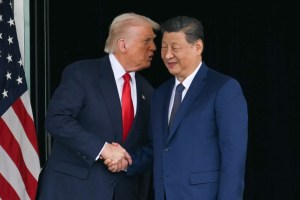
Greer also said a “potential pause” was on the table, should the Commander in Chief approve it. Trump himself added Tuesday that he felt the meetings had been positive, and said he aims to meet with Chinese President Xi Jinping before the end of 2025.
The president didn’t espouse such a rosy outlook with regard to one of the country’s other biggest trading partners, however.
Despite a close relationship with India’s prime minister, Narendra Modi, Trump said Tuesday that he plans to slap the country with 25-percent tariffs on Friday should Washington and New Delhi fail to reach a consensus. On “Liberation Day” in April, Trump threatened India with 26-percent duties. He didn’t offer an explanation for the adjustment, but has repeatedly called the dealmaking process “tough” due to India’s high import duties and a growing trade imbalance with the U.S.
Greer said in an interview on CNBC Monday that brokering a deal with India will take more time.
“They have expressed strong interest in opening portions of their market, we of course are willing to continue talking to them,” the USTR ambassador said. “But I think we need some more negotiations on that with our Indian friends to see how ambitious they want to be.”